

Audio By Carbonatix
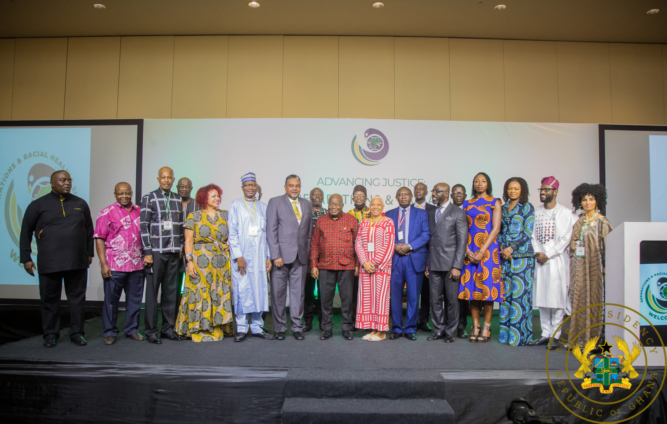
A year-long series of meetings focused on Reparations and Racial Healing facilitated by a cohort of organizations working as a collective, culminated in an international convening attended by heads of state, diplomats, scholars, activists, artists, and civil society to affirm a bold agenda for the Global Reparations Movement.
Recognizing the past historical injustices including the Trans-Atlantic Slave Trade and colonialism, amongst others and the recent yet critical historic moment in the wake of the 2020 murder of George Floyd and subsequent global outcry, the disparities laid bare as a result of the global Covid-19 pandemic, economic fallout from the pandemic, and the technological and digital advances fostering increased connectedness of Global Africa across languages, ethnicities and geographies, the need emerged for a bold vision to advance an agenda that addresses the root causes of the legacies of the Trans-Atlantic Slave Trade, Colonialism, Neocolonialism, and current manifestations of anti-Blackness permeating systems and structures around the world.
In 2021, twenty-three organizations were selected by the John D. and Catherine T. Macarthur Foundation as part of its Equitable Recovery Grant Initiative. Believing in the utmost importance of capitalizing on this moment, the cohort, calling themselves the Global Circle for Reparations and Healing, began to meet regularly to develop strategies to amplify and support each other's' work. To that end, the Global Circle believed it imperative for reparations advocates, scholars, artists, and activists from around the world to come together to dialogue, learn from each other, and hopefully strengthen opportunities for collective action to advance a reparations and healing agenda worldwide.
The discussions resulted in three major gatherings:
1. A convening in Italy at which experts from around the world deepened their understanding of the role of the Global North in the Trans-Atlantic Slave Trade and its legacies of colonialism, neocolonialism, racism, apartheid, genocide, and plunder
2. A meeting with the Roman Catholic Church on the issue of accountability for its role in initiating and facilitating the Trans-Atlantic Slave Trade
3. A global summit bringing reparations and racial healing practitioners together to learn about the current reparations and racial healing landscape, increase the knowledge base to include information about practical steps currently being implemented internationally to advance reparations and healing, and lay the groundwork for relationships upon which to develop collective action.
On all three goals, the Global Circle met and even exceeded critical objectives.
The cohort held a convening with participants from around the world in Bellagio, Italy at the Rockefeller Foundation Bellagio Center upon the invitation of Howard University Knight Journalism Professor and Creator of the 1619 Project, Nikole Hannah-Jones.
That convening produced 15 Commitments to which attendees agreed will serve as the basis for global collective strategy development. The Global Circle subsequently held a meeting at The Vatican in Rome, Italy with key Vatican Leadership. They issued a formal Presentment and discussed a plan for accountability for the Roman Catholic Church’s role in the initiation of the Trans-Atlantic Slave Trade.
Out of this meeting, the cohort developed, with input from Vatican leadership, an engagement strategy and list of contacts of key individuals and groups from the Roman Catholic Church around the world. Follow up meetings will take place with the Vatican in September 2022. Finally, the Global Circle hosted a successful Advancing Justice: Reparations and Racial Healing Summit from August 1 – August 4, 2022. Scholars, activists, academics, and artists from around the world held a number of plenary sessions exploring the role of global systems and structures in perpetuating harm, fundamental components for racial healing and exploring the current landscape of reparations and healing advocacy.
The President of Ghana, His Excellency Nana Addo Dankwa Akufo-Addo served as keynote speaker. In his remarks, he declared Reparations and Racial Healing as unequivocally global imperatives.
Moreover, the representative of the African Union seized the opportunity availed by the Summit to recommit the continental organization to the agenda of justice, racial healing and accountability across the board.
Out of this summit, “The Accra Declaration” has been developed. Building on The Abuja Proclamation of 1993 and the Durban Declaration and Program of Action of 2001, The Accra Declaration pushes forward a global agenda for reparations and healing and lays the framework for the organizing, engagement, and advocacy strategy moving forward.
Latest Stories
-
‘I didn’t expect this under Mahama’ – Annoh-Dompreh on Baffour Awuah’s detention at EOCO
2 seconds -
GRA welcomes Tribunal decision upholding US$393 million tax assessment
4 minutes -
COMAC says Uniform Fuel Pricing Fund should not be confused with fuel subsidy
13 minutes -
Mercy Ships targets over 2,000 surgeries, 3,500 dental treatments during Ghana mission
15 minutes -
NITA appoints ShaQ Express founder Anthony Owusu-Ansah as Acting Deputy DG
21 minutes -
Government moves to compel public institutions to buy food from Ghanaian farmers
27 minutes -
‘Baffour Awuah won’t die in EOCO’s detention, even if he dies there, that’s okay for us’ – John Boadu
31 minutes -
OccupyGhana calls for parliamentary scrutiny of EOCO, BNI powers
37 minutes -
Mahama calls for continued care for Mercy Ships patients after surgeries
42 minutes -
NDPC DG calls for stronger financing, accountability to improve nutrition outcomes
48 minutes -
Over 130 courts are without magistrates – JUSAG
57 minutes -
SWAG calls on GFA leadership to fix Ghana football or step aside
1 hour -
Gender Ministry launches breast cancer campaign, pushes support over stigma
1 hour -
Feed Ghana Programme cuts food import dependence
1 hour -
Mahama welcomes Global Mercy Hospital Ships back to Ghana
1 hour