

Audio By Carbonatix
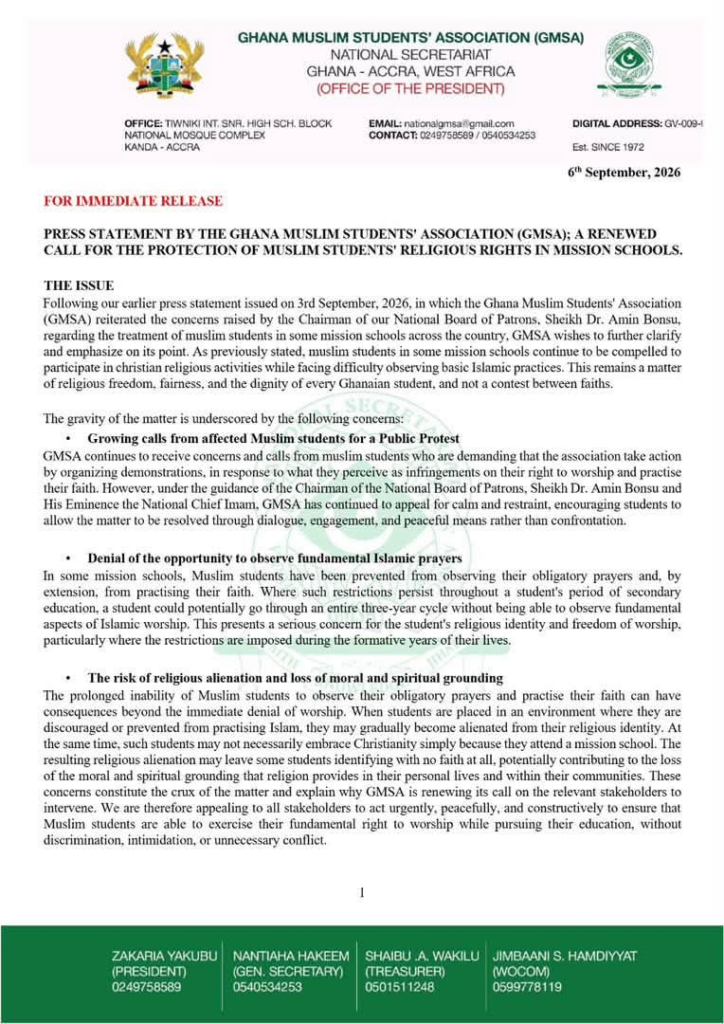
The Ghana Muslim Students’ Association (GMSA) has renewed calls for authorities and mission schools to protect the religious rights of Muslim students, amid concerns that some pupils are being compelled to participate in Christian religious activities while facing restrictions on basic Islamic practices.
The Association said the issue was one of religious freedom, fairness and the dignity of Ghanaian students, rather than a contest between Christianity and Islam.
In a press statement issued on Sunday, September 6, GMSA said it was reiterating concerns earlier raised by its National Board of Patrons Chairman, Sheikh Dr Amin Bonsu, over the treatment of Muslim students in some mission schools across the country.
According to the Association, it continues to receive complaints from affected students who say their ability to practise their faith has been restricted.
GMSA said some affected Muslim students had called on the Association to organise public demonstrations over what they consider infringements on their right to worship.
The Association, however, said it had resisted calls for confrontation and was instead encouraging affected students to remain calm and allow the matter to be addressed through dialogue and peaceful engagement.
It said this position was being maintained under the guidance of Sheikh Dr Amin Bonsu and the National Chief Imam.
“GMSA has continued to appeal for calm and restraint,” the Association said, urging students to pursue resolution through dialogue rather than confrontation.
A major concern raised by the Association is the alleged denial of opportunities for Muslim students in some mission schools to observe their obligatory prayers.
GMSA argued that where such restrictions persist throughout secondary education, some students could potentially complete an entire three-year cycle without being able to observe fundamental aspects of Islamic worship.
It said such restrictions could have serious implications for students' religious identity and freedom of worship, particularly because they occur during their formative years.
The Association maintained that attending a mission school should not mean that a Muslim student must sacrifice the practice of their faith.
GMSA also expressed concern that prolonged restrictions on religious practice could lead to what it described as religious alienation among Muslim students.
It argued that students who are discouraged or prevented from practising Islam could gradually become detached from their religious identity.
The Association further cautioned that such students might not necessarily become Christians simply because they attend mission schools, potentially leaving some with no religious affiliation.
According to GMSA, this could have implications for the moral and spiritual grounding that religion provides to young people.
It therefore urged stakeholders to intervene urgently and constructively to ensure Muslim students can practise their faith while pursuing their education without discrimination, intimidation or unnecessary conflict.
The Association has appealed to a wide range of stakeholders to support efforts to protect the religious rights of Muslim students.
It called on the Office of the National Chief Imam to continue providing leadership and guidance, while urging Muslim leaders across the country to speak with one voice in support of affected students.
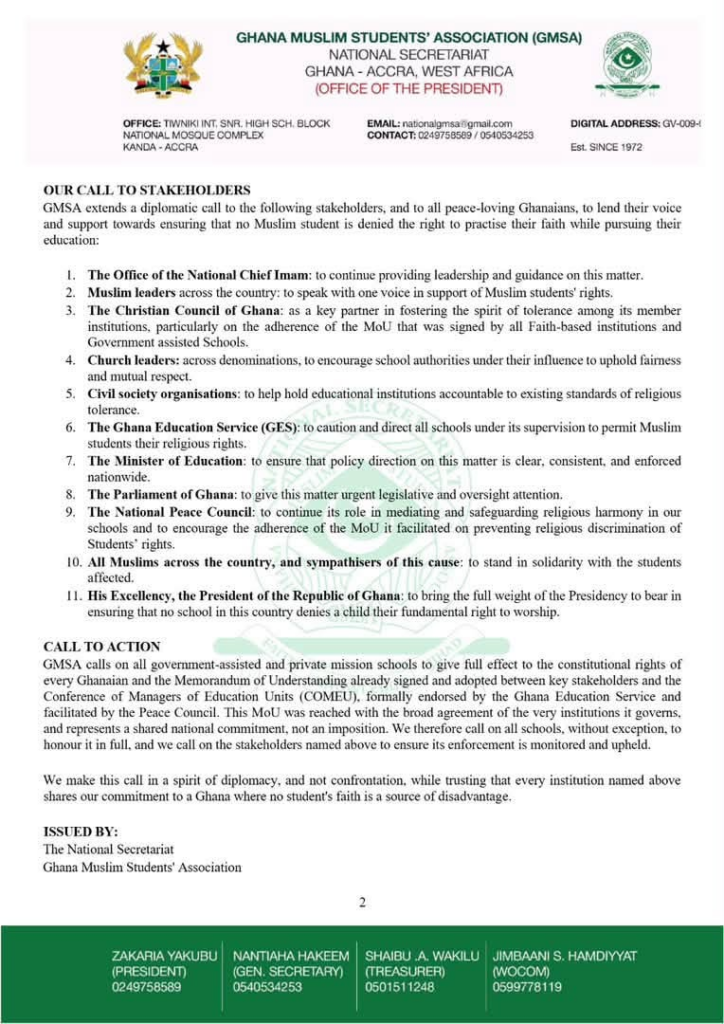
The Christian Council of Ghana was also urged to promote religious tolerance among its member institutions, particularly regarding adherence to an existing Memorandum of Understanding (MoU) involving faith-based institutions and government-assisted schools.
GMSA further called on church leaders across denominations to encourage school authorities under their influence to uphold fairness and mutual respect.
The Ghana Education Service (GES) was asked to caution and direct schools under its supervision to permit Muslim students to exercise their religious rights.
The Association also appealed to civil society organisations to help ensure that educational institutions adhere to standards of religious tolerance.
It called on the Minister of Education to provide clear and consistent policy direction on the matter and urged Parliament to give the issue urgent legislative and oversight attention.
The National Peace Council, GMSA said, should continue its mediation role and help safeguard religious harmony in schools while encouraging adherence to the MoU it facilitated on preventing religious discrimination against students.
The Association also appealed to Muslims and sympathisers across the country to stand in solidarity with affected students.
It further called on President John Dramani Mahama to use the authority of the Presidency to ensure that no school denies a child the fundamental right to worship.
In its call to action, GMSA urged all government-assisted and private mission schools to give full effect to the constitutional rights of every Ghanaian student.
It also called for the enforcement of an MoU adopted by key stakeholders and the Conference of Managers of Education Units (COMEU), formally endorsed by the GES and facilitated by the National Peace Council.
GMSA described the agreement as a shared national commitment rather than an imposition, arguing that schools should honour its provisions without exception.
The Association consequently called on the relevant stakeholders to monitor and ensure its implementation.
Despite the growing calls from some students for demonstrations, GMSA stressed that its renewed intervention was being made “in a spirit of diplomacy, and not confrontation”.
It said its ultimate objective was to help build a Ghanaian educational system where a student's religious faith does not become a source of disadvantage.
Latest Stories
-
National Investment Quiz 2026: Six schools qualify for quarter-finals
1 minute -
‘Do not let Russia pay for its madness with lives of your people’ – Zelensky to Ghana, 46 other countries
8 minutes -
6,079 promotion cases fully processed and paid – CAGD says amid nationwide teachers’ strike
28 minutes -
Teacher unions to meet government Monday over nationwide strike
43 minutes -
Photo story: Republic Bank-JoyNews Habitat Fair clinic wraps up after three days of housing solutions, expert engagement
46 minutes -
National Peace Council urges investment in youth to sustain Ghana’s peace
1 hour -
Afenyo-Markin urges youth to speak up against injustice
1 hour -
CAF annuls Edo Queens victory, orders WAFU B final to resume from extra time
2 hours -
Interior Minister urges traditional authorities to enforce anti-bushfire bye-laws
2 hours -
3rd Republic Bank-JoyNews Habitat Fair Clinic ends on a high note after three days of strong patronage
2 hours -
Ten climbers missing after avalanche hits Himalayan base camp
2 hours -
NPP had more permanent fuel relief measures than current GH¢2 diesel cut – Amin Adam
3 hours -
Photos from the 3rd Republic Bank-JoyNews Habitat Fair Clinic
3 hours -
Ethiopia’s army promises restraint amid fears of new civil war
3 hours -
Amin Adam calls for review of fuel taxes as diesel prices remain above GH¢18
3 hours