

Audio By Carbonatix
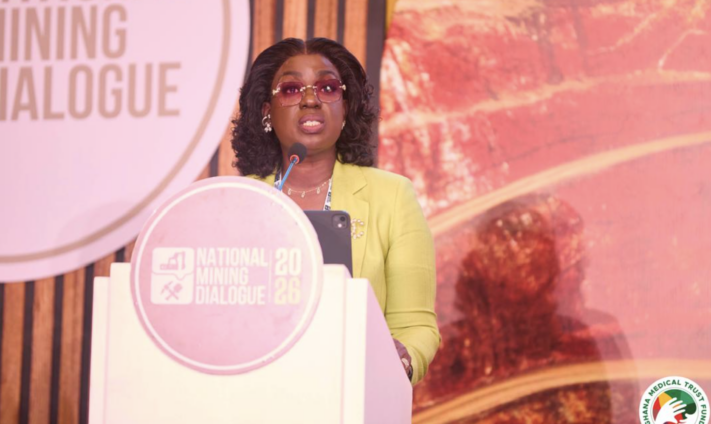
The Administrator of the Ghana Medical Trust Fund (GMTF), Adjoa Obuobia Darko-Opoku, has challenged Ghana’s mining industry to redefine its social responsibility.
She said that they could do by investing not only in roads, schools and boreholes, but in the healthcare systems that keep mining communities alive.
Speaking at the National Mining Dialogue 2026 in Accra on the theme “Rethinking the Social License to Operate,” Ms. Darko-Opoku told mining executives, investors and policymakers that the true wealth of Ghana was not buried beneath the soil, but found in its people.
“You do not extract value from the soil. You extract value through people.”
She warned that when the health of a nation failee, every industry, including mining, ultimately suffered.
“At 2AM, Money Cannot Buy Time”
In one of the most striking moments of her address, the Administrator challenged the assumption that wealth provides immunity from Ghana’s healthcare challenges.
She painted the picture of a sudden heart attack in the middle of the night, when there may be no time to fly a patient to London or Johannesburg, no matter how wealthy the family is.
“At 2:00 AM, money cannot buy time. In a medical emergency, your wealth does not save you; the infrastructure nearest to you does.”
Her message was simple but unsettling: Ghana’s healthcare crisis does not discriminate between the rich and poor.
She recounted the devastating reality of families who spend decades building modest lives, only for a diagnosis such as prostate cancer to wipe out their savings, force them to sell property and leave them borrowing desperately to keep a loved one alive.
For many families outside Accra, the situation becomes even more painful when they are told the equipment needed to save their loved one simply does not exist nearby.
By the time they travel across regions in search of treatment, she said, “the family is financially ruined, the patient is significantly weaker, and the cost of treatment has doubled.”
“A Healthcare Gap That Should “Awaken Every Leader”
Obuobia Darko-Opoku revealed worrying findings from a nationwide needs assessment conducted by the Ghana Medical Trust Fund across teaching, regional and referral hospitals.
According to the assessment, Ghana’s public tertiary health sector had only two functional MRI machines, five mammogram machines and two public radiotherapy machines for cancer treatment.
The entire northern sector, she added, had only two practising cardiologists without the appropriate equipment, serving millions of people.
The consequences, she said, are measured not merely in statistics, but in human lives.
Mining Companies Must Leave More Than Pits Behind
Turning directly to Ghana’s mining industry, the GMTF Administrator challenged companies to move beyond the traditional definition of Corporate Social Responsibility.
For decades, she noted, mining companies had demonstrated their commitment to host communities through projects such as schools, boreholes and roads.
But the time has come, she argued, to raise the bar.
“A true Social License cannot simply mean, ‘The community tolerates our presence.’ It must mean, ‘Because this company operates here, our people live longer, healthier lives.”
She reminded mining companies that their host communities are more than coordinates on concession maps; they are families whose lives can be transformed by access to specialised healthcare.
She asked industry leaders to imagine a mining company being able to tell a community:
“We didn’t just extract gold from your soil. We built the regional Cancer Centre that saved your mother. We installed the Cath Lab that saved your chief.”
“That is not CSR,” she declared. “That is an unshakable, generational Social License.”
The Administrator invited mining companies to partner the GMTF to map healthcare needs in their operational areas, co-invest in urgently needed medical equipment, sponsor the training of specialists and build healthcare infrastructure capable of serving communities long after mining operations have ended.
“Ghana’s Greatest Resource Is the Ghanaian”
Ms. Darko-Opoku ended with an emotional reminder to corporate leaders about the legacy they will ultimately leave behind.
Years from now, she said, history may not remember how many ounces of gold they extracted, their quarterly profits or the contracts they signed.
But families will remember the hospital that saved a father.
A child will remember the equipment that helped a mother survive cancer.
A doctor will remember the company that provided the tools to save a life.
And communities will remember businesses that stood with them when survival was on the line.
“The gold beneath our soil is valuable. But Ghana’s greatest resource has never been underground. Ghana’s greatest resource is the Ghanaian.”
She called on corporate Ghana, particularly the mining sector, to help build a new legacy; one measured not only in gold extracted from the earth, but in lives saved above it.
“Let us rethink the Social License. Let us build a legacy of health, dignity and survival. Because when life is on the line, none of us can stand alone.”
Latest Stories
-
Guidelines, regulations of cryptocurrency in Ghana fall short of comprehensive oversight – IMF
15 minutes -
COCOBOD’S GH¢16.3bn SPV: Real progress toward a sustainable cocoa sector
36 minutes -
Ghana lose Morocco friendly as Atlas Lions turn to Mali
3 hours -
2026/2027 GPL: Kelvin Nkrumah strike sends Medeama top of league table
3 hours -
Emmanuel City crowned champions of maiden Global Game Scouting Tournament
3 hours -
Thomas Partey loses father Jacob Teye Partey
3 hours -
Martin Kpebu explains when EOCO can arrest Manhyia South MP after securing court warrant
3 hours -
EOCO’s reasons for seeking Manhyia South MP arrest warrant not justified – Kpebu
3 hours -
MTN Ghana warns SMEs against sharing PINs amid digital fraud risks
3 hours -
Yendi nursing students warn restricted access to skills lab could affect their training
3 hours -
Minority awaits formal notice of arrest warrant for Manhyia South MP – Annoh-Dompreh
3 hours -
LTIF announces 2026 Pan-African edition in Accra from October 6-7
3 hours -
Mfantsipim needs broader funding partnerships to bridge infrastructure gap – Prof Baiden
3 hours -
MP status must not shield anyone from law enforcement – Kwakye Ofosu
4 hours -
EOCO had tactical team ready to arrest Baffour Awuah – Felix Kwakye Ofosu
4 hours