

Audio By Carbonatix
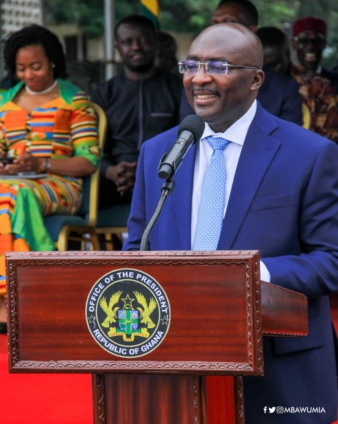
Vice President, Dr Mahamudu Bawumia, says the Government, for the past five years, has been pursuing an inclusive development agenda to ensure holistic growth and progress of all communities across the nation.
He mentioned the Coastal, Middle Belt, Northern and Zongo Development Authorities as the development vehicles the government had established to mitigate the suffering and challenges of the people, especially those in deprived areas.
In addition, educating and empowering the people economically, and providing them with functional skills were the only realistic ways to alleviate extreme poverty and underdevelopment.
Vice President Bawumia said this on Thursday in a keynote address at the second edition of the Annual National Muslim Conference at the National Mosque, Kanda, Accra.
He said the four thematic areas around which the conference revolved – education, health, finance, and economic empowerment – were in conformity with the development goals of the Government, the African Union and the United Nations to address the challenges of unbalanced growth in deprived communities.
It brought together key stakeholders within the Muslim Ummah to discuss ways of developing an action plan and education strategy to achieve those goals and empower the Muslim youth.
It was also intended to galvanise the energies, and human and material resources of the Muslim Community in Ghana to spur growth.
The conference was on the theme: “Towards the coherence and holistic economic empowerment strategy for national development- The Ghanaian Muslim Ummah in Context”.
Vice President Bawumia said: “For our government, bridging the development gap between the less privileged communities and others is important for the overall growth of our country.”
“Ghana will suffer if members of these communities grow and leave others behind. Therefore, the government is working to get rid of any form of exclusion.”
He called for the pursuance of continuous intra-face dialogues and interface engagements with the Christian counterparts to proffer strategies to mitigate the daily challenges facing Ghanaians.
He noted that several studies had established a strong link between education and social mobility and believed that with the right educational policies like the Free SHS, Free TVET and a guarantor free access to loans for tertiary education, a child from any background should not have any barrier to his or her development.
Data shows that the biggest beneficiaries of the Free SHS had been members from deprived communities including the Zongos, witnessing a significant rise in secondary school enrolment.
The Vice President urged the Muslim leaders to take advantage of Science, Technology, Engineering and Mathematics (STEM) and TVET education as a strategy to empower the youth, which underpins the government’s resolve to invest more in that sector.
Latest Stories
-
I don’t have an official car, I use my own – Pelpuo
9 minutes -
Maiden Black Star Fashion Week to highlight Ghana’s national fashion platform
9 minutes -
GPRTU has entrusted vehicle inspection responsibility to station masters – GPRTU member
9 minutes -
President Mahama to open housing finance conference in Accra on October 7
17 minutes -
Cocaine probe: Speaker is right in dismissing Minority’s motion of parliamentary inquiry – Dr Pelpuo
17 minutes -
Academic City presents cybersecurity white paper to Communications Minister
18 minutes -
Pelpuo calls for independent commission to oversee Ghana’s public sector remuneration
19 minutes -
Bekwai MP to engage Assembly over traders displaced by market redevelopment
20 minutes -
Accra-Abidjan flight relaunch will boost trade, investment and regional integration – Ambassador Alhassan Abu
22 minutes -
Mahama tasked me to identify initiatives that fit Reset Agenda – Pelpuo
22 minutes -
Makola and Abossey Okai named in crime index as fake goods trade grows
25 minutes -
John Boadu, Justin Kodua, Nana B lead NPP’s race in latest survey
29 minutes -
Abdul-Rashid Pelpuo praises Mahama’s UNGA 81 address as bold and decisive
30 minutes -
Girls must have equal place in Ghana’s digital future – Vice President
42 minutes -
High Court issues EOCO warrant to arrest Manhyia South MP Baffour Awuah
47 minutes