


Audio By Carbonatix
Iran has announced it will break a limit set on uranium enrichment, in breach of the landmark 2015 deal designed to curb its nuclear ambitions.
Deputy foreign minister Abbas Araqchi said Iran still wanted to salvage the deal but blamed European countries for failing to live up to their own commitments.
The US unilaterally withdrew from the agreement in 2018.
It has since reimposed tight sanctions affecting the Iranian economy.
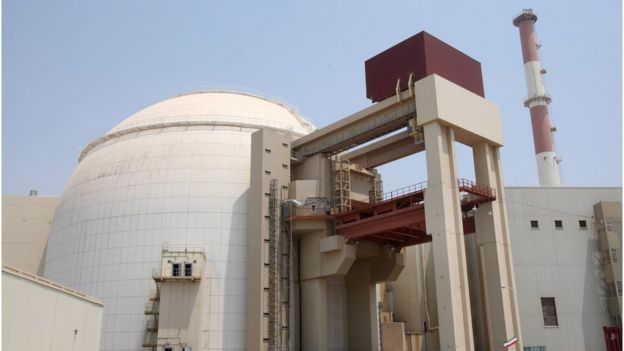 Image copyrightEPA
Image captionIran says the enriched uranium will be used to fuel its power plant at Bushehr
Officials previously said this would mean a concentration of about 5%. Weapons-grade uranium is 90% enriched or more.
However, Iran's Atomic Energy Organisation spokesman Behrouz Kamalvandi said that Iran would not be making fuel for its Tehran reactor, which requires a concentration of 20%.
"We will enrich uranium based on our needs," he said. "Right now we don't need to enrich uranium for the Tehran reactor."
Mr Araqchi said Iran would keep reducing its commitment to the 2015 deal every 60 days.
But he also stressed that diplomacy was still an option, provided the sanctions are lifted.
Image copyrightEPA
Image captionIran says the enriched uranium will be used to fuel its power plant at Bushehr
Officials previously said this would mean a concentration of about 5%. Weapons-grade uranium is 90% enriched or more.
However, Iran's Atomic Energy Organisation spokesman Behrouz Kamalvandi said that Iran would not be making fuel for its Tehran reactor, which requires a concentration of 20%.
"We will enrich uranium based on our needs," he said. "Right now we don't need to enrich uranium for the Tehran reactor."
Mr Araqchi said Iran would keep reducing its commitment to the 2015 deal every 60 days.
But he also stressed that diplomacy was still an option, provided the sanctions are lifted.
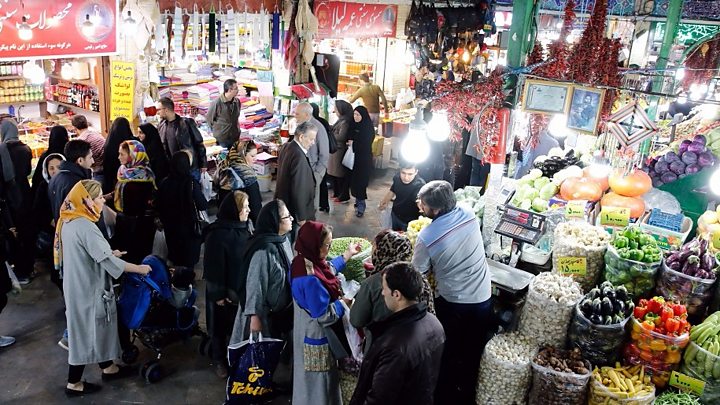 Media captionThe BBC's James Landale went to Tehran's Grand Bazaar to see what people think of the stringent sanctions
Israel's energy minister Yuval Steinitz has already criticised the move, saying that while the increase was "moderate", Iran had "begun its march... toward nuclear weaponry".
The announcement comes a day after French President Emmanuel Macron spoke to Iranian President Hassan Rouhani and expressed his "strong concern" about what would happen if the agreement was abandoned.
A French statement said the two leaders had agreed "to explore by 15 July the conditions for the resumption of dialogue between all parties".
Mr Rouhani called on European countries to act now to save the deal.
Media captionThe BBC's James Landale went to Tehran's Grand Bazaar to see what people think of the stringent sanctions
Israel's energy minister Yuval Steinitz has already criticised the move, saying that while the increase was "moderate", Iran had "begun its march... toward nuclear weaponry".
The announcement comes a day after French President Emmanuel Macron spoke to Iranian President Hassan Rouhani and expressed his "strong concern" about what would happen if the agreement was abandoned.
A French statement said the two leaders had agreed "to explore by 15 July the conditions for the resumption of dialogue between all parties".
Mr Rouhani called on European countries to act now to save the deal.

 The demise of the 2015 nuclear accord to contain Iran's nuclear programme seems to be coming ever closer.
Iran's policy of progressive breaches of the agreement's terms is seen in Tehran as a way to pressure the Europeans to relieve the impact of US economic sanctions.
But there is little they can do in practical terms to mitigate Iran's dire economic situation. The Europeans want the deal to survive but are caught between Tehran and Washington.
This has been a slow-motion diplomatic car crash - ever since the US walked out of the agreement a year ago.
The French President Emmanuel Macron's telephone conversation with his Iranian counterpart yesterday bought a little more time for consultations. The Europeans are struggling to postpone the moment when they have to declare the nuclear deal dead.
But at some point, if Iran continues to chip away at its limits and restrictions, they may have little choice.
The demise of the 2015 nuclear accord to contain Iran's nuclear programme seems to be coming ever closer.
Iran's policy of progressive breaches of the agreement's terms is seen in Tehran as a way to pressure the Europeans to relieve the impact of US economic sanctions.
But there is little they can do in practical terms to mitigate Iran's dire economic situation. The Europeans want the deal to survive but are caught between Tehran and Washington.
This has been a slow-motion diplomatic car crash - ever since the US walked out of the agreement a year ago.
The French President Emmanuel Macron's telephone conversation with his Iranian counterpart yesterday bought a little more time for consultations. The Europeans are struggling to postpone the moment when they have to declare the nuclear deal dead.
But at some point, if Iran continues to chip away at its limits and restrictions, they may have little choice.
- Iran nuclear crisis in 300 words
- The nuclear fuel cycle
What has Iran announced?
On the anniversary of the US withdrawal, Iran gave a 60-day deadline to the remaining signatories of the deal - China, France, Germany, Russia and the UK - to protect it from US sanctions. Speaking at a press conference on Sunday at the end of that deadline, Mr Araqshi said Iran would start enriching uranium above a concentration of 3.67% within a few hours, to provide fuel for its Bushehr power plant.Image copyrightEPA
Image captionIran says the enriched uranium will be used to fuel its power plant at Bushehr
Officials previously said this would mean a concentration of about 5%. Weapons-grade uranium is 90% enriched or more.
However, Iran's Atomic Energy Organisation spokesman Behrouz Kamalvandi said that Iran would not be making fuel for its Tehran reactor, which requires a concentration of 20%.
"We will enrich uranium based on our needs," he said. "Right now we don't need to enrich uranium for the Tehran reactor."
Mr Araqchi said Iran would keep reducing its commitment to the 2015 deal every 60 days.
But he also stressed that diplomacy was still an option, provided the sanctions are lifted.
Media captionThe BBC's James Landale went to Tehran's Grand Bazaar to see what people think of the stringent sanctions
Israel's energy minister Yuval Steinitz has already criticised the move, saying that while the increase was "moderate", Iran had "begun its march... toward nuclear weaponry".
The announcement comes a day after French President Emmanuel Macron spoke to Iranian President Hassan Rouhani and expressed his "strong concern" about what would happen if the agreement was abandoned.
A French statement said the two leaders had agreed "to explore by 15 July the conditions for the resumption of dialogue between all parties".
Mr Rouhani called on European countries to act now to save the deal.
The demise of the 2015 nuclear accord to contain Iran's nuclear programme seems to be coming ever closer.
Iran's policy of progressive breaches of the agreement's terms is seen in Tehran as a way to pressure the Europeans to relieve the impact of US economic sanctions.
But there is little they can do in practical terms to mitigate Iran's dire economic situation. The Europeans want the deal to survive but are caught between Tehran and Washington.
This has been a slow-motion diplomatic car crash - ever since the US walked out of the agreement a year ago.
The French President Emmanuel Macron's telephone conversation with his Iranian counterpart yesterday bought a little more time for consultations. The Europeans are struggling to postpone the moment when they have to declare the nuclear deal dead.
But at some point, if Iran continues to chip away at its limits and restrictions, they may have little choice.
What is the nuclear deal?
Six countries signed the Joint Comprehensive Plan of Action in 2015 to curb Iran's nuclear programme. Tehran agreed to let in international inspectors and to limit its nuclear activities, in exchange for an end to tight economic sanctions. Under the deal, Iran is only permitted to produce low-enriched uranium, which has a 3-4% concentration of U-235, and can be used to produce fuel for nuclear power plants. The deal also restricted Iran to stockpiling no more than 300kg (661lb) of the low-enriched uranium. According to the Arms Control Association, a stockpile of 1,050kg could be further enriched later into enough material to build one bomb,DISCLAIMER: The Views, Comments, Opinions, Contributions and Statements made by Readers and Contributors on this platform do not necessarily represent the views or policy of Multimedia Group Limited.
Tags:
DISCLAIMER: The Views, Comments, Opinions, Contributions and Statements made by Readers and Contributors on this platform do not necessarily represent the views or policy of Multimedia Group Limited.
Latest Stories
-
SOS Children’s Villages Ghana deepens partnership with Gender Ministry
8 minutes -
Gender Ministry celebrates Christina Koch, reaffirms commitment to empowering girls
21 minutes -
Live stream: Newsfile digs into E&P’s takeover of Damang Mines, OSP powers and Anti-LGBTQ Bill
30 minutes -
Moody’s maintains Ghana’s rating at Caa1, revises outlook to positive
1 hour -
Zambia elevates tourism education to national priority as President Hichilema backs continental summit
2 hours -
Activa promotes credit insurance to boost SME export growth
2 hours -
ILTM Africa 2026 opens doors to inbound and outbound luxury travel in Cape Town
2 hours -
“BP Soul Travel and Tours scored the highest marks” – Sports Minister Kofi Adams endorses agency for World Cup travel
2 hours -
‘At the age of 12, I was teaching people and collecting money from them’ – Forty Under 40 Awards
3 hours -
I broke my virginity at the age of 26 after university – Richard Abbey Jnr.
4 hours -
Sacked for fees, saved by faith: The untold story of Forty Under 40 Awards founder Richard Abbey Jnr
5 hours -
GCB Bank surges GH¢0.45, ETI gains GH¢0.06 as GSE ends week higher
5 hours -
Two teens jailed 55 years for robbery
6 hours -
UDS demands apology for MPhil student wrongly branded as Tamale robber
7 hours -
“We don’t sell fish!” – Tema Shipyard CEO hits back over dead fish discovery
7 hours