

Audio By Carbonatix
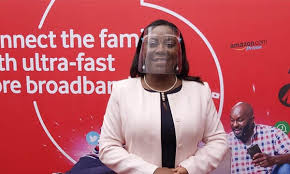
The Chief Executive of Vodafone Ghana, Madam Patricia Obo-Nai, says leveraging digital technology is a way out in accelerating the achievement of the 169 targets under the 17 United Nations’ Sustainable Development Goals (SDGs).
She said although the outbreak of the Covid-19 pandemic presented multi-dimensional challenges to Africa in achieving the Sustainable Development Goals (SDGs), leveraging digital technology could help to attain them.
She remarked while a panellist at the United Nations General Assembly, held on the theme: “The Role of Technology in Unlocking Gender Equality; Connecting Women to Maternal Health and Girls to Education’, on September 24, 2020.
This was contained in a statement from Vodafone Ghana to the Ghana News Agency.
Madam Obo-Nai said Africa was currently the world’s fastest-growing market for mobile phones and Vodafone was committed to creating a ‘Digital Society’ of connected people, communities and things.
“We are digitally empowering millions of people across the continent. Our pioneering interventions have seen some incredible success stories, where mobile phone capabilities are now being used to transform healthcare delivery, improve access to educational resources and deliver digital financial inclusion to the unbanked,” she said.
She said there was a gender gap in mobile phone ownership and a GSMA report showed that women and girls in Sub-Saharan Africa were still 13 per cent less likely to own a phone and 37 per cent less likely to use the mobile data that could help them to live healthier lives and access better medical care during their pregnancies.
The CEO explained that it was why the telecom company committed to adding 20 million women living in Africa and Turkey on to the internet by 2025.
“We have made progress towards our goal and have an estimated 46.2 million active female customers across these regions, 9.3 million more since our original goal was set in 2016,” she added.
Vodafone, she said, was through the power of the mobile technology abating maternal and infant mortality in Africa, reducing child mortality by one per cent to increase GDP by as much as five per cent in African countries.
Speaking about some of the interventions put in place by Vodafone to help need groups, Madam Obo-Nai said: “An expectant mother in sub-Saharan Africa is 50 times likely to die from pregnancy-related issues than a woman in Europe, Vodafone is taking steps to address this issue of maternal health with three transformational initiatives across sub-Saharan Africa involving.
“They include educating and empowering adolescent girls to make well-informed decisions about their health; giving emergency support for expectant mothers, and supporting new mothers.”
Being concerned about maternal health, she said Vodafone Foundation has made over $24 million (€20.3 million) of philanthropic investment to support maternal health over the past decade, enabling one million women, girls and babies to receive lifesaving treatment, transport, medical care and health education.
The Foundation had introduced the M-Mama programme to use mobile technology to provide free emergency transport for pregnant rural women in obstetric crisis, delivering lifesaving interventions in partnership with governments.
Madam Obo-Nai also said in the regions of Tanzania where Vodafone had operated to date, M-Mama had been proven to reduce maternal mortality by 27 per cent and was sustainable within local health budgets.
“Early this month, the Foundation announced the expansion of M-Mama to Lesotho and other sub-Saharan markets by 2025. In Ghana, Vodafone is working in partnership with the government and relevant stakeholders to implement this initiative in April 2021.
“The Office of the President and the Ghana Health Service have all shown earnest commitment in playing their part to help the country address the issue of ‘accessibility’ with M-Mama, which is projected to save about 400 lives each year,” she said.
Despite all the positive interventions, Madam Obo-Nai said Vodafone across the continent depended on the availability of spectrum.
She called on governments to continue to invest in mobile communications infrastructure and introduce policies and regulations that would enable the telecoms industry to thrive and ultimately propel broad-based digitalisation across the globe.
Latest Stories
-
Fiabci-Ghana inaugurated to promote professionalism and global collaboration in real estate sector
18 minutes -
‘No flying in just for matches’ – Kofi Adams sets conditions for next Black Stars coach
22 minutes -
Ghana and BRICS: Strategic opportunity, economic imperative or geopolitical gamble?
27 minutes -
SML vs GRA: Court grants preservation order in dispute over US$500 million investment
28 minutes -
Spotify brings audiobooks to Ghana
31 minutes -
GPL 2026/27: ‘We are the team to beat’ – Medeama boss Tanko ahead of Samartex clash
32 minutes -
Parliamentary Select Committee on Health assesses progress of work on KATH maternity block
38 minutes -
Ghana’s fertility rate too high for development – Reproductive health specialist warns
53 minutes -
NLA/KGL Licence Contract: Why Ghana must reform the law to maximise the state’s benefit
58 minutes -
Association of Small-Scale Industries empowers trade executives in Bono East with a mentorship programme
1 hour -
AMA evacuates refuse along Graphic Road, warns against indiscriminate dumping
1 hour -
STC interdicts driver over Pokuase overtaking incident
1 hour -
Ekumfi: How $6m EXIM participation built a $53m industrial asset — now poised for a 24-Hour Economy breakthrough
1 hour -
4 arrested, 142 parcels of suspected Indian hemp seized as officers reject GH¢50k bribe
1 hour -
No MMDCE can say they don’t see galamsey – Local Government Ministry
1 hour