

Audio By Carbonatix
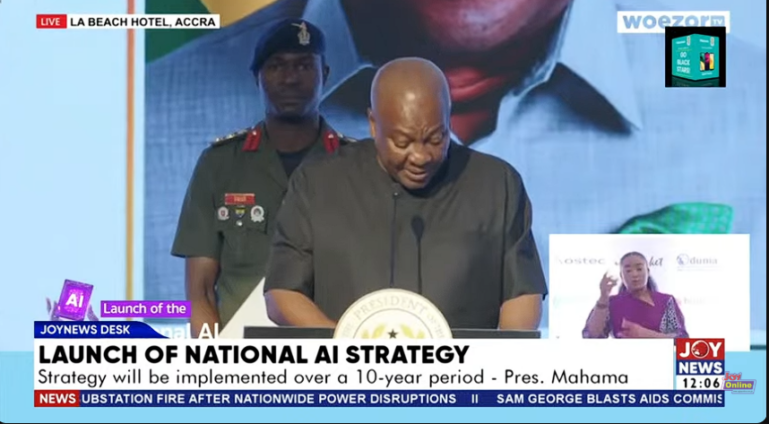
President John Dramani Mahama has outlined a 10-year national strategy aimed at building a strong artificial intelligence ecosystem to drive innovation, create jobs and promote inclusive economic growth.
Speaking at the launch of the National AI Strategy, he said the plan will be implemented with clear targets and measurable indicators across key sectors, with close monitoring to ensure it remains on track.
“This strategy will be implemented over 10 years with clear targets and indicators across all its pillars. We intend to monitor progress closely and ensure that implementation remains as planned,” he stated.
A key component of the rollout, according to him, will be the establishment of a Responsible Artificial Intelligence Office to oversee implementation, coordinate stakeholders and drive the strategy’s objectives.
“One of the most critical steps will be to establish a Responsible Artificial Intelligence Office to oversee implementation, coordinate stakeholders, and drive the strategy’s objectives,” he added.
President Mahama said the vision is to develop a fully-fledged national AI ecosystem by 2035 that expands digital literacy and access, strengthens job creation and entrepreneurship, and supports local innovation.
“By 2035, our ambition is to have built a truly national AI ecosystem that expands literacy and access, strengthens jobs and entrepreneurship, and supports local innovation,” he said.
The strategy also focuses on strengthening data sovereignty, promoting indigenous language technologies and improving public service delivery.
“We envision a future in which AI is embedded across our educational system, where innovation flourishes beyond the classroom, and where universities lead in frontier research,” he noted.
He further explained that the plan seeks to help Ghanaian startups scale globally while ensuring that the informal sector and persons with disabilities are not excluded from technological advancement.
“We want a future where Ghanaian startups scale globally, and where our informal sector and persons with disabilities are not excluded from the technological process,” he emphasised.
President Mahama also stressed the importance of inclusivity, adding that gender considerations will be prioritised in implementation, while the civil and public service will be strengthened to lead AI-driven transformation.
“We will ensure gender inclusion in the rollout of AI and build a civil and public service that is fully capable of leading AI-enabled transformation,” he said.
Latest Stories
-
Education Minister inaugurates NDU Governing Council, announces $25m seed funding
7 minutes -
THE LAW 101: La Beach Demolitions – The State’s own documents, the courts’ orders – and the bulldozers
10 minutes -
DVLA contributes GH¢17.7m to Consolidated Fund in 2025
13 minutes -
Why disaster risk reduction must connect early warnings, preparedness and financial protection to household-level resilience
20 minutes -
The AI Gold Rush: Who strikes gold and who gets left behind?
44 minutes -
Pius Hadzide rejects blame for journalists’ visas in 2018 Australia scandal
1 hour -
What Is Wrong With Us: We queue for the Colosseum while our own Castles crumble
1 hour -
Dangote IPO fever could deepen Africa’s capital markets, Citi Bank executive says
2 hours -
US hopes diesel deal can ‘soften’ Moscow on peace talks, sources say
2 hours -
Oil falls as Russia diesel supply prospects counter Gulf supply risks
2 hours -
Moroccan centrist party agrees to form coalition government with three other parties
2 hours -
IMF cites AI slowdown, spiking yields as looming global market risks
2 hours -
Nvidia’s China AI-chip share falls as Huawei closes gap, report finds
2 hours -
Trump says he does not believe China and Russia are helping Iran ‘at all’
3 hours -
One dead and several hurt after rollercoaster incident at Six Flags
4 hours