

Audio By Carbonatix
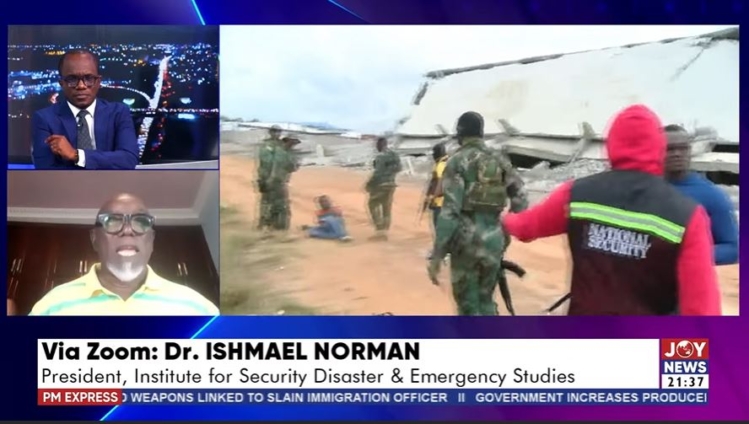
Dr. Ishmael Norman, President and CEO of the Institute for Security, Disaster and Emergency Studies (ISDES), has criticised the training protocols of the Ghana Armed Forces (GAF), blaming them for the recent assault on JoyNews journalist Carlos Calony.
Speaking on JoyNews’ PM Express on Monday, August 4, Dr. Norman argued that the incident was a clear sign of poorly trained soldiers lacking the necessary skills to handle civilian interactions.
The incident, which took place in Accra during a demolition of structures belonging to businessman Daniel McKorley, saw soldiers brutally assaulting Carlos Calony, his cameraman, and an eyewitness during the government-sanctioned exercise.
The footage of the assault, widely circulated on social media, shows Calony being physically harassed and hit in the neck by uniformed soldiers, an act that has drawn condemnation from media bodies and civil society groups.
The eyewitness was also not spared, as multiple soldiers pounced on him and delivered blows and kicks while the victim struggled on the floor.
Dr. Norman's comments were unsparing.
"They [soldiers] don't have any skills in dealing with this kind of escalation, but there was no escalation. Carlos was basically interviewing an eyewitness, and they didn't want Carlos to see the camera to capture what was going on. They decided that Carlos doesn't have a right to report that the people there don't have a right to know what the military was doing. And that is why the soldier typically started beating the civilian for doing absolutely nothing. Look at that; it is sad," he stated emphatically.
Dr. Norman, a disaster management specialist with a PhD, acknowledged the legality of the military's presence and their involvement in the demolition exercise.
However, Dr. Norman was quick to draw a line between the legality of the deployment and the conduct of the individual soldier.
"But for the soldier, I'm sure this was not what his commanding officer told him to go and do. That shows that they are not well trained because if they were, you wouldn't go and do that," he concluded.
The security expert also highlighted a worrying trend where civilians who critique or question military conduct are often seen as enemies.
"But the moment some of us civilians start talking, we become enemies. Why? Are we not taxpayers? Are we not citizens of this country? Look at that. Every time I see that side, it just makes my head – something goes wrong in my head. It's so wrong for a soldier to start beating on a civilian simply because it's an eyewitness to a demolition exercise."
He defended his right to speak out, stating, "I'm not a coward. I'm not a friend of anybody. Nobody can suppress my freedom of speech. Nobody. I will not allow it."
The Ghana Armed Forces have, in recent years, faced multiple accusations of excessive force and unprofessional conduct in civilian operations.
Notable incidents include the military's involvement in a violent protest in Ashaiman in 2023, where soldiers allegedly assaulted residents, and other reported clashes with civilians during land disputes and law enforcement operations.
These events have consistently raised questions about the level and type of training soldiers receive for non-combat roles, particularly in crowd control, de-escalation techniques, and respect for civilian rights and press freedom.
The Ghana Journalists Association (GJA) has frequently condemned such attacks on its members, calling for better protection for journalists and more professional conduct from security forces.
The Ministry of Defence and the GAF High Command have on several occasions promised to investigate such incidents and improve training, but critics argue that these promises have not led to lasting change in soldier-civilian relations.
Latest Stories
-
EOCO working with AG to arraign Nana Baffour Awuah before weekend court
2 minutes -
Duraplast reassures customers after fire, announces October 5 reopening
10 minutes -
Call off strike, gov’t will not renege on promotion arrears pledge – Haruna Iddrisu appeals to teacher unions
12 minutes -
Committee set up to validate teachers eligible for 20% deprived-area allowance – Education Minister
16 minutes -
Five-member committee to search for new Black Stars coach after Sports Ministry-GFA meeting
51 minutes -
Pinktober: Breast cancer survival exceeds 90% when detected early – Breast Society of Ghana
58 minutes -
TCDA to adopt Upper West’s MATCO mango farm as northern prototype, issues warning against felling shea trees
1 hour -
‘Fear delegates’ tag: Afoko touts genuineness among delegates ahead of NPP delegates conference
1 hour -
John Boadu: The leader our party needs at this time – Amb. Edward Akwasi Boateng
1 hour -
Baffour Awuah: EOCO effected an arrest, detained MP after hours of waiting, questioning – Afenyo-Markin
2 hours -
EOCO court warrant authorised search of Baffour Awuah’s law firm, not residence – Afenyo-Markin
2 hours -
NPP delegates conference: 3,000 to 4,000 police personnel deployed for security in Kumasi – Anthony Karbo
2 hours -
KGL Foundation commits $200,000 to support juvenile football for the next two years
2 hours -
UNDP invites Mahama Ayariga to Northern Peace Conference in Tamale
2 hours -
Afoko can give NPP ‘new identity’ ahead of 2028 to overcome NDC – Political scientist, Dr Amakye-Boateng
2 hours