

Audio By Carbonatix
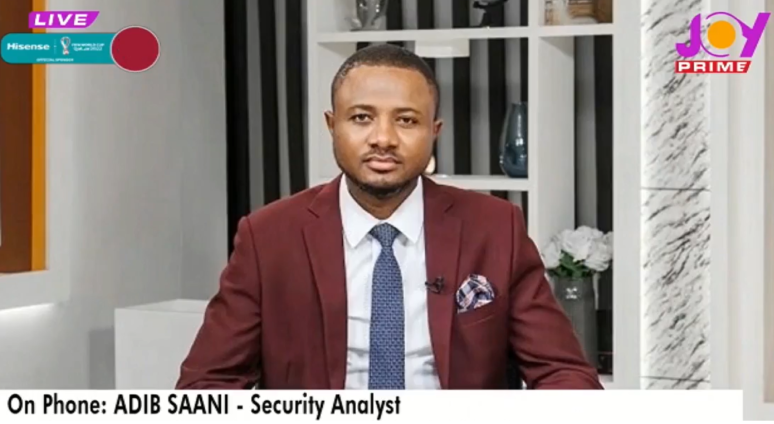
Security Analyst, Adib Saani has opposed calls by some Civil Society Organisations for the President to declare a state of emergency in mining areas in the country.
Adib Saani in an interview on The Pulse on Friday contended that a state of emergency in mining areas is not an option to end illegal mining.
He wants the government to rather address fundamental problems such as unemployment which is compelling the youth in mining communities to engage in 'galamsey'.
“Well, I do not think a state of emergency is the way to go. We know what the real issues are and it makes me wonder why we seem to be ignoring the elephant in the room, yet we keep talking about state of emergency and the deployment of security personnel to mining areas. Meanwhile, the fundamental issues such as unemployment is there,” he said.
According to him, government’s use of the military has not aided in solving any issue be it 'galamsey' or terrorism.
He noted that the government’s fight against 'galamsey' has been a “monumental failure” because there is no commitment to end the menace.
“There is no military solution to anything when we try the military solution through Operation Bacantapoba, Accra initiative, Joint task force and the rest against terrorism. What happened? The terrorists are in Burkina Faso. We need to address the fundamental issues.”
It will be recalled that pressure group, OccupyGhana, petitioned President Akufo-Addo to immediately declare a state of emergency in all mining areas to help government streamline mining activities in the country.
There have also been suggestions that it is a sure way of dealing with the menace.
However, Lands and Natural Resources Minister, Samuel Abu Jinapor, says there must be consultations on the implications of declaring a state of emergency in mining areas.
He contended that since mining activities take place in almost all the regions, government cannot just announce such directive without careful consideration.
Mr. Jinapor argued that such calls demand further interrogations and discussions.
“If we say state of emergency, I don’t understand what the import is. So, state of emergency [at] where? So in the mining areas you declare state of emergency, it means that people can be arrested and kept for more than 48 hours? It means that martial law would then operate in those places?
“We need to consider all that. I am not making a decision on this, I’m not taking a position on this, but I think it requires more interrogation before making a conclusion that a state of emergency be announced or be imposed in mining areas of our country,” he explained.
“Always remember that 13 or so out of the 16 regions in Ghana are mining regions. So, you are going to impose state of emergency on almost all of the regions?” he quizzed.
Latest Stories
-
Vibes The Movie: Big Ghun’s Ghanaian film earns five nominations at 2026 REFFA
9 minutes -
MamaCare CEO warns unresolved conflicts among health workers could undermine maternal and neonatal care
33 minutes -
Health professionals urged to translate medical knowledge into practice to save mothers
39 minutes -
Conflicts among care providers linked to maternal, neonatal deaths – Expert
2 hours -
GIS marks 10th TIME conference, champions improved teaching practices
2 hours -
BRICS Or Balance? What Ghana’s bid really means
3 hours -
GPRTU wants full TRAFFITECH-GH implementation to start in 2027
3 hours -
Mahama announces plans to import electric wheelchairs for PWDs
3 hours -
KGL U17 Colts 2026: Western beat Prempeh Elite Academy to set up final final with Greater Accra Region
3 hours -
Late Solanke strike salvages 10-man Spurs draw at Man United
4 hours -
Gender Ministry to monitor welfare of Nana Akua Addo’s children amid domestic violence case
4 hours -
Benedict Okyere Yeboah: Ghana’s football problem goes beyond sacking a coach
4 hours -
GPL 2026/27: Darkwah Wiafe’s winner sees All Blacks beat Kotoko
4 hours -
ITF World Tour : Patel Wins Boys’ Singles Final at J100 Accra
4 hours -
Ghana must pursue BRICS partnership if it brings economic benefits – Kpebu
4 hours