

Audio By Carbonatix
It was a week today.
Tuesday, May 12.
Another normal workday appeared to be unfolding.
At 8:28 GMT, my phone rang.
The morning had barely settled. My morning TV show was done. The usual office meetings had begun.
I had walked up to the third floor for a production conversation with the Channel Manager of Joy Prime on how we could access the feed and which window within the channel would be suitable.
We were about to disrupt the normal programming.
Then came the voice on the other end.
“Muftawu, where are you?”
Calm. Direct. Urgent.
“I’m in the office,” I replied.
“I’m told you’re on commentary duty this morning.”
For a few seconds, my mind froze.
Commentary?
No briefing. No preparation. No formal assignment. But the tone on the other side suggested urgency.
If you are wondering about the caller, it was Veronica Commey -- veteran sports journalist, now Deputy Director General of the National Sports Authority (NSA) and a member of the Local Organising Committee (LOC) for the 24th African Athletics Championships in Accra.
“What can we do? We need your help,” she said.
In moments like that, hesitation becomes a luxury.
“I am coming,” I replied.
About a 20-minute drive away, the production team at the University of Ghana Sports Stadium had already completed setup.
Cameras were aligned. Signals were being tested. The broadcast was scheduled to go live at exactly 9:00 GMT.
But there was one thing missing.
A voice.
A voice to describe every stride, every throw, every leap, and every bar cleared.
Kokomlemle to Legon suddenly felt too long. A car was not an option if I were to beat the traffic.
Before I could flag down a motorbike, another call came through. It was the competition production team lead, Gilbert Allotey.
“How far are you from here?” he quizzed.
“I will be there in 20 minutes,” I assured him.
I flagged down a motorbike rider and spoke with the urgency of a man racing against time.
“I’m late for an assignment. I need to get to Legon Stadium before 8:50.”
There was no negotiation over fare. No questions. Only movement.
The rider accelerated with frightening confidence, weaving through traffic as though the roads had opened exclusively for him.
Between the Mallam Atta Market area and New Town, suburbs of Accra, he almost crashed into an oncoming vehicle.
God saved us.
If that moment was meant to scare us, it never did. He flew past the cars. My head buried behind him to protect my eyes from the unforgiving wind.
Between 8:38 GMT, when I climbed onto the bike, and 8:55 GMT, when I arrived at the stadium, my life had changed direction.
The Executive Producer handed me the programme lineup almost immediately.
No rehearsal. No script. No time to think.
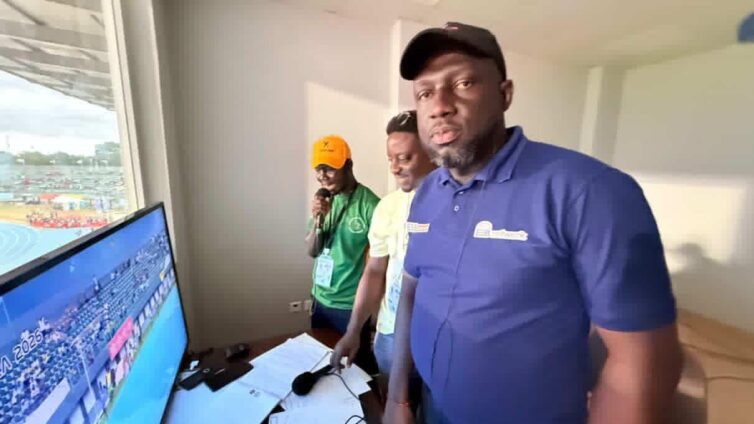
I was taken straight into the commentary booth.
Earpiece on. Microphone in hand. Giant and mini screens in front of me. Across Africa, televisions waited for a voice to carry the championship into homes, bars, hotel rooms, living rooms and digital platforms.
Then came the instruction from the director.
“Commentary in 3…2…1… let’s go!”
And suddenly, instinct took over.
“Good morning, Ghana. Good afternoon, good evening, whichever time zone you find yourself in, welcome to the ultimate stage of continental track and field competition…”
There was a brief pause. Just a few seconds, but inside me, it was battle. My system was fighting a stubborn cold which had defeated my vocal chords, adding weight to my voice.
However, live television has no sympathy.
The viewer at home, the fan in the bar in Mombasa or Nairobi, Cape Town or Johannesburg, the athletics enthusiast glued to the screen across the other end of the continent -- none of them care what you are going through. They only expect excellence.
And in that moment, excellence had to answer the call.
I took a breath, cleared my throat, blew my watery nostrils and returned breathing through the television speakers of people track and field matter to them.
“The stage is set for the 24th edition of the African Senior Championships here in Accra, and from now until 19:20 GMT, Africa’s finest will battle for glory on this stage of continental athletics. Stay with us.”
That was the beginning.
The African Athletics Championships had begun. So had an entirely new chapter of my life.
The opening words flowed naturally. Give me the event, and I will deliver the rest, even if I walk in blank. But beyond the introduction lay unfamiliar territory. I had never commentated before.
Not football. Not athletics. Nothing.
However, there I was, describing decathletes launching the championships into motion, narrating every stride, every hurdle, every leap, and every finish as though I had done it for years.
But perhaps the signs had always been there.
Back in 2017 at Kwesé TV, a colleague, Millicent Forson, once asked me to step in and host a current affairs show because the regular anchor was unavailable. It was was about Power Distribution Services likely take over Electricity Company of Ghana (ECG), and many other topics.
I agreed.
When the show ended, she said: “Nabila, you were born to do this. You’re so good at it.”
At the time, I brushed it aside. I never truly believed I possessed that kind of versatility.
Journalism, presenting, producing, writing, basic editing of three-camera work, and operating basic cameras were simply responsibilities attached to survival and passion.
But standing inside that commentary booth in the Legon stadium, speaking to an entire continent without preparation, something finally became clear.
I am far more multi-talented than I ever allowed myself to believe.
I was never in a conversation to be the voice. At best, I was likely to be a colour commentator, because organisers had spoken to voices who have described scenes in football and athletics, but they never showed up.
Perhaps some people were informed too late.
Perhaps others feared the chaos.
Either way, many stepped away from the challenge.
And, to be fair, the opening two days were chaotic.
Schedules changed constantly.
Start lists arrived incomplete.
Some athlete names were wrong.
Some athlete numbers were wrong.
Technical problems appeared without warning.
There were moments when everything felt as though it could collapse under pressure.
Moments I expected someone to tap my shoulder and say, “Thank you, someone else is taking over now.”
But nobody came.
And slowly, survival became rhythm.
The spikes kept hitting the track.
The starter’s gun kept firing.
Athletes kept chasing history.
So I adapted.
When official details failed us, national colours became my compass. Red, green, yellow, black, blue -- every vest became part of the storytelling.
And somewhere inside the confusion, beauty emerged.
The tension before the gun.
The silence before the jump.
The explosion of applause before and after South Africa’s Valco van Wyk cleared the bar in the Pole Vault.
He is a showboy.
That monstrous javelin throw from Kenya's Julius Yego who has now won six gold medals on this stage had the skies kissing the javelin.
Niger's Badamasi gold in the 110m men's hurdle final.
South Africa's Joseph Rogail third consecutive gold medal in the women's 400m hurdles. Ivory Coast Kone Maboundou gold in the women's 200m final and Cheikh Traore's men's 200m crown. The 4×100m and 4×400m relay final for both men and women.
There was the steeplechase for men and women, 5000 and 10,000m men and women, 1,500 men and women's final. The 100m men's and women's final.
Athletics slowly revealed itself to me like poetry in motion.
But I cannot forget that the morning session on Day One was rough around the edges. However, the calmest man in the storm is the man who earns victory.
When the first day ended, exhaustion should have won. Instead, curiosity did.
Sleep became secondary.
I requested the programme lineup and start lists for Day Two. I returned a better man and never looked back.
For six consecutive days, I became one of the voices of African athletics.
It came with sacrifice.
My small business, one that supports both my life and family, remained locked throughout the championships.
Six days without attention.
Six days without routine income.
But sometimes, when a nation calls, you answer first and calculate later.
There were difficult days hidden behind the broadcast smiles.
I visited the pharmacy twice: once when I was losing my voice, and again when my cold wanted to get the better of me.
Then, one morning, in my rush to get to the stadium after my early shows, I left without my bag — the same bag that carried my money. The shop was also partially locked before I jumped onto another motorbike.
The only fortunate part was that I had enough Mobile Money balance left to pay for the ride.
After that, there was nothing left in my wallet.
When commentary ended that evening, I walked from the University of Ghana Sports Stadium all the way to Madina.
Yes, walked.
The next morning, I walked back to the venue again.
Funny enough, those moments now feel beautiful when I look back at them.
How could I have forgotten when the messages started arriving?
From the United States.
From the United Kingdom.
From Zimbabwe.
From Kenya.
That was truly the moment I felt people were listening.
For six days, my words travelled farther than I ever imagined.
The feedback was overwhelming. Some praised the passion. Others pointed out the mistakes. There were errors — plenty of them.
There is no point pretending otherwise. Big stages punish imperfections mercilessly, and critics rarely miss their opportunities.
But mistakes are not always evidence of failure. Sometimes, they are evidence of arrival.
Because beyond the flaws were moments I still struggle to explain — moments where the commentary felt alive, instinctive, cinematic. Moments where descriptions flowed naturally with the rhythm of the race.
Those moments mattered more. I cannot even begin to count them. I loved them.
And throughout it all, I was not alone.
Benjamin Yamoah of EIB Network became the steady right hand throughout the journey. His experience repeatedly provided calm during difficult moments. He knew exactly when to step in, when to guide, and when to lift the broadcast.
Then there was Nii Akwei, arriving with statistics, context, and detail that completed the storytelling.
Together, we survived six unforgettable days.
By the time Zimbabwe stormed to victory in the men’s 4x400 metres relay to close the championships, something had quietly changed forever.
The 2026 African Athletics Championships in Accra did not just produce champions on the track.
It produced a commentator who never knew he was one.
Latest Stories
-
World Cup visa scandal: People have leveraged public office to facilitate fraud – Senyo Hosi
24 seconds -
Glut! Farmers count losses as prices crash, customers happy
36 minutes -
GSA postpones auction of unserviceable vehicles
38 minutes -
Man charged with attempted murder after stabbing
41 minutes -
World Cup visa scandal: Senyo Hosi says issue goes beyond calls for Sports Minister’s resignation
43 minutes -
Yaw Ampofo Ankrah hasn’t taken or received any money to facilitate visas – Lawyer insists
1 hour -
World Cup visa scandal: Senyo Hosi urges focus on constitutional accountability
1 hour -
La Beach demolition: Senyo Hosi condemns lack of consultation
1 hour -
Russian glide bomb attack on Zaporizhzhia kills at least 15 people
1 hour -
Jinapor warns underperforming energy sector CEOs of consequences, says no protection for failure
1 hour -
Fire destroys head of tipper truck on Lower Volta Bridge
2 hours -
Palmer signs new Chelsea contract until 2034
2 hours -
World Cup visa scandal: Mahama will act on corruption allegations – Abass Nurudeen
2 hours -
Abass Nurudeen accuses Minority of ‘scandal scavenging’ over World Cup visa controversy
2 hours -
US Embassy recognised NSA, GFA and GTA as separate entities for visa applications – Sports Minister’s aide
2 hours