

Audio By Carbonatix
The Chairperson of the Gender Is My Agenda Campaign (GIMAC) Network, Dr Helen Kezie-Nwoha, has called on the youth to promote a gender-responsive and inclusive education in their countries at the local and national levels.
She said ensuring the quality and relevance of education and equipping the youth with skills aligned with the demands of a rapidly evolving global landscape, was vital to achieving the pursuit of empowering the youth, particularly young women through education.
This, she said, was conversely pivotal for Africa’s sustainable development and active global participation.
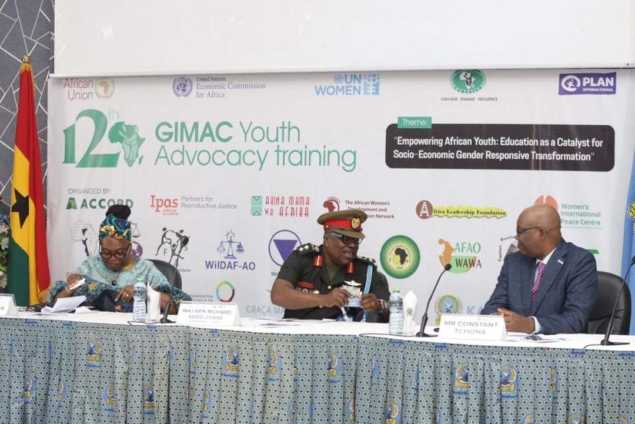
Dr Kezie-Nwoha made the call in an interview with the Ghana News Agency at the sixth GIMAC Engagement with AU, Regional Economic Communities, and partners in Accra on the theme: “Advancing Educational Transformation for Gender Equity and Sustainability towards Agenda 2063”.
Participants of the meeting were youth, especially young women from West, East, Southern and Northern Africa and beyond.
She said education as a cornerstone for development, demanded holistic approaches, policy reforms and financial commitments from all governments and partners to achieve valuable goals.
Dr Kezie-Nwoha, also the Founder of Researchers Without Borders, speaking at the GIMAC Engagement meeting, said it was crucial to train young people and equip them with advocacy tools to be able to promote an all-inclusive education in Africa.
“We do this event every year at the sideline of the AU Heads of States meeting to ensure that the voices of young women are profiled in policy making at the African Union,” she said.
The GIMAC Network, she said, had a huge network working in diverse thematic areas towards a common goal, and invited all organisations and individuals working on gender equality and women empowerment to join.
“We are not just doing this for the AU but also for the skills acquired here to be trickled down to the work people are doing at the communities and we look at it in a very vast way.
“So even as the steering committee, we would follow up with the recommendations on some of the implementation in our organisations, at the local and national government levels on the AU theme for this year,” She said.
Dr Kezie-Nwoha advised the participants to be open to learning from different regions and countries while sharing best practices in their operations on education.
The Country Director of Plan International Ghana, Mr Constant Tchona, said his organisation remained steadfast in its youth-centred approach by empowering young individuals and their organisations through the transfer of power, decision-making authority, and resource allocation.
“This strategy is integral to our distinct method of working with young people and this is why we are working with more than 60 youth-led organisations across the country,” he said.
Mr Tchona said promoting and ensuring an all-inclusive education was the prerequisite for the growth of a nation and its people.
For the part of Major General Richard Addo Gyane, the Commandant, Kofi Annan International Peacekeeping Training Centre, host ground for the event, ensuring that quality education was accessible to all, regardless of gender, socioeconomic status or geographical location was fundamental.
The inclusivity, he said, strengthened societal cohesion and enabled diverse perspectives to flourish, enhancing innovation and problem-solving capacities.
“By providing girls with the same educational opportunities as boys, we can break down traditional gender roles, empower young women to pursue careers and leadership roles and promote a more balanced and equitable society,” he said.
The engagement meeting was organised by Accord, Ipas African Alliance, Partners for Reproductive Justice, African Leadership Foundation, The African Women’s Development and Communication Network, Akina Mama Wa Afrika, and the Institute for Social Transformation.
The rest are Forum for African Women Educationists, Femmes Africa Solidarite, WilDAF-AO, World YWCA, AFAO WAWA, Women’s International Peace Centre, Rozaria Memorial Trust, Pan-African Women’s Organization, Egyptian Business Women Association and ACDHRS.
It was also supported by Plan International, ActionAid, Graca Machel Trust, Women for Women International, African Population and Health Research Center, Organisation Internationale de la Francophonie, African Renaissance, UNFPA, Christian Aid, She Leads, UNDP, African Women’s Development Fund, and Prof. Janet Barasa Foundation.
Latest Stories
-
Turn CSIR research into commercially viable products for national dev’t – Dr Agyeman-Rawlings
11 minutes -
Baffour Awuah thanks Bawumia, NPP supporters after GH¢10m bail
14 minutes -
Ghana gaining notoriety for drugs – Bawumia demands bipartisan probe
30 minutes -
Government urges SMEs to embrace digitalisation for growth and job creation
33 minutes -
Ghana’s university libraries urged to lead change in digital age
36 minutes -
NPP National Delegates Conference: Nhyiaeso MP calls for unity and peace
49 minutes -
Cargill Ghana renovates, equips ICT laboratory for Ahmadiyya Basic School
52 minutes -
GH¢6,500 cocoa promise has turned out to be a scam – Bawumia
52 minutes -
Firefighters battle blaze behind Amasaman China Mall
53 minutes -
We’ll pursue accountability despite intimidation – Afenyo-Markin
58 minutes -
‘Ghana Jollof’: Restoring the flavor
1 hour -
SSNIT outlines plans to transform Labadi beachfront into tourism hub
1 hour -
Today marks the beginning of a glorious chapter of the NPP – Bawumia
1 hour -
‘Justice has prevailed’ – Atta Akyea reacts to Baffour Awuah’s GH¢10m bail
2 hours -
I’m above board, no dirt can stick on me – Baffour Awuah
2 hours