

Audio By Carbonatix
In every election season, the spotlight shines brightest on the candidate. Yet, often standing just beside that light is a figure whose grace, voice, and presence quietly shape public sentiment — the candidate’s spouse.
In Ghana’s evolving democracy, this role has become more visible and more powerful. The modern political spouse is no longer a ceremonial companion; she is a communicator, a bridge-builder, and at times, a quiet force capable of influencing hearts and minds.
The Human Side of Politics
Ghanaian voters respond to warmth, authenticity, and character. Policies matter — but so do personal values.
A spouse who embodies compassion, humility, and service helps voters see those same qualities reflected in the candidate. In a society that prizes family and moral integrity, the personal and political often blend seamlessly.
The Two Faces of Influence: Global Parallels
Across the world, influential spouses have played defining roles — sometimes strengthening the spouse’s campaign or weakening them.
The Positives: Michelle Obama’s poise and empathy deepened Barack Obama’s message of hope and inclusion, inspiring millions beyond America’s borders. In Kenya, Rachel Ruto has emerged as a strong moral pillar and an active advocate for prayer, entrepreneurship, and social development — adding moral weight and authenticity to her husband’s political image.
The Negatives In France’s 2017 presidential race, François Fillon’s strong lead collapsed after revelations that his wife, Penelope Fillon, had received public funds for a parliamentary job she allegedly never performed. The resulting “Penelopegate” scandal shattered voter trust and cost him the presidency.
Similarly, in the Philippines, Imelda Marcos’s reputation for extravagance — epitomized by her vast shoe collection — became a global symbol of excess and detachment from ordinary citizens. Her public image deepened resentment toward the Marcos regime, contributing to its fall during the 1986 People Power Revolution.
These examples, both good and bad, show that a spouse’s presence in politics is never neutral. It can humanize a candidate, bridging emotional gaps with voters — or it can erode credibility if public perception is negative.
From Global Lessons to Ghanaian Realities
In Ghana, political spouses have increasingly become visible campaign assets. Their ability to connect emotionally with voters, especially women and youth, has made them key partners in shaping national conversations.
The Late Nana KONADU Agyemang Rawlings, prior to becoming a First Lady in democratic Ghana, publicly demonstrated positive spousal influence beside the political campaign podium of his late husband, Jerry John Rawlings.
Samira Bawumia: A Case Study in Public Campaign Influence
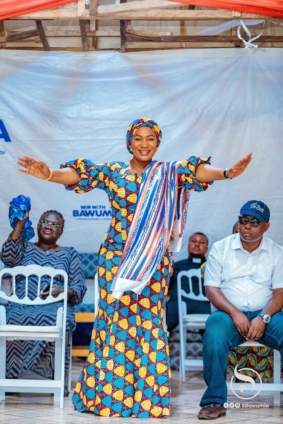
Few figures embody this new model of political partnership more vividly than Mrs. Samira Bawumia.
Elegant, eloquent, and deeply committed to social causes, she has redefined what it means to support a national vision.
Through her speeches at literacy and women empowerment programs, and her active presence on campaign trails for both her husband and party, she has emerged as a relatable face of modern Ghanaian womanhood — confident, purposeful, youth and community-focused.
In particular, her ability to relate and connect with young people, professionals, and rural communities alike highlights a subtle but significant truth: influence is not always loud. It can be soft-spoken, persuasive, and built on consistency, compassion, and credibility.
Beyond the Campaign Trail
The influence of such figures extends far beyond elections. When the public sees a genuine partnership built on mutual respect and shared purpose, it strengthens trust in leadership itself.
In this sense, a political spouse becomes an informal ambassador of empathy, service, and unity — qualities every successful campaign depends on.
Summarizing
The story of Samira Bawumia underscores a broader shift in Ghanaian politics — one that recognizes the growing importance of emotional intelligence, communication, and good character in leadership.
As campaigns evolve, the person beside the campaign podium will continue to shape narratives, connect with communities, and help redefine what leadership looks like in the eyes of the people.
Article by Joseph Cudjoe, a former MP for Effia Constituency and a former Minister for Public Enterprises.
Latest Stories
-
‘I never said I’ll declare a state of emergency’ – President Mahama on galamsey
6 minutes -
Bobby Banson condemns EOCO’s attempted arrest of Nana Agyei Baffour Awuah
31 minutes -
When Kumasi begins to look like somebody is in charge
31 minutes -
Parliamentary probe into cocaine seizure would be a waste of time – Inusah Fuseini
37 minutes -
Cocaine seizure: Focus on Ghana’s reputation, not partisan blame – Osae-Kwapong
44 minutes -
Two Invitations, Three Interrogations: Did Baffour Awuah tell the whole story?
53 minutes -
Drug cartels may be seeing Ghana as easy route – Lenin Anane Agyei
2 hours -
Ghana risks gaining notoriety as drug-trafficking hub – Bobby Banson
2 hours -
Government dismissed my drug trafficking warning, then tried to arrest me – Ntim Fordjour
2 hours -
Day Two: 3rd Republic Bank-JoyNews Habitat Fair Clinic underway at Junction Mall
2 hours -
NACOC addressing inherited gaps in fight against drug trafficking – Deputy Director-General
2 hours -
Taekwondo goes to school as GTF launches five-region youth campaign
2 hours -
The issues Mourinho is struggling to fix at Real Madrid
2 hours -
Hundreds throng EducationUSA College Fair in Kumasi in pursuit of abroad studies
2 hours -
Drug bust: NACOC should be part of port inspection team – Twum-Barimah
2 hours