

Audio By Carbonatix
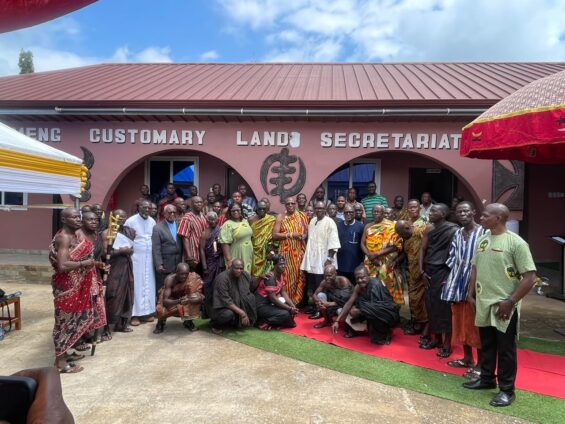
Two Customary Land Secretariats have been inaugurated in Sunyani in the Bono Region and Kwahu Obomeng in the Eastern Region as part of efforts to promote effective, transparent, and accountable land administration at the customary level.
The initiative is being supported by the Office of the Administrator of Stool Lands (OASL) as government seeks to strengthen land documentation and collaboration between traditional authorities and state institutions.
Speaking at the inaugurations, the Administrator of Stool Lands, Gad Asorwoe Akwensivie, commended the traditional authorities of Sunyani and Kwahu Obomeng for establishing the secretariats.
He said the move demonstrated a commitment to improving land administration while ensuring that customary practices can work alongside modern systems.
“It reflects a deep sense of responsibility towards your people. It also demonstrates your belief that customary land practices can co-exist with modern systems of land administration,” he said.
Mr Akwensivie said effective land management was critical to national development, warning that poorly managed land could instead become a source of conflict.
“Land is a very powerful tool for national development if very well managed; but could retard national development and become a source of conflicts when mis-managed,” he said.
He noted that about 80 per cent of land in Ghana is held under customary ownership, placing a significant responsibility on traditional authorities to manage the resource in a manner that benefits both present and future generations.
According to the OASL, the new secretariats will serve as repositories for land records, document land rights and record transactions within their respective areas.
They are also expected to provide accurate and accessible land information to the public, including prospective investors.
Mr Akwensivie said the system could help reduce land disputes, improve tenure security and promote orderly planning and development.
The Administrator disclosed that there are currently about 100 Customary Land Secretariats operating in different parts of the country.
These secretariats, he said, are helping to strengthen collaboration between customary authorities and state institutions involved in land administration.
They include the Office of the Administrator of Stool Lands, Lands Commission, Land Use and Spatial Planning Authority (LUSPA), National Development Planning Authority and land-based non-governmental organisations.
Mr Akwensivie stressed that effective management of the secretariats would be crucial to maintaining cordial working relationships among stakeholders.
He urged staff and members of the Land Management Committees to uphold integrity, professionalism and accountability in their work.
“The trust of the people should be earned and maintained,” he said.
Mr Akwensivie also urged residents of Sunyani and Kwahu Obomeng to support the new secretariats by making use of their services.
He said a well-functioning customary land secretariat was a shared responsibility between traditional authorities and their subjects.
He further assured that government remained committed to supporting such initiatives, adding that the OASL and the Lands Commission would continue to provide technical assistance to ensure that the secretariats fulfil their intended purpose under the Land Act, 2020.
He challenged the Land Management Committees of both secretariats to work towards making them models for other stools, skins, clans and family land-owning communities that are yet to establish similar structures.
The initiative is expected to contribute to more systematic land documentation at the customary level while improving access to land information and helping reduce disputes associated with land transactions.
Latest Stories
-
Parliament questions proliferation of unapproved containers in East Legon
4 minutes -
Promotion arrears alone cannot end teachers’ strike — PRETAG
10 minutes -
Ebi Bright alleges assault on driver in dispute with Tema Central MP
16 minutes -
GH¢35m Darkuman 24-hour market to be completed in 16 months — MCE
23 minutes -
NPP risks losing Karaga seat if Amin Adam doesn’t contest – John Boadu
27 minutes -
Ghana Reference Rate falls to 10.04% in October as borrowing costs ease
29 minutes -
53% of NPP delegates backed alternatives to John Boadu in chairmanship race – Mussa Dankwah
32 minutes -
High taxes, water shortages push up hotel operating costs — Hotels Association
33 minutes -
Catholic Bishops demand tougher action on tramadol, marijuana and other drugs
37 minutes -
Government positioning Banda District to become major tourism destination hub – Housing Minister
43 minutes -
Deputy Education Minister appeals to striking teachers to return to classrooms
48 minutes -
Government to involve corporate Ghana in street maintenance – Ayariga
54 minutes -
Contractors to resume work on Phase Two of Kejetia Market Project
1 hour -
Government committed to resolving teachers’ concerns - Vice President
1 hour -
Agric Minister cuts sod for construction of Inland Valley project at Aninkroma
1 hour