


Audio By Carbonatix
The number of people who have died in a series of deadly blasts in Nigeria thought to have been carried out by female suicide bombers has risen to more than 30, the vice president says.
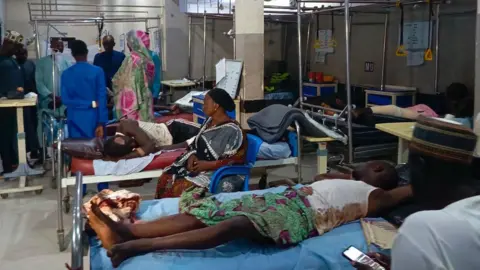
Kashim Shetim visited the hospital treating the wounded in Borno State capital Maiduguri on Monday and said there were 42 people injured, according to AFP.
The horror of Saturday's brutal coordinated attacks that targeted a wedding, the victims' subsequent funeral and a hospital in the town of Gwoza, close to the border of Cameroon, has left the community reeling.
President Bola Tinubu condemned the attacks calling them "desperate acts of terror".
He vowed stern action against those responsible for the killings in the town of Gwoza and insisted that the incident had not undermined recent gains made against jihadists.
"The president declares that the purveyors of wanton violence shall have a certain encounter with justice and that these cowardly attacks are only but an isolated episode as his government will not allow the nation to slither into an era of fear, tears, sorrow, and blood," a statement issued by his spokesperson on Facebook said.
No-one has admitted carrying out the attacks, but the Nigeria-centred Islamic State West Africa Province (ISWAP) insurgents have previously claimed deadly bombings in Borno.
The degree of injuries ranges from abdominal ruptures to skull and limb fractures.
A curfew has been imposed by the military.
Amnesty International Nigeria called for an end to assaults on civilians in Borno.
"These deplorable attacks that took place at a time people were mourning demonstrate complete disregard for human life," it said.
The US Mission in Nigeria also described the attack as "horrific".
“These reprehensible acts of violence show a cruel and heartless disregard for human life…these abhorrent attacks are a stark reminder of the ongoing threat posed by terrorism in the region."
In the last four months, attackers have twice targeted people through suicide and improvised explosive devices in Borno state.
Borno state has been at the centre of a 15-year insurgency by Boko Haram Islamist militants, which has displaced more than two million people and killed more than 40,000.
Boko Haram gained international notoriety in April 2014 when it kidnapped more than 270 schoolgirls from the town of Chibok, also in Borno state.
Shortly after the kidnapping, the group carried out an attack in June and used their first female suicide bomber.

This was only three years after it deployed its first male suicide bomber.
Since then, there have been speculations that some of the female suicide bombers may be the missing Chibok school girls.
A study found that Boko Haram has utilised more women as suicide bombers than any other group in history.
Recent numbers suggest that over half of all suicide bombers used by Boko Haram are female.
Many suggest that their mode of dressing (usually in hijab – a covering from the head to the feet) offers adequate means for hiding explosives.
Gwoza was seized by Boko Haram in 2014, and taken back by the Nigerian forces in 2015 - but the group has since continued to carry out attacks and kidnappings near the town.
The Gwoza suicide attacks has reignited suspicions that jihadist groups may be trying to reinvent themselves and show that they still have the capacity to do damage.
Last November, 20 people were killed by Boko Haram insurgents while returning from a funeral service in neighbouring Yobe state.
The attack happened a day after militants killed 17 people in a raid on Gurokayeya village, after villagers refused to pay a so-called harvest tax, police said.
Latest Stories
-
Nhyiramma Foundation calls for greater support for widows and single mothers
33 seconds -
Ghana must stop turning rivers into gutters through encroachment – Kwadwo Poku
2 minutes -
‘We’ll never compromise on quality’ – Agbodza tells Accra-Kumasi bypass supervisors
8 minutes -
Roads Minister urges motorists to drive cautiously on Accra-Kumasi Highway
9 minutes -
Hohoe MCE appeals for more relief supplies as flooding displaces residents
9 minutes -
‘Free Salomey now!’ – Women march to EOCO over Salomey Awitey Baffoe’s continued detention
11 minutes -
GES appeals to teachers to rescind strike and return to class as efforts to resolve concerns intensify
11 minutes -
Effiduase hospital begins new maternity ward construction amid maternal health concerns
13 minutes -
World Vision calls for stronger prevention of child malnutrition across West Africa
14 minutes -
Ghana and Philippines agree to boost trade, investment and labour mobility
15 minutes -
Ziavi Chieftaincy dispute: E.P. Church Moderator appeals for peace
15 minutes -
Roads Minister rejects claims government has abandoned Accra-Kumasi by-pass project
18 minutes -
Rainfall in Togo driving rising floodwaters in Hohoe – MP
19 minutes -
Mrs Victoria Keren Lamiorkor Adomakoh
22 minutes -
PUWU postpones protest against private sector participation in ECG
22 minutes