


Audio By Carbonatix
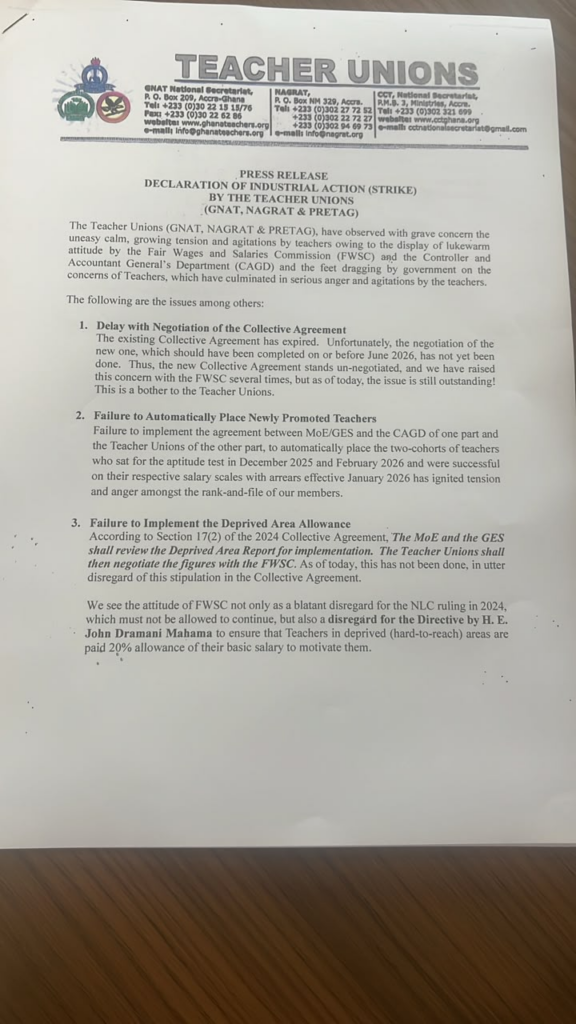
The three teacher unions — the Ghana National Association of Teachers (GNAT), the National Association of Graduate Teachers (NAGRAT), and the Pre-Tertiary Teachers Association of Ghana (PRETAG), have declared a nationwide industrial action effective Friday, September 25, 2026, following the government’s failure to resolve outstanding issues concerning the payment of promotion allowances and arrears owed to teachers.
The unions had given the government until midday on Thursday, September 24, 2026, to address the concerns.
The unions say the decision follows what they describe as prolonged delays, unfulfilled commitments and growing frustration over conditions affecting teachers.
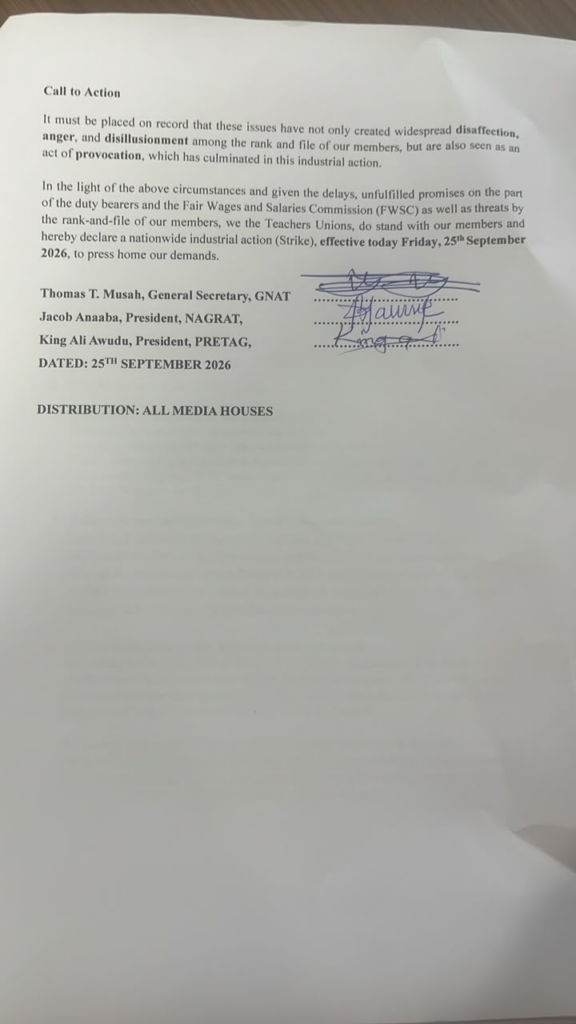
“In light of the above circumstances and given the delays, unfulfilled promises on the part of the duty bearers and the Fair Wages and Salaries Commission (FWSC), as well as threats by the rank-and-file of our members, we, the teacher unions, do stand with our members and hereby declare a nationwide industrial action (Strike), effective today, Friday, 25th September 2026,” the statement said.
In a joint statement dated September 25, the unions cited three major concerns, including the delay in negotiating a new Collective Agreement, the failure to automatically place newly promoted teachers on the appropriate salary scales, and the non-implementation of the Deprived Area Allowance.
According to the unions, the existing Collective Agreement has expired, while negotiations for a new agreement, which they say should have been completed by June 2026, remain outstanding.
They said the matter has been raised with the Fair Wages and Salaries Commission (FWSC) several times, but has yet to be resolved.
The teacher unions are also demanding the automatic placement of teachers who successfully passed the promotion examinations in December 2025 and February 2026 onto their respective salary scales, including payment of arrears effective January 2026.
They said the failure to implement the arrangement has created tension and anger among their members.
On the Deprived Area Allowance, the unions referenced provisions in the 2024 Collective Agreement requiring the Ministry of Education and the Ghana Education Service (GES) to review the Deprived Area Report for implementation, after which the unions and the FWSC would negotiate the applicable figures.
They, however, said this process has not been completed.
The unions further expressed concern about what they described as a failure to honour a directive on incentives for teachers working in deprived and hard-to-reach areas.
They said the outstanding issues have resulted in “widespread disaffection, anger, and disillusionment” among their members.
Latest Stories
-
Joyce Bawah Mogtari urges women leaders to build strong support networks
5 minutes -
Bawumia engages GUTA over import duties, VAT and rising business costs
5 minutes -
Fuel prices begin to fall as Star Oil cuts petrol to GH¢16.45
7 minutes -
GoldBod supplies banks with US$282m in weekly forex sales
8 minutes -
Joyce Bawah Mogtari says Obaasima Conference should help women connect and learn
9 minutes -
Nzema East launches Responsible Cooperative Mining Programme to tackle environmental destruction
38 minutes -
Ghana included in WHO lead-testing programme as questions remain over local exposure risks
46 minutes -
2026 Amputee World Cup: We will win the trophy – Samson Deen
55 minutes -
Controller and Accountant-General pays promotion arrears to 56,003 GES teachers ahead of deadline
55 minutes -
2026 Amputee World Cup: We want to make the continent proud – Black Challenge coach
59 minutes -
International Day of the Girl: Central Region Education Directorate calls for action to tackle child marriage, teenage pregnancy
1 hour -
The Eyes of Ghana: iShowSpeed joins Obamas as producers of Chris Hesse documentary
1 hour -
FirstBank Ghana pledges action on customer feedback at service week forum
2 hours -
Sahara Group urges journalists to look beyond fuel prices in energy reporting
2 hours -
Today’s front pages: Friday, October 16, 2026
2 hours