

Audio By Carbonatix
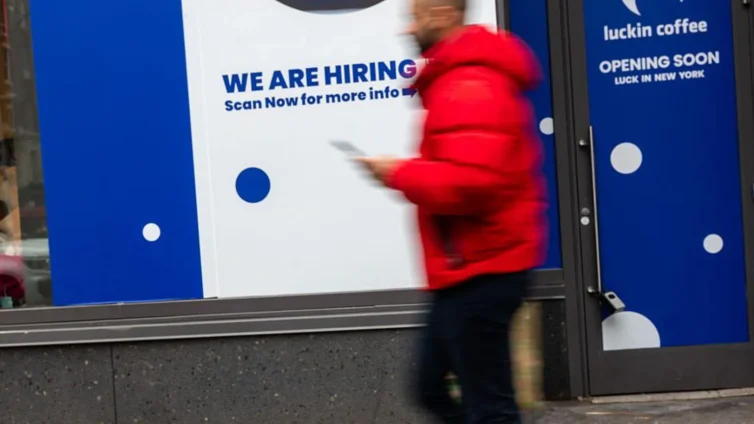
Hiring in the US surged last month, despite the energy shock and uncertainty stemming from the US-Israel war in Iran.
Employers added 178,000 jobs, far more than expected, while the unemployment rate dipped to 4.3%, the Labor Department said.
Analysts said the gains were likely lifted by the end of strikes in the health care industry which had led to steep losses in February. But the figures are still likely to increase confidence in the resilience of the job market, which has slowed sharply over the last year.
It is also expected to bolster the case for the US central bank to hold off on cutting interest rates, as it waits to see what impact the rise in oil prices has on the economy.
US President Donald Trump has pushed the Federal Reserve to lower borrowing costs aggressively, a move that would give the economy a boost.
But the bank has held off in recent months, citing concerns about inflation, which remains above its 2% target. Fed chair Jerome Powell has described the economy as being in a delicate balance, with muted job creation but also relatively limited job cuts.
The White House crackdown on immigration, and other policy changes such as tariffs have contributed to the static market.
The war in Iran could add to that dynamic, though it remains too soon to fully gauge its impact. The Labor Department typically surveys employers and households around the middle of the month, which was only a few weeks after the conflict had started.
Economists have warned that a sustained rise in oil prices could push up transport and food costs, pushing households and businesses to cut back spending in other areas and leading to a wider slowdown.
"The question now is how much blowback will come from the war in Iran and the associated uncertainty around energy prices," said Olu Sonola, head of US economics at Fitch Ratings.
The Labor Department report showed job gains in March were driven by the health care industry, but extended into other sectors, including construction and manufacturing.
Financial firms and those in the information sector, which includes film, publishing and tech posted losses, as did the government.
Sonola described the latest figures as "great" but cautioned that hiring has bounced up and down for much of the last year, reflecting business uncertainty. He said that was poised to increase due to the war.
"For the Fed, wait-and-see is the only sensible option at this point," he said.
Latest Stories
-
Photos: Mahama commissions 85-bed Police Hospital ward, donates two ambulances
8 minutes -
GTEC directs Ghana’s public universities to reopen by October 16 and begin lectures on October 19
9 minutes -
Star Oil donates GH¢1million towards construction of new CID facility
13 minutes -
Court hands Adjetey Sowah, two others lifetime bans after Amputee Football legal dispute
22 minutes -
NDC appoints Julius Kwame Anthony as a Deputy Communications Director
23 minutes -
Ghana repatriates 120 Nigerians rescued from suspected cybercrime centres
27 minutes -
NPP rejects Emelia Agbenyo’s appointment as Deputy EC Chair, demands withdrawal
32 minutes -
EOCO grants Suame MP John Darko enquiry bail in GH¢27m SIC investigation
35 minutes -
NPP cannot question EC appointment after appointing own people to Commission – Kwakye Ofosu
41 minutes -
BoG deepens public trust with regional stakeholder forum in Techiman
50 minutes -
‘We have turned the tide’ – Ato Forson says Ghana is ready to take off
55 minutes -
Police arrest man captured in viral video assaulting wife in Agona Nkwanta
57 minutes -
KATH Mother and Baby Unit construction stalled for 14 months over unpaid contractor arrears
1 hour -
Government wanted to ‘tilt the balance’ with new EC appointments – Kwakye Ofosu
1 hour -
Angry Tema Community 25 residents threaten to sleep at GWL over water shortage
2 hours