

Audio By Carbonatix
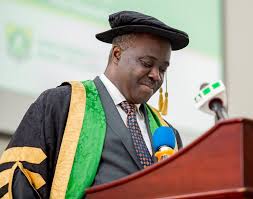
The Vice Chancellor of the University of Health and Allied Sciences, Professor John Owusu Gyapong, says the government’s decision to wean public universities off its payroll was first suggested by the University Teachers Association of Ghana (UTAG).
According to him, UTAG is hoping that such an initiative would help address the fiscal challenges public universities and lecturers face while performing their duties.
As put by the University of Ghana’s UTAG Secretary, Ransford Gyampo, in an earlier interview, weaning public universities off state funds, would allow these institutions charge appropriate fees in order to be run effectively and efficiently.
He had said, “Some of the proceeds can be used to pay lecturers or beef up the infrastructure of these various universities, rather than always waiting for government subvention that delays and government subvention that are woefully inadequate that are not able to do anything for the university and for expanding their infrastructure.”
Speaking on PM Express, Prof Gyapong noted that the suggestion which was made by UTAG was an attempt to address the poor conditions of service which had culminated into their strike action.
“This suggestion came from the UTAG side, that a better management system is giving the university the grants that it requires to be able to run the university. So I guess in the expectation of UTAG, if for instance government is giving us 5 million cedis for salaries every month, then over the year it will be about 60 million.
“So government will give the university the 60million and say you manage it and don’t come to me. I conjecture that that was the expectation. So it is not to say that government was going to take away all the funds that it gives to the universities.
“Of course in that discussion it became clear that it wasn’t going to be the total 100% that will come to the university but as to what proportion will come, nobody discussed that. I mean the subject was broached, it wasn’t discussed in detail.”
The Finance Minister, Ken Ofori-Atta is yet to release the full details of how the government intends to wean off the tertiary institutions, and how the block grant will be administered.
Meanwhile, the Minority have expressed their opposition to the suggestion.
A Deputy Ranking Member of Parliament’s Education Committee says that the proposal to wean public tertiary institutions off government payroll “will invariably restrict access to tertiary education.”
Dr Clement Apaak says implementing the proposal will create a financial barrier, which would add to the existing infrastructure challenges and “prevent the poor and marginalised from accessing tertiary education.”
Latest Stories
-
Newsfile to tackle World Cup visa scandal, beach demolitions, education strikes, BRICS bid
3 minutes -
UK-Ghana Trade & Investment Summit: Trade Resource Centre to help businesses maximise UK-Ghana trade opportunities
17 minutes -
Embassy of Denmark celebrates World Maritime Day
25 minutes -
Linking LEAP to productive inclusion could cut extreme poverty by 2030 – UNICEF
2 hours -
Trade Ministry backs use of creative arts to rehabilitate prison inmates
2 hours -
Negotiations with government to continue despite strike suspension – GNAT
2 hours -
‘Ghana cannot afford to waste public resources; every cedi has a job’ – Ato Forson
2 hours -
Ghana expects economic boost as World Assemblies of God Congress brings 10,000 delegates to Accra
2 hours -
Joy in Nayilifong as Farouk Aliu Mahama donates 100kVA transformer to improve power supply
2 hours -
Chief Justice urges employers to tackle mental health stigma in workplaces
3 hours -
Analysis: Ghana’s yellow fever numbers reveal a gap between vaccination and protection
3 hours -
Education Ministry welcomes suspension of teachers’ strike
4 hours -
Vice Chancellors Ghana appeal to striking university administrators to resume work
4 hours -
KNUST postpones 2026/2027 academic year reopening indefinitely amid GAUA strike
4 hours -
Fire destroys mattress factory at Sokoban in Kumasi
4 hours