

Audio By Carbonatix
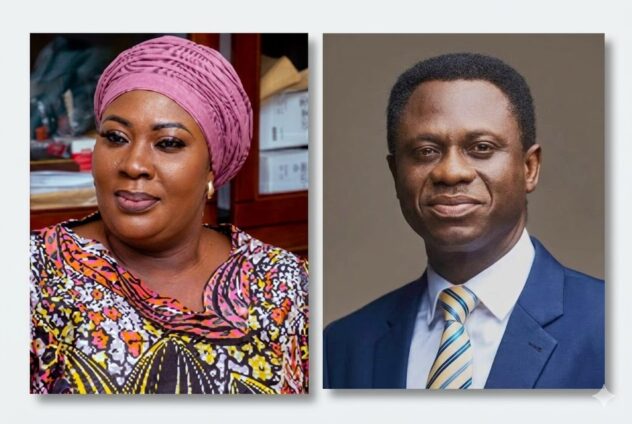
The Chief Executive Officer of the Ghana Free Zones Authority, Dr Mary Awusi, has issued a sharp response to the Chairman of the Church of Pentecost, Apostle Dr Eric Nyamekye, cautioning him over his recent public comments on illegal mining (galamsey) and warning that future interventions could be treated as political statements.
Speaking in an interview on Accra FM on Thursday, April 23, 2026, Dr Awusi said she had initially refrained from responding robustly out of respect for his religious office.
“He’s a man of God, so we’ll forgive him. But next time, he shouldn’t stoop so low to that level. I am telling him. If he descends to that level to behave like a politician, we will deal with him as a politician. I’ve given him reverence because he’s a man of God and the Chairman of the Church of Pentecost,” she stated.
Her comments were in direct response to Apostle Nyamekye’s recent remarks on galamsey, in which he expressed concern about its impact on the environment and even church activities. In a widely reported address, he had warned that illegal mining was polluting water bodies and disrupting religious practices.
While speaking at the Church’s 48th General Conference during the State of the Church Address, where he outlined key challenges, progress, and ongoing interventions within the denomination, the Church leader noted that galamsey was affecting baptism rites, explaining that polluted rivers had made traditional water-based baptisms difficult in some areas.
Read Also: The Church of Pentecost raises alarm over galamsey impact on baptism and livelihoods
“The extensive pollution of water bodies due to illegal mining has hampered traditional water baptism in some mining communities, necessitating a shift to synthetic rubber pools in several districts to carry out the ordinance. These unpredictable environmental conditions, along with the seasonal migration of fish stocks, continue to impact the steady financial growth and stability of affected local assemblies."
Dr Awusi, however, insisted that while religious leaders are respected voices in society, they must be careful when commenting on politically sensitive national issues such as galamsey.
When the host of the programme interjected and described the Apostle as an anointed man of God, she responded firmly: “It’s not about anointing. If he were that anointed, he wouldn’t speak in this manner.”
She argued that the framing of galamsey discourse must remain balanced, noting that environmental conditions have fluctuated across different administrations.
“What he said is a highly political statement. When Nana Addo was in office, many communities in the mining communities had their water looking very thick and brown. Was he not in Ghana? Did he see it or not?” she asked.
Dr Awusi further maintained that improvements have been observed under the current administration, cautioning against what she described as selective narratives.
“Today, after John Mahama came to power, due to the measures he has put in place, the rivers are flowing, so you cannot claim that you’ve seen no difference in the state of the water. During Akufo-Addo’s time, the rivers were not flowing at all,” she claimed.
She added a strong warning directed at the Church leader, stressing that his intervention could be interpreted as political if repeated in a similar tone.
“So, if you’re a reverend minister and you bypass the truth by taking off your pastoral robe and putting on political clothes and a political lens to speak, the next time we’ll treat him as a politician. This time we’ll spare him. We beg of him to focus on his pastoral work,” she said.
Dr Awusi concluded that respect for religious leaders remains important, but that public commentary must remain within appropriate boundaries.
The exchange comes amid Ghana’s long-running struggle with illegal mining, which has devastated large parts of the country’s river systems and forest reserves. Successive governments, including both the Nana Akufo-Addo and John Dramani Mahama administrations, have implemented various anti-galamsey initiatives, though the problem persists.
Civil society groups, churches, and environmental advocates have increasingly joined the national conversation, calling for stronger enforcement, restoration of degraded lands, and protection of water bodies critical to both livelihoods and public health.
The latest back-and-forth between a senior public official and the Church of Pentecost leadership highlights the growing sensitivity surrounding galamsey discourse, where environmental concerns, politics, and moral authority continue to intersect.
Latest Stories
-
NPP will impose $500m bail bond on NDC offenders if we return to power — Abanga
1 second -
Mahama Ayariga urges banks to take responsibility for beautifying public spaces
35 minutes -
Account for the old economy before selling us a new one
1 hour -
Abanga sets 4 million youth-vote target for Bawumia ahead of 2028 election
1 hour -
Gold edges lower with focus on Fed minutes, rate path clues
2 hours -
Oil prices rise as storms and air strikes threaten supply
2 hours -
Nigeria nears 2,000 repatriations from South Africa after latest evacuation flight
2 hours -
‘How can an office…close at 5pm?’ – Abanga questions 24-Hour Economy
2 hours -
‘4 million is possible’ – Abanga unveils NPP’s youth-vote battle plan
2 hours -
‘I never gave up’ – Abanga Fusani reflects on journey to NPP Youth Organiser victory
3 hours -
World Bank maintains Ghana’s growth rate forecast at 4.8% in 2026
3 hours -
Cedi was worst African currency in quarter 2, 2026 – World Bank
3 hours -
US death row inmate Christa Pike awake and speaking after failed execution, lawyers say
3 hours -
AI gains can lift three times as many people out of poverty in Ghana – World Bank
3 hours -
Scammers target ECG customers with fake meter sales and MoMo payment calls
5 hours