

Audio By Carbonatix
Ghana, that resourceful republic where even arithmetic occasionally develops political affiliations, has discovered something remarkable about gold.
For centuries, gold was simple. It glittered. Kings wore it. Nations stored it.
Ghana has improved upon the science.
Here, gold can apparently make a profit in one office and a loss in the next, with everybody holding respectable documents to prove that the arithmetic is innocent.
The confusion began after the IMF reported that Ghana’s Domestic Gold Purchase Programme contributed to Bank of Ghana losses equivalent to about *1.5% of GDP in 2025*.
One-point-five per cent sounds harmless.
Then somebody translated it into money.
Around $1.7 billion.
Suddenly, citizens who had successfully avoided economics since secondary school began sitting upright.
Naturally, explanations followed.
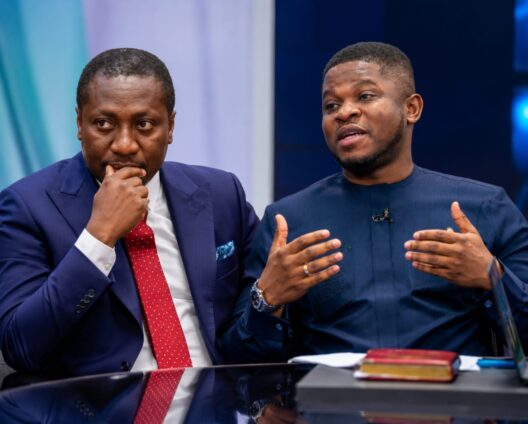
The Minority says the gold operations produced huge losses and wants GoldBod to account. GoldBod says people are knocking on the wrong door.
Its CEO, Sammy Gyamfi, insists GoldBod itself recorded a GH¢5.4 billion surplus.
And so Ghana has arrived at one of its favourite national junctions: everybody has figures, everybody has documents, everybody is confident, and the citizen in the middle begins regretting not paying attention during accounting lessons.
The easiest way to understand the quarrel is to imagine a Ghanaian family entering the tomato business.
Father provides the money.
Kojo buys the tomatoes.
Ama handles transport.
Kofi sells them at Kejetia.
At the end of the month, Kofi returns home smiling.
“My department made GH¢20,000 profit.”
Unfortunately, Father has examined the family ledger and discovered that the entire tomato enterprise has cost the household GH¢60,000.
“We have lost money,” Father announces.
Kofi looks offended.
“Nana, please speak for yourself. My department made profit.”
Ama produces transport receipts.
Kojo blames the exchange rate.
Someone remembers the truck broke down at Nkawkaw.
An auntie asks why nobody listened when she suggested onions.
Then an uncle arrives from abroad carrying a calculator.
That uncle, broadly speaking, is the IMF.
And unfortunately for everybody, he has pressed the ON button.
That appears to be the heart of Ghana’s golden quarrel.
GoldBod can conceivably record a surplus on its own operations while the Bank of Ghana, which financed purchases and absorbed exchange-rate differences and other costs, records losses elsewhere.
Both statements can therefore be true.
But if the profit belongs to one public institution and the loss belongs to another, at what point may the citizen stop being impressed by the seating arrangement?
These are rooms in the same house.
When rain enters the bedroom, it is limited comfort to announce that the sitting room has recorded a surplus.
To be fair, the programme had benefits. Ghana’s reserves improved. Gold exports brought in foreign exchange. The cedi strengthened.
The patient appeared to be responding beautifully.
Unfortunately, while everybody was admiring the improved blood pressure, somebody looked at the hospital bill.
And this is where national accounting begins to resemble a Ghanaian family funeral.
Everybody remembers exactly what he contributed.
The man who supplied the drinks has his receipts.
The auntie who brought rice remembers every bag.
The cousin who hired the chairs can account for every pesewa.
Then, after the funeral, the family discovers that the entire exercise cost far more than everybody says they spent.
Suddenly, each person points to his own little ledger and says:
“As for my side, everything balanced.”
Yet the family purse is empty.
And that is the question in this gold affair:
If everybody’s side made sense, whose side produced the loss?
A public programme cannot celebrate its benefits collectively and distribute its losses individually.
Our elders say that when two people carry a load, neither should claim his shoulder was merely supervising.
GoldBod deserves credit where it created genuine value. The programme deserves credit for strengthening reserves.
But the costs must also be counted.
So the argument continues.
$1.7 billion loss.
GH¢5.4 billion surplus.
Economists will explain exchange-rate differentials. Politicians will hold press conferences. Party communicators will discover accounting qualifications nobody knew they possessed.
Meanwhile, the ordinary Ghanaian is left asking how we found the gold, bought it, sold it, earned the dollars, strengthened the reserves, recorded the surplus...
…and still ended up searching for who owns the loss.
Gold still glitters.
In Ghana, however, it occasionally requires an auditor to explain exactly where the shine went.
While politicians across the political divide hurl invectives at one another, what’s your take on this golden arithmetic?
Latest Stories
-
I have no issue with John Boadu; we’ll work together – Justin Kodua
20 minutes -
Adom FM Y2K Jam delivers a night of music, fashion and nostalgia
1 hour -
Lawrence Kobena Nsarko Otoo, Esq
2 hours -
Bel-Aqua intensifies mental well-being campaign ahead of 15th anniversary
2 hours -
From banking to party finances: Alfred Kwadwo Thompson elected NPP Treasurer
2 hours -
George Christian Papa Mends
2 hours -
Ali Suraj elected NPP NASARA Coordinator
2 hours -
Mustapha Hamid misses out on NPP Vice Chairmanship by 31 votes despite early poll lead
3 hours -
Kojo Bamba, Henry Nana Boakye and Nana Akomea elected NPP Vice Chairmen
3 hours -
From Delta Force to NPP First Vice Chairman – Kojo Bamba’s political journey
3 hours -
Police restore calm at Larteh following Odwira festival disturbance
4 hours -
‘All the camps will dissolve’ – Bawumia demands one NPP for 2028
4 hours -
There is no time to waste – Bawumia orders NPP to begin 2028 work
5 hours -
Sarkodie visits MobileMoney Fintech LTD
5 hours -
John Boadu unveils new NPP strategy to win back youth and modernise party
5 hours