

Audio By Carbonatix
Researchers at the University of Ghana have concluded that some fish that washed ashore last week was as a result of low oxygen concentration in the waters.
Preliminary investigations conducted by the Marine and Fisheries Sciences Department revealed that “most parameters required for life in the ocean were within acceptable limits, with the exception of Chemical Oxygen Demand (COD), which was significantly higher than expected.”
This comes on the back of tons of fish washed ashore in Accra which attracted many residents, some of whom picked them up either for consumption or for sale during the Easter festivities.
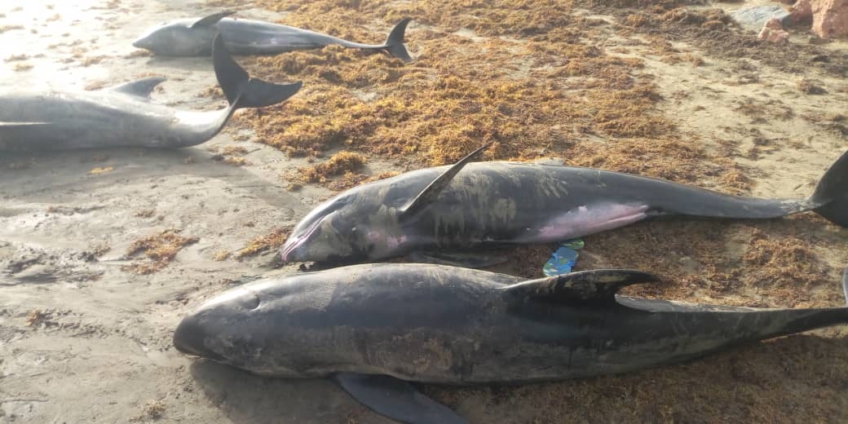
Similarly, some 60 dead dolphins were sighted at the shores of Axim-Bewire in the Nzema East Municipality of the Western Region.
The Fisheries and Aquaculture Minister, Mavis Hawa Koomson had revealed that fish stress is what caused the mass fish deaths that washed ashore at Osu beach per preliminary investigations by Veterinary Doctors of the Fish Health Unit of the Fisheries Commission.
Fresh information from the University of Ghana researchers corroborates this as it explains that “this oxygen demand would most likely create a condition of stress on living organisms that depend on dissolved oxygen in the water body.”
The department's press press release on April 11 says it observed a sudden drop in sea surface temperature in the coastal waters from Cote d’Ivoire to Togo a few days to the washing ashore of the fish.
Although it is not yet clear what may have triggered this development, “this is most likely an indication of upwelled water from the bottom of the ocean, probably carrying low oxygen concentration,” per the reseachers.
The statement signed by the head of department used the opportunity to appeal to government to procure a ferries geared towards monitoring marine for research purposes as global warming presents new challenges within the field.
"We depend very much on the marine living and non-living resources for a significant portion of our national wealth. It is implicit that we protect this asset through regular monitoring so as to avert any future calamity. The impact of global climate change and its vulnerability is real and coastal states are the worst to be affected," the statement added.
Latest Stories
-
Court fines trader GH¢12,000 for selling counterfeit Amuzu Bitters
20 minutes -
Daily Insight for CEOs: The CEO’s role in strengthening financial discipline
22 minutes -
Food vendor jailed seven years over human trafficking, prostitution
31 minutes -
When Man City call you don’t say no – Ndiaye
41 minutes -
Peter Mac Manu buries wife on Saturday
41 minutes -
Man found dead in open drain at Wa SSNIT Residence
44 minutes -
VIDEO: Watch Bright Simons and Kpessa-Whyte clash over SIGA report on SOEs
46 minutes -
EXPLAINER: Why Chief Justice Baffoe-Bonnie’s ‘past eight years’ comments have sparked controversy
56 minutes -
Ghana, Uganda deepen upstream petroleum cooperation through peer learning
1 hour -
Sam George opens Girls-In-ICT Open Day, urges girls to lead Ghana’s digital future
1 hour -
‘No matter where you hide, we will come for you’ – IGP warns criminals
1 hour -
Ghana, Burkina Faso deepen cooperation on Human Capital and AI
1 hour -
‘We have the spaces, but they don’t meet demand’ – Kofi Asare on SHS placement
2 hours -
SHS placement: Gov’t taking steps to address challenges – Education Ministry assures
2 hours -
Mrs. Alice Serwah Manu
2 hours