

Audio By Carbonatix
Electricity access rate in Ghana according to latest data from the Ministry of Energy is at 88.54%.
Generation is owned by public utilities and Independent Power Producers (IPPs), with IPPs contributing approximately 3,791 MW, or 69%, of the total installed capacity of 5,492.145MW.
The transmission system for electricity generated is owned and operated by a state-owned transmission utility while the distribution of electricity to consumers is done by three utilities, two owned by the state and one private company.
The West African nation also exports electricity to neighbouring countries in West Africa through the West African Power Pool (WAPP). In 2022, Ghana exported 1,953 GWh to neighboring countries, representing about 9 percent of the total energy supplied in the country.
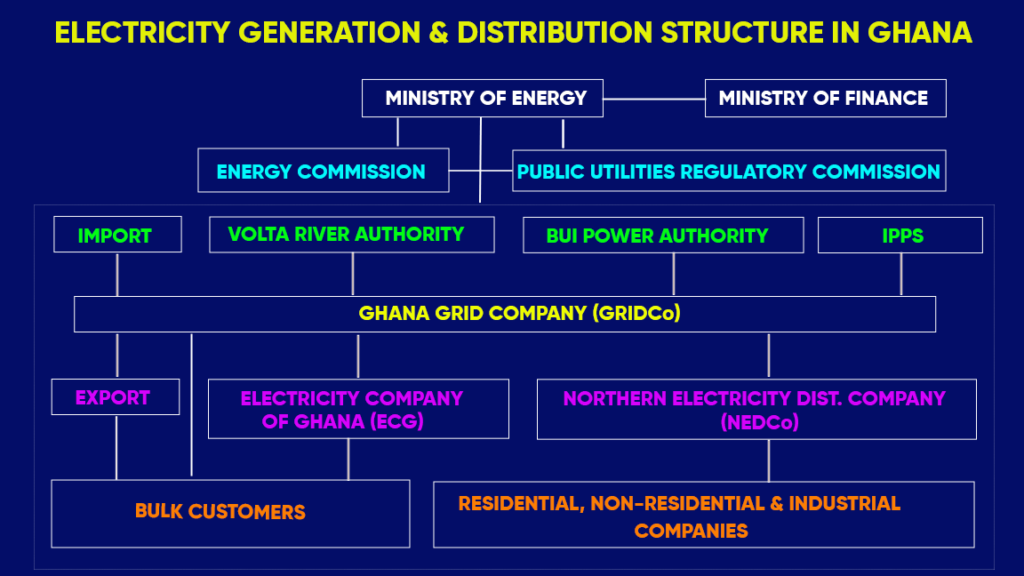
Ghana’s energy sector specifically, the power sector is regulated in a processional structure in terms of policy making, regulation, power generation, transmission, distribution and consumption of electricity. Here is a thorough breakdown of the various stakeholders at each level of operation in the power sector and what they do.
Policy Makers of the Sector
The Ministry of Energy (MoEn) in Ghana is responsible for developing, monitoring, and evaluating policies, plans, programmes, and projects within the power sector, with financial support from the Ministry of Finance (MoF). Additionally, the MoEn is directly in charge of implementing the National Electrification Scheme across various regions of the country.
Regulators
The Public Utilities Regulatory Commission (PURC) and the Energy Commission (EC) are the economic and technical regulators respectively. The Public Utilities Regulatory Commission (PURC) is an independent regulatory agency tasked with the economic regulation of the power sector. This includes approving electricity rates charged by distribution utilities to the public. Additionally, PURC is responsible for monitoring the quality of electricity services provided to consumers.
The EC is responsible for the technical regulation of the power sector, which includes licensing operators and advising the Minister of Energy on energy policy and planning matters. These two commissions are responsible for regulating the activities of the power sector.
Power Generators
The power generation is done by three major groups, including the Volta River Authority (VRA), Bui Power Authority BPA), and Independent Power Producers (IPPs). The sources of generation include hydro power plants, thermal power plants and solar photovoltaic power plants. According to the to the 2024 Energy Outlook report, as of November, hydro plants (VRA and BPA) contributed 28.9% of the total installed capacity, with conventional thermal plants (IPPs) and renewable sources (VRA,BPA,BXC and Meinergy) contributing 69.1% and 2.0% respectively.
Transmitters
The transmission of electricity from the generation companies to the distribution companies is done through the National Interconnected Transmission System (NITS) owned and operated by the state-owned Ghana Grid Company Ltd (GRIDCo). The company serves as a bridge between generators and the distributors of electricity to respective consumers.
GRIDCo is responsible for receiving funds to improve methodology and processes for achieving economic dispatch of power and strengthening of a critical transmission line to remove constraints of economic dispatch.
Distributors of Power
The distribution of electricity to final consumers in Ghana is managed by three companies: two state-owned entities, the Electricity Company of Ghana (ECG) and the Northern Electricity Distribution Company (NEDCo), and one private entity, Enclave Power Company.
ECG is responsible for distributing electricity in the southern sector of Ghana. It also receives funds aimed at enhancing corporate governance and operational performance. These improvements include:
- Upgrading the Low Voltage (LV) network by supplying and installing transformers and other network equipment.
- Procuring and installing pre-payment meters compliant with the Metering Management System (MMS) for customers.
- Installing meters at ECG Bulk Supply Points (BSPs).
- Implementing an online Independent Power Producer (IPP) invoicing system.
NEDCo, on the other hand, distributes electricity to the northern sector of Ghana and neighboring countries, ensuring a safe and reliable supply to homes and businesses. Covering approximately 64% of Ghana's geographical area, NEDCo operates in a region with a low customer density and an electricity access rate of about 68% as of June 2023.
Both ECG and NEDCo benefit from reduced energy losses, increased revenue, and improved corporate governance.
Enclave Power Company is Ghana's only private-owner power distribution company.
It is responsible for distributing about 45MW of power from the Volta River Authority to multinational and local manufacturing companies in the Team Free Zone Enclave as well as the Dawa industrial zone.
It is Ghana's largest privately-owned substation located in Tema.
Consumers
Electricity consumers in Ghana are classified into four primary categories: bulk, industrial, residential, and non-residential.
Bulk Consumers: These are large-scale electricity users who either have a Maximum Demand of at least 500 KVA for three consecutive months or consume at least 1 million kilowatt-hours (kWh) annually.
Industrial Consumers: Also known as Special Load Tariff (SLT) consumers, these include entities that utilise electricity for industrial purposes, such as the Volta Aluminum Company (VALCO), mining companies, and other production and manufacturing facilities.
Residential Consumers: These encompass households in both rural and urban areas across the country.
Non-Residential Consumers: This category primarily includes commercial establishments and businesses.
Additionally, electricity consumption for street lighting across the country is categorised separately under the street lighting class.
The total electricity consumption for the entire year of 2023 was 23,617 GWh, marking a 5.1% rise from the 2022 consumption of 22,478 GWh. In 2024, the projected electricity consumption is 24,997 GWh, representing a 5.8% increase over the expected consumption in 2023.
ECG consumption is estimated to reach 16,314 GWh, while NEDCo’s consumption will be 2,276 GWh representing 65.3 % and 8.4%. The remaining goes to Mines, exports as well as losses.
Latest Stories
-
AFCON 2027Q: Ghana will face Ivory Coast, Gambia unscathed – Sports Minister
25 seconds -
Heavy security at Accra High Court ahead of Salomey Baffoe bail hearing after EOCO’s attempted arrest of Manhyia South MP
11 minutes -
Teen rocker Nene Royal becomes first Thai to win America’s Got Talent
16 minutes -
Skills Bridge Ghana Foundation trains 50 professionals in solar energy
21 minutes -
Photos: Mahama Ayariga inspects waste evacuation exercise at Agbogbloshie
22 minutes -
Photos: Mahama meets world leaders at 81st UN General Assembly
22 minutes -
From the Accra Reset to Reparatory Justice: Inside President Mahama’s diplomatic agenda in New York
24 minutes -
Photos: Ghana-China relations strengthened at China’s 77th anniversary celebration
26 minutes -
Majority says stronger enforcement drove rise in NACOC arrests
26 minutes -
He took fees above legal limit – Inusah Fuseini alleges in Baffour Awuah case
27 minutes -
Jan Alessie joins African Collaborations Group advisory board
27 minutes -
It has absolutely nothing to do with Salomey – Inusah Fuseini on Baffour Awuah’s EOCO case
36 minutes -
GES orders SHS heads to refund unauthorised fees collected from parents
40 minutes -
African Collaborations Group appoints Paulo J. Cruz as founding CEO
42 minutes -
Ethiopia and Tigray accuse each of launching offensives, fuelling fears of new war
42 minutes