

Audio By Carbonatix
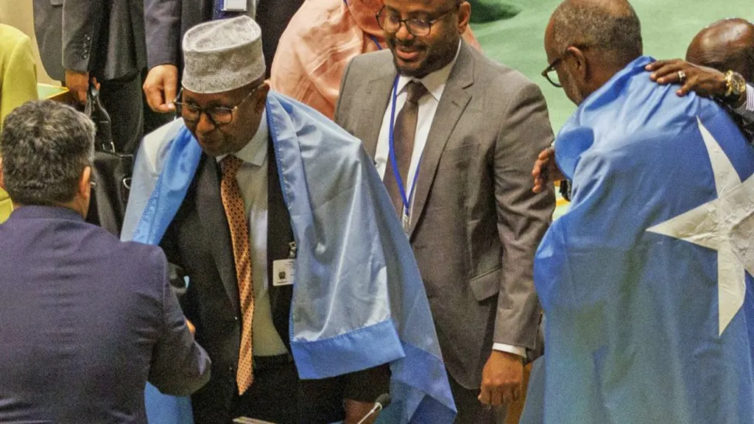
Somalia has won a non-permanent seat on the United Nations (UN) Security Council - hailed as a significant step for the worn-torn nation.
It will be the first time the country, which descended into civil war more than 30 years ago, has held the position since the 1970s.
The top table at the UN determines how the organisation should respond to conflicts around the world.
Analysts say Somalia’s battle to bring an end to its turmoil and its fight against Islamist militants will help inform the UN’s decisions.
There are 10 rotating non-permanent members on the council, along with the five permanent members - the US, the UK, France, China and Russia.
To win a seat, which carries much influence in world affairs, a country needs to secure the support of at least two thirds of the General Assembly delegations that are voting.
Somalia was elected along with Denmark, Greece, Pakistan and Panama to serve for two years from January next year.
It bagged the seat allocated to the East Africa region unopposed and went on to win 179 votes in a secret ballot in the 193-member General Assembly.
Following the vote, Somalia's Foreign Affairs Minister Ahmed Fiqi, who led a delegation of Somali officials to New York, said his country would now take up “its position on the global stage".
"We stand ready to play a vital role in promoting peace and security in the world," he said.
The ousting of Mohamed Siad Barre as Somalia’s president in 1991 sparked a decades-long civil war between rival clan warlords.
Over the years, the UN and African Union (AU) have played key roles in helping to re-establish a central authority.
Somalia has also been battling the Islamist militant group al-Shabab, which still controls large parts of the country.
The al-Qaeda-allied fighters want to topple the central government and establish their own rule based on a strict interpretation of Islamic law.
In recent months, the government has intensified its fight against the group as foreign troops withdraw and pass the baton on to the Somali army.
James Swan, the UN secretary general’s acting special representative for Somalia, said the country's experiences placed it in a unique position to contribute to the Security Council's deliberations on international peace and security.
“Somalia has come a long way over the past three decades on its path to peace, prosperity and security," Mr Swan said.
Security expert Samira Gaid told UK-based Warpod podcast that Somalia was "no longer the poster child for problems in the Horn of Africa".
The UN Security Council has significant responsibilities and can authorise peacekeeping operations and impose international sanctions.
Last December, it lifted a longstanding arms embargo on Somalia.
Non-permanent members of the council are allocated by region, but unlike the five permanent members, they do not have the power of veto.
The AU has been pushing for Africa to have two permanent representatives on the council and an additional two seats as non-permanent representatives.
Latest Stories
-
We must account for every cedi entrusted to us as public officials – Ato Forson
24 minutes -
Supreme Court rejects Solomon Asamoah’s bid to overturn Sky Train ruling
39 minutes -
Nungua Traditional Stool, WT Plastics partner to establish factory, create 1,400 jobs
41 minutes -
Mahama describes Ghana’s religious diversity as its greatest treasure, defends fairness to all faiths
46 minutes -
Police to arrest motorists who use pedestrian footbridges – ACP Obeng
47 minutes -
KNUST announces revised reopening dates, lectures begin October 19
1 hour -
GoldBod, military engineers partner to reclaim galamsey-damaged Tano Nimri Forest
1 hour -
NACOC educates 450 Koforidua SHS students on dangers of drug abuse
1 hour -
First-year students stranded as Obuasi SHTS remains closed over misconduct probe
1 hour -
Court halts promotion of 40 police officers pending IGP’s appeal
1 hour -
Gender Ministry deploys teams nationwide to monitor LEAP cash grant payments
1 hour -
GNFS contains Somoco warehouse fire; bushfire near TTU in Takoradi
1 hour -
Recurring teacher-student sexual abuse cases give cause for worry – Salaga South MP
1 hour -
D-Black shocked as only 16 radio and TV stations pay music royalties
1 hour -
Former SIC Savings and Loans MD Amma Frimpomaa Dwumah honours EOCO invitation
2 hours