

Audio By Carbonatix
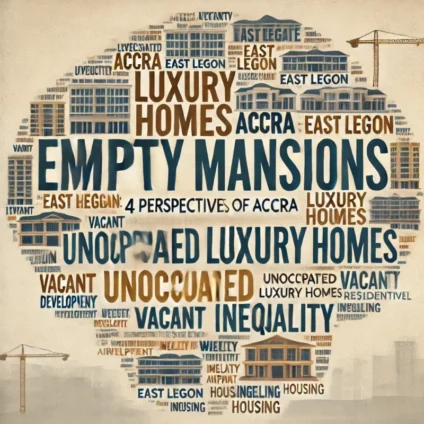
Accra’s affluent neighbourhoods, such as East Legon, Cantonments, Trasacco and Airport Residential, are known for their stunning homes and opulent lifestyles. But amidst the grandeur, an unusual trend has emerged: large, fully furnished houses sitting vacant for months or even years. These unoccupied mansions have become a talking point for many across the city. We gathered four voices, each with a different perspective on what these vacant homes represent.
The Real Estate Agent
For Kwame Mensah, a seasoned real estate agent with over 15 years in the industry, the sight of empty mansions is not a new phenomenon. According to him, the boom in Accra’s real estate market has led to an oversupply of luxury homes.
“Many of these properties are built by wealthy Ghanaians living abroad or foreign investors who want to tap into the growing demand for high-end homes in Accra. But the truth is, the demand isn’t growing as fast as the supply. The upper class in Ghana is not large enough to fill all these homes, and many expatriates prefer renting rather than buying.”
He points out that the value of land in these prime areas continues to rise, making it a good investment for those who can afford it. “They don’t mind leaving these houses unoccupied because the value appreciates over time. They see it as a long-term investment. To them, it’s better than putting the money in the bank.”
The Local Resident
Akua Nyarko, a resident of East Legon for over 20 years, finds the trend of unoccupied houses puzzling and, in some ways, unsettling.
“Every morning, I pass by these huge, beautiful homes that nobody lives in. Some of them have perfectly manicured gardens and state-of-the-art security systems, but not a soul inside. It’s strange. I remember when I moved here, these neighbourhoods were full of life. Now, it’s almost like a ghost town in certain areas.”
For Akua, it feels wasteful, especially considering the housing struggles faced by many in Accra. “There are people in this city who are living in overcrowded conditions, struggling to afford rent, and then you see these empty houses just sitting there, untouched. It makes you wonder if we’re getting our priorities right as a society.”
The Aspiring Homeowner – Daniel Owusu
For Daniel Owusu, a young professional with dreams of owning his own home in Accra, the sight of these unoccupied mansions is both inspiring and frustrating.
“When I see these empty houses, part of me is motivated. I want to be successful enough to own a home like that one day. But the other part of me feels like it’s unfair. These properties are out of reach for most people in Accra, and they’re just sitting there. It’s discouraging when you think about how hard it is for the average person to even get a mortgage or afford a modest home.”
Daniel believes that while the luxury market is booming, there needs to be more focus on affordable housing. “There’s a big gap in the real estate market. We need more middle-income and affordable housing options. These empty mansions don’t solve the housing problem most of us are facing.”
The Developer – Nana Agyeman
Nana Agyeman, a real estate developer who has worked on several high-end projects in Accra, has a more pragmatic view of the situation.
“Many people don’t understand that building these luxury homes is a long-term investment. It’s not about selling the house tomorrow; it’s about holding onto the property because the value will increase in a few years. Accra is growing, and the demand for prime real estate will only increase as the city expands. We’re building for the future.”
He also notes that these unoccupied houses often belong to investors who live abroad. “They come to Ghana once or twice a year, and they want a place to stay that reflects their lifestyle. When they’re not here, the house remains vacant. But to them, it’s like owning a holiday home in another country—except this is in their homeland.”
Nana admits that the vacant homes might seem like a problem to outsiders, but from an investment perspective, it’s a strategy. “It’s not always about having someone living there. Sometimes, it’s about securing your investment and waiting for the right buyer or renter to come along.”
Conclusion
The unoccupied mansions in Accra’s affluent areas paint a picture of the city’s evolving real estate landscape. For some, they symbolise wealth and investment opportunities, while for others, they represent inequality and a misalignment of priorities. Whether viewed through the lens of real estate, community impact, or personal aspirations, these empty houses tell a complex story of a growing city grappling with both prosperity and disparity.
Latest Stories
-
Ghana’s grid not the strongest – Jinapor admits as gov’t eyes critical power investments
5 minutes -
I support calls for Energy Minister to appear before Parliament – Sagnarigu MP
20 minutes -
Frequent power trips alarming; urgent measures needed to prevent nationwide blackouts – Ben Boakye
24 minutes -
Blackout: Akosombo control station works to be completed next month – Energy Minister insists
27 minutes -
ACEP warns frequent power trips expose weaknesses in Ghana’s transmission system
33 minutes -
Ageing transmission infrastructure needs urgent investment – Agyapa-Mercer
38 minutes -
Ghana must address root cause of 330kV line trips to avert blackouts – ACEP
49 minutes -
Global Mercy Hospital Ship arrives in Tema for 10-month Ghana field service
52 minutes -
Wontumi eligible to pick NPP nomination form, but vetting will determine his fate – Opare-Ansah
55 minutes -
Michael Tetteh Kwetey to contest NDC Greater Accra Regional Chairmanship
2 hours -
Mahama disappointed by US opposition to UN slavery resolution
3 hours -
Chamber of Mines commends government for breakthrough in Adamus Resources dispute
3 hours -
CMC launches 24-hour cocoa operations
3 hours -
Construction work on Winneba-Accra Highway poses challenges for commuters
3 hours -
Audit irregularities surged in 2024 as GACC flags weak financial controls
3 hours