

Audio By Carbonatix
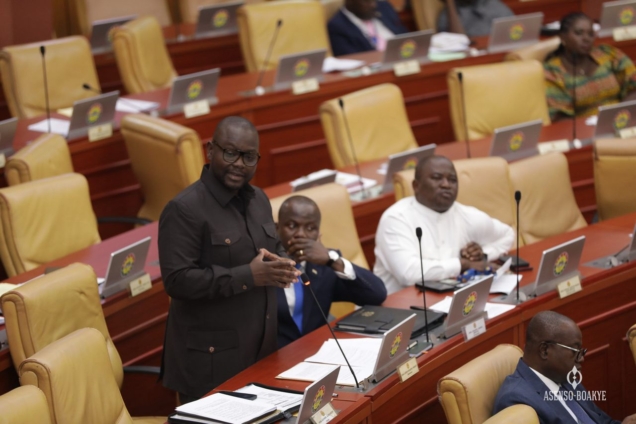
During a recent parliamentary session, Francis Asenso-Boakye, Member of Parliament for Bantama and former Minister of Roads and Highways, strongly criticised President John Dramani Mahama’s State of the Nation Address, particularly regarding the government’s stance on road infrastructure debt.
Highlighting contradictions in infrastructure investment
Asenso-Boakye pointed out what he perceived as a contradiction in President Mahama’s address. While the President acknowledged the importance of road infrastructure for national development, he simultaneously expressed concerns over the associated debt.
Mr Asenso-Boakye argued that such investments are crucial for economic growth, stating, “Debt, in itself, is not bad; it depends on how it is used.”
He referenced the U.S. interstate highway programme of the 1950s as an example, where every dollar invested reportedly generated six dollars in economic returns.
Defending the NPP’s infrastructure record
The former minister defended the New Patriotic Party’s (NPP) record on road infrastructure, highlighting that between 2017 and 2024, the Akufo-Addo-Bawumia administration undertook works covering 13,624.25 kilometres of roads.
This, he noted, was significantly higher than the 4,636 kilometres completed by the previous administration. He clarified that these figures included construction, rehabilitation, reconstruction, and upgrading projects.
Advancements in interchanges and bridges
Beyond road construction, Asenso-Boakye underscored the NPP administration’s efforts in improving interchanges and bridges to enhance connectivity and road safety.
He highlighted that the Akufo-Addo government had completed nine interchanges, with thirteen more under construction, compared to just five delivered under the Mills-Mahama administration.
Additionally, he noted that between 2017 and 2024, over 35 bridges were completed, with more than 50 others at various stages of construction across the country.
Addressing urban road conditions
In response to President Mahama’s concerns about the poor state of urban roads, Asenso-Boakye attributed the situation to rapid urbanisation and population growth.
He explained that as cities expand, new access roads are created, often starting in basic conditions before receiving further investment, reflecting the government’s efforts to accommodate growing urban populations.
Asenso-Boakye concluded by asserting that the road sector is now in a stronger position than before, reaffirming the NPP’s commitment to infrastructure development.
He stated, “Our record in the roads sector is unmatched and unprecedented. No other government in Ghana’s history has done more.”
The parliamentary debate continues to highlight differing perspectives on infrastructure investment and its role in national development.
Latest Stories
-
Carabao Cup fourth-round draw: Liverpool to host Chelsea as Arsenal drawn away to League Two Fleetwood
8 minutes -
Mbappe, Vini and Konate obscure Real’s Ceuta message
8 minutes -
Reggie Rockstone named Unichem Ghana brand ambassador
16 minutes -
Man United lose to Brighton from 2-0 up to end 50-year record
18 minutes -
Man United lose to Brighton from 2-0 up to end 50-year record
19 minutes -
Petrol and diesel price rises push UK inflation higher
29 minutes -
City of David Foundation donates to Koforidua Hospital, Koforidua Prison
31 minutes -
AMA says Konkomba traders were consulted ahead of Agbogbloshie 24-hour market project
1 hour -
Let’s pilot Chinese in public schools before scaling up – EduWatch
1 hour -
Ghanaian tech professionals develop SMS-based AI tool for non-smartphones
2 hours -
MTN@30: Three customers drive away brand-new Land Cruiser Prado in Kumasi
2 hours -
If BOST made GH¢684m profit, why use NPA Bill 2026 to weaken it? – IERPP questions Gov’t
2 hours -
NPP alleges executive, administrative confusion over Arabic, Chinese language policy
2 hours -
Minority accuses AMA of targeting Konkomba Yam Market in planned demolition over 24-hour market
2 hours -
Ghana struggles to raise local funds for delayed cocoa season as investors demand higher returns
3 hours