

Audio By Carbonatix
A post-election survey by the Ghana Institute of Management and Public Administration (GIMPA), in collaboration with the Konrad Adenauer Stiftung (KAS), has revealed that 81.6% of voters blame the New Patriotic Party’s (NPP) defeat in the 2024 general elections on economic mismanagement, with 47.3% specifically pointing to the high cost of living as the leading cause.
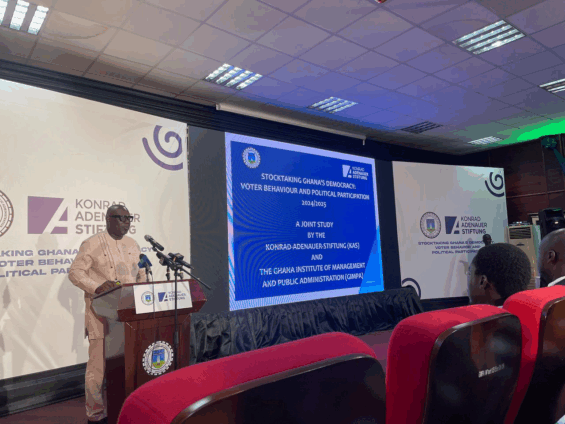
The findings were presented by Dr Joseph A. Darmoe, Director of Programmes at KAS and a Senior Lecturer at GIMPA, during the launch of the report titled “Stocktaking Ghana’s Democracy: Voter Behaviour and Political Participation”, held at GIMPA in Accra on 3 June 2025.
The nationwide survey, conducted between 8 and 20 May 2025, sampled 16,988 registered voters across all 276 constituencies using a multi-stage probability sampling method. The study was conducted through computer-assisted personal interviews (CAPI) and recorded a 99% confidence level with a 1% margin of error.
Key Findings:
Among respondents who blamed the NPP’s defeat on economic mismanagement, 47.3% identified the high cost of living as the dominant concern.
8.7% cited corruption as a key factor in their decision to vote out the party.
Other issues mentioned included the E-levy, arrogant or disrespectful conduct by party representatives, and the betting tax.
Concerns over LGBTQ+ matters were considered, but only by a small fraction.
The data also reveal that 73.5% of voters based their decision on party programmes and manifestos, rather than personal loyalty or ethnic affiliations.
When it came to reasons for choosing a presidential candidate:
46.2% voted based on personal admiration for the candidate.
16.7% were influenced by tribal or ethnic loyalty.
13.8% said their vote was intended to punish the NPP government.
11.6% admitted to voting in exchange for financial inducement.
Additionally, the survey showed that 90.5% of voters live and vote in the same constituency, suggesting that local conditions strongly shape electoral decisions.
The findings point to a maturing electorate increasingly driven by economic realities and policy impact rather than traditional political affiliations.
Latest Stories
-
Black Princesses Coach Charles Sampson confident ahead of World Cup opener against Ecuador
1 hour -
TV presenter among 12 sentenced to death in Egypt drugs case
1 hour -
Accra Airport VIP Lounge project to be completed this year without taxpayer funds – Ablakwa
2 hours -
NPP clears all 47 aspirants for 2026 national officers’ election
2 hours -
Domelevo backs OSP probe into GH¢70k allegation
3 hours -
CAF Confederation Cup: Dennis Korsah confident Nations FC can overturn Mali defeat
3 hours -
Chief Justice should stop commenting on some political issues – Domelevo
4 hours -
‘I don’t trust OSP’ to probe GH¢70k ‘bribe’ allegation – Kwasi Kwarteng
4 hours -
Road inspections not to witch-hunt contractors – Kwame Agbodza
4 hours -
Inter Milan mount stunning comeback to beat Napoli
4 hours -
Modric plans to play for Croatia past 41st birthday
5 hours -
Bayern fail to score for first time in 59 games
5 hours -
Bawumia preparing new cocoa policy package for farmers – Annoh-Dompreh
5 hours -
Wa-Tumu-Bolga road upgrade will unlock agriculture, trade – Agbodza
5 hours -
Ghana Maritime Authority readies oil-spill response vessel for deployment
5 hours