

Audio By Carbonatix
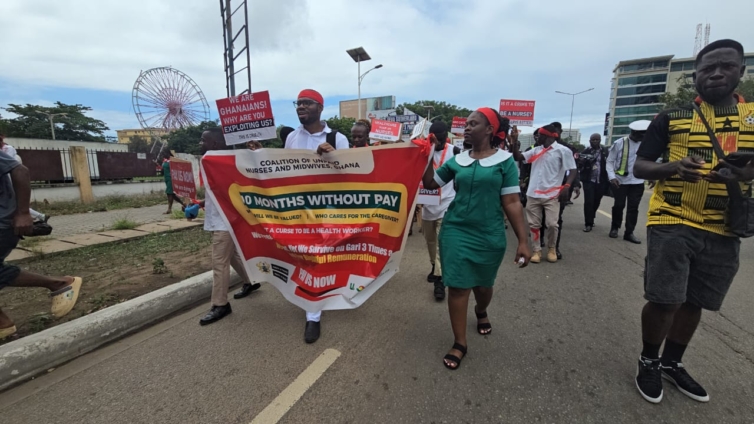
The Coalition of Unpaid Nurses and Midwives on Thursday, October 2, staged a protest in Accra to demand the payment of salaries for nearly 7,000 health workers who have been working without pay for close to 10 months.
The demonstration started at the Efua Sutherland Children’s Park before the protesters marched through the capital and later gathered at the Ministry of Finance and the Ministry of Health, where petitions were presented.
Background of the Protest
The group explained that they received official postings in December 2024 after financial clearance was granted.
While about 6,500 of their colleagues were paid in April 2025, thousands remain without salaries despite repeated appeals.
Convener of the coalition, Stephen Kwadwo Takyiah, said the continuous delay was unacceptable and demoralising.
“While some 6,500 colleagues have been paid since April 2025, the delay in settling the arrears of the rest is crippling the delivery of quality healthcare across the country,” he said.
Human Cost of Delayed Salaries
Mr. Takyiah recounted heartbreaking stories of how the unpaid salaries have taken a toll on the lives of health workers.
“One of my colleagues just underwent surgery, and we are still struggling to pay her hospital bills. Another is an asthmatic patient who spends about GH¢300 every month on inhalers, buying them three times a month. Our people are suffering and some are dying, yet we have worked honestly,” he lamented.
He further drew attention to the broader implications for Ghana’s health sector, warning that delays in payment are not only unjust but also dangerous to national healthcare delivery.
Citing the words of President John Dramani Mahama at the recent UN General Assembly, Mr. Takyiah made a powerful comparison.
“The President said slave trade is the biggest crime against humanity. Today, I stand here to say this is modern-day slave trade. To deny citizens and health workers their salaries is the greatest crime any leader can commit. We are pleading with the government to act urgently—if not, we are dying, and our healthcare system is collapsing,” he declared.
Voices from the Protesters
Some demonstrators also shared their personal experiences, painting a vivid picture of the hardship they endure.
“It has been extremely difficult. My rent is due this December, and I have no means to pay. I have been borrowing from friends and family since January, but now they ignore my calls because they are tired of me,” one nurse said.
Another nurse described his daily struggle for survival.
“Most days I wait until 2 p.m. just to eat "gob3" and then drink water till the next day. Sometimes I eat only once, and on some days not at all,” he revealed.
Broader Challenge
The protest highlights a recurring problem in Ghana’s public sector, where newly recruited workers—particularly in health and education—often face long delays in receiving their first salaries.
For the nurses and midwives, Thursday’s demonstration was not just about salary arrears but also about dignity, survival, and the stability of Ghana’s healthcare system.
By taking to the streets, they are sending a direct appeal to the government and the public, insisting that health professionals—who play a critical role in saving lives—must be treated with fairness and paid promptly.
Latest Stories
-
Sentuo offers fuel supply reassurance as NPA sees steady output through December
26 minutes -
Ghanaian smock showcased at Lesotho Tourism Summit
52 minutes -
Four pupils to one desk: The painful plight of schools in New Juaben North
1 hour -
Ipswich launch investigation into racist abuse of Abdul Fatawu
1 hour -
Arrest of Techiman nurse is purely political persecution – ‘Ghana Jollof’
2 hours -
Isak nets winner as Liverpool edge Bournemouth
2 hours -
I dare gov’t of Ghana to extradite me; they can never do it – ‘Ghana Jollof’ speaks
2 hours -
Semenyo scores twice as Manchester City beat Sunderland 5-3 in eight-goal thriller
2 hours -
Parliament calls for government-private sector collaboration to improve waste management
3 hours -
Volta Region described as cleanest so far in Parliament’s nationwide sanitation monitoring
3 hours -
Parliament urges MMDAs to enforce sanitation bylaws to curb indiscriminate waste disposal
3 hours -
Mohammed Kudus drops out of Ghana squad for AFCON 2027 qualifiers against Côte d’Ivoire and Gambia
3 hours -
Africa World Airlines unveils first Embraer E190 as part of 10-aircraft fleet expansion
4 hours -
Civilian hospitalised after alleged machete attack by prison officers, inmates
5 hours -
Toobu rejects calls to recall Parliament over 3.9-tonne cocaine shipment
5 hours