

Audio By Carbonatix
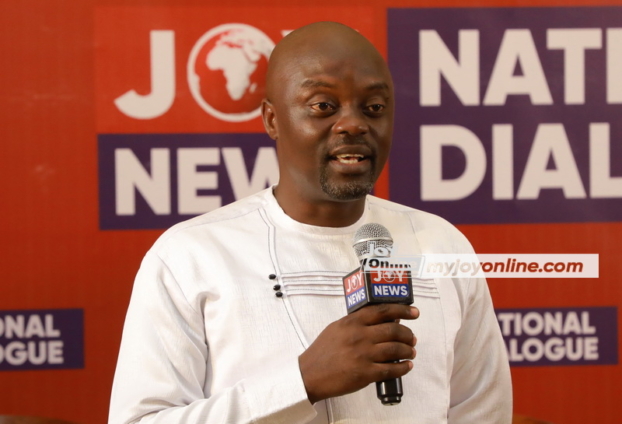
JoyNews investigative journalist Erastus Asare Donkor has questioned the government’s commitment to ending illegal mining, locally known as galamsey, arguing that the fight cannot succeed as long as excavators used in galamsey operations continue to “disappear and reappear like ghosts.”
Delivering the keynote address at the Kronti ne Akwamu Lecture on Thursday, November 27, under the theme “Galamsey: A Country’s Search for a Solution in Plain Sight,” Mr Donkor criticised the weak enforcement system that allows heavy equipment to be moved in and out of mining zones without accountability.
He stressed the urgent need for the Minerals Commission to operationalise the long-delayed excavator tracking system, insisting that every excavator in the country must be registered and monitored in real time.
According to him, any unregistered machine found within a mining area should be seized without hesitation.
“This is not a suggestion. It is common sense,” he said, adding that no government can claim to be serious about fighting galamsey while refusing to adopt basic tracking measures.
Mr Donkor also called for water bodies and major biodiversity zones to be declared national security areas where mining is strictly prohibited.
However, he warned that such measures would require robust enforcement, something he said is currently lacking.
He pointed out that the National Anti-Illegal Mining Taskforce (NAIMOS) remains under-resourced, without a dedicated budget, adequate logistics, or political protection.
These gaps, he argued, undermine the taskforce’s ability to safeguard rivers and forest reserves.
“How do we expect them to protect rivers when we don’t protect them?” Mr Donkor asked, calling for stronger collaboration with local police and the decentralisation of NAIMOS to enforce security zones effectively.
To ensure transparency and accountability, he recommended that NAIMOS establish internal watchdog structures to prevent corruption and institutional weakness.
Mr Donkor further proposed the creation of a credible intelligence network made up of journalists, community leaders, forestry officers, and civic groups who can report directly to the President with unfiltered information from the ground.
He also urged major reforms within the Forestry Commission, which he accused of enabling the plunder of forest reserves under the guise of reclamation.
To fix this, he suggested upgrading the Commission to a paramilitary-level institution capable of enforcing demarcations and protecting Ghana’s forest frontiers.
Latest Stories
-
MamaCare CEO warns unresolved conflicts among health workers could undermine maternal and neonatal care
20 minutes -
Health professionals urged to translate medical knowledge into practice to save mothers
27 minutes -
Conflicts among care providers linked to maternal, neonatal deaths – Expert
2 hours -
GIS marks 10th TIME conference, champions improved teaching practices
2 hours -
BRICS Or Balance? What Ghana’s bid really means
3 hours -
GPRTU wants full TRAFFITECH-GH implementation to start in 2027
3 hours -
Mahama announces plans to import electric wheelchairs for PWDs
3 hours -
KGL U17 Colts 2026: Western beat Prempeh Elite Academy to set up final final with Greater Accra Region
3 hours -
Late Solanke strike salvages 10-man Spurs draw at Man United
3 hours -
Gender Ministry to monitor welfare of Nana Akua Addo’s children amid domestic violence case
4 hours -
Benedict Okyere Yeboah: Ghana’s football problem goes beyond sacking a coach
4 hours -
GPL 2026/27: Darkwah Wiafe’s winner sees All Blacks beat Kotoko
4 hours -
ITF World Tour : Patel Wins Boys’ Singles Final at J100 Accra
4 hours -
Ghana must pursue BRICS partnership if it brings economic benefits – Kpebu
4 hours -
Success and Wright Claims J100 Accra Girls’ Doubles Championship
4 hours