

Audio By Carbonatix
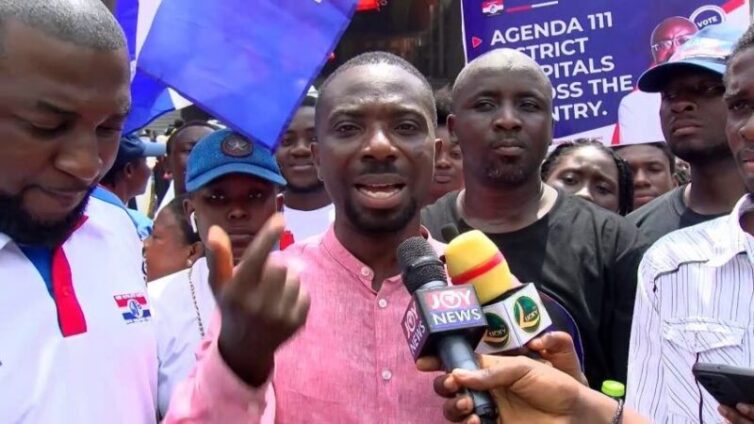
Director of Communications for the Bawumia Campaign, Dennis Miracles Aboagye, has argued that the cost of living for Ghanaians has deteriorated after one year of the National Democratic Congress (NDC) administration, describing the current economic situation as a reversal rather than the promised reset.
Speaking at the People’s Forum, organised to assess the government’s first year in office, Mr Aboagye said that despite improvements in headline indicators such as lower inflation and a stronger cedi, the everyday experiences of households tell a different story.
He maintained that living expenses continue to rise faster than incomes, leaving many families under increasing financial pressure.
According to him, prices of essential goods and services have gone up across the country, deepening the strain on workers and low-income households.
“If this is a reset, then we are in trouble,” he said.
“What we are seeing from the People’s Forum is not a reset but a reverse, and the people are clearly upset.”
Mr Aboagye stressed that there is a clear gap between the economic progress being highlighted by government and the realities faced by ordinary Ghanaians.
He noted that while inflation and the exchange rate have improved on paper, these gains have not translated into meaningful relief at the household level.
“They are upset because inflation and the dollar are dropping, yet the cost of living keeps rising,” he said. “There is a disconnect between the policies the government is touting and the evidence we experience.”
He cited rising utility tariffs and education-related costs as key examples of this disconnect, arguing that modest salary increases are being wiped out by higher expenses.
“If I am a teacher coming from Dodowa and you give me a nine per cent increase, but I am now spending more on electricity, water, school fees and hostel fees, then it becomes a problem,” he stated.
Mr Aboagye also questioned the practical relevance of falling inflation figures in the face of steep utility price hikes.
“When electricity tariffs go up by 28 per cent, it makes nonsense of inflation coming down from 23 per cent to 15 per cent,” he said, urging government to pay closer attention to feedback from market women, drivers and other ordinary citizens.
“The indicators may be true, but they are not reflecting in our lives,” he added.
Latest Stories
-
Guinness Ghana DJ Awards 2026 Pub Fest celebrates Ghana’s DJ culture as Accra turns up the energy
3 minutes -
10th woman found dead in South Africa’s string of killings
4 minutes -
French Embassy trains Ghana Police CTU in counter-terrorism operations
35 minutes -
UPSA uncovers mass results manipulation involving 178 students, over 500 results compromised
1 hour -
ECG announces planned power outages in parts of Tema from Sept. 29 to October 1
1 hour -
Sylvester Mensah urges Latenu FM to promote trade, export opportunities in Ga
2 hours -
Ga language under threat of decline as children shy away from speaking it – Sylvester Mensah
2 hours -
‘Let every Ga child you raise know the Ga language and story’ – Sylvester Mensah
2 hours -
‘We are not deterred’ – Ablakwa responds to backlash over South Africa evacuation
2 hours -
NCA announces major voice and data disruption across Northern Ghana due to fibre cuts
3 hours -
Photos: Housing solutions take centre stage at Day 2 of the 3rd Republic Bank-JoyNews Habitat Fair
3 hours -
Ghana Air Force passes out 293 recruits after six months of intensive training
4 hours -
EOCO vrs Baffour Awuah: EOCO should have secured warrant before arrest attempt at court – Inusah Fuseini
4 hours -
Triple fibre cuts disrupt telecom services across Northern, Oti regions – Sam George
4 hours -
Politicisation could undermine parliamentary probe into cocaine seizures – Dr Osae-Kwapong
4 hours