

Audio By Carbonatix
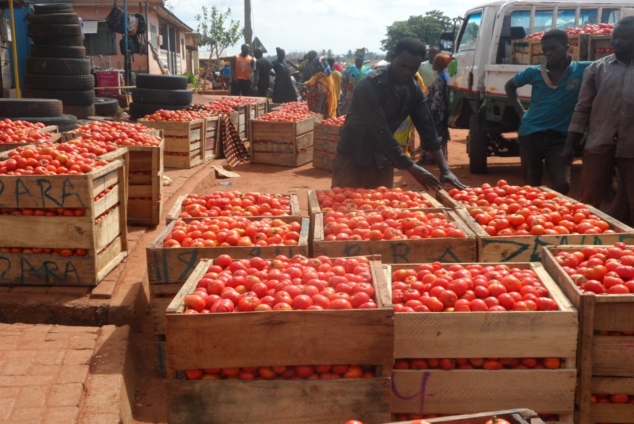
The Deputy Minister for Food and Agriculture, John Dumelo, has urged Ghanaian farmers to intensify dry-season farming to help stabilise food supplies and boost local production.
His comments come amid a decision by Burkina Faso to suspend all fresh tomato exports across its territory, as the military-led government seeks to protect domestic processing units from supply shortages.
The ban, announced in a joint communiqué dated 16 March 2026, was signed by Serge Gnaniodem Poda, Minister of Industry, Commerce and Artisanat, and Ismaël Sombié, Minister of State for Agriculture, Water, Animal and Fisheries Resources.
Speaking on Midday News on March 19 on JoyNews, Mr Dumelo disclosed that the restriction is intended to protect Burkina Faso’s local tomato processing industry, a development that could have significant implications for Ghana’s food supply.
He noted that the ministry is still seeking clarity on the policy and its full impact.
“We need to further interrogate. I read a memo yesterday, and it is something that I need to find out whether it is true and why they banned it, and then after that, seek further clarification on the way forward,” he said.
Mr Dumelo explained that the situation emphasised the urgent need for Ghana to boost domestic production, particularly through dry-season farming.
He recounted his recent visits to farming communities in the Upper East Region, including Garu and Talensi, where he had earlier encouraged farmers to take up tomato cultivation during the dry season.
According to him, many farmers had heeded the advice and were already harvesting tomatoes.
“Most of them had gone into tomato production, and some of them were doing quite well,” he said.
The Deputy Minister added that farmers had expressed strong interest in expanding their operations and called for government support to scale up production ahead of the next dry season.
“I encouraged them to let me know the support they need to scale up, adding that the government is committed to helping them increase production,” he stated.
While acknowledging that Ghana’s reliance on imports will not end immediately, Mr Dumelo expressed confidence that sustained investment in local agriculture could transform the sector.
“If farmers are properly supported and encouraged, within three to four years we should be self-sufficient when it comes to tomato production,” he said.
Latest Stories
-
Ghana needs a law to sustain constitutional reforms – CDD-Ghana
1 hour -
COVID fumigation audit: Auditor-General has a lot of questions to answer – Akwatia MP
1 hour -
Stranded Ghanaian medical graduates in Cuba appeal to Mahama for immediate return
1 hour -
GNFS contains fire outbreak at Teshie Lekma Road near Lekma Hospital
8 hours -
Samia Nkrumah rejects the narrative that Ghanaians were happy after Nkrumah’s overthrow
9 hours -
A Mother’s pain: Tribute by Ivan Baidoo’s mother
9 hours -
‘Forgive us for staying away’ — Samia Nkrumah leads family back to Nkroful, pledges to preserve Nkrumah’s legacy
9 hours -
Ernest Nuamah scores twice as Lyon beat Rennes
9 hours -
‘My dear Ivan’ – A father’s tribute to a son tragically killed
9 hours -
GNPC Explorco advances Voltaian Basin drilling preparations with 13.5km access road
9 hours -
Cabinet approves facility manager for Borteyman Sports Complex – Kofi Adams
10 hours -
Sanitation is improving; critics may be ‘living in another world’ – Salaga South MP replies Bekwai MP
10 hours -
Government must do more to tackle sanitation crisis – Bekwai MP
10 hours -
World Cleanup Day: GFF begins sanitation education in local communities
11 hours -
EU Ambassador, IGP discuss stronger cooperation on policing and security
11 hours