

Audio By Carbonatix
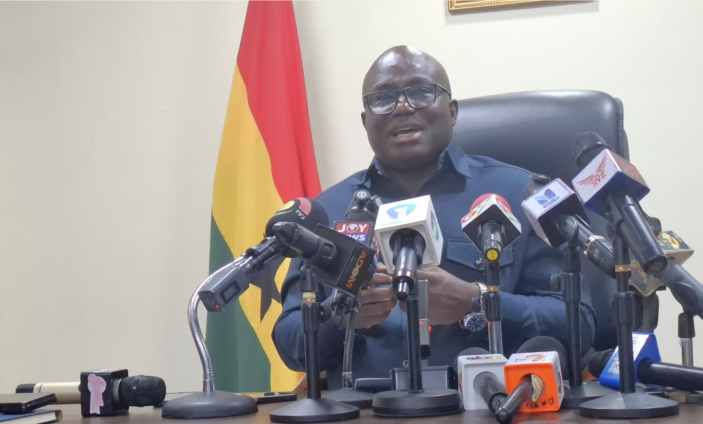
Minister of Food and Agriculture, Eric Opoku, on Wednesday assured the public that Ghana will not face a tomato shortage despite an export ban by Burkina Faso.
He said the Government was rolling out measures to boost yields, cut post-harvest losses and expand irrigation-backed production to stabilise supply.
Addressing a press conference in Accra, Mr Opoku said the immediate response centred on developing high-yielding seed varieties, scaling up irrigation schemes and linking farmers directly to ready markets to reduce waste.
He said collaboration with the West Africa Centre for Crop Improvement would deliver improved tomato seeds capable of raising yields to at least 15 metric tonnes per hectare within months.
In addition, he said government was expanding irrigation under the Vegetable Development Project, including cluster farming in Ahafo and Fanteakwa, drilling 250 boreholes across the northern regions, and securing hundreds of hectares under existing irrigation systems for immediate tomato cultivation.
“We have been importing tomatoes from Burkina Faso to supplement local production… a clear indication that if we don’t put in place the right mechanisms to increase production, we are likely to run into challenges,” Mr Opoku noted.
Ghana’s annual tomato demand stands at about 805,000 metric tonnes, while current production is estimated at 510,000 metric tonnes, leaving a deficit of nearly 300,000 metric tonnes.
The Minister said about 30 per cent of local production- approximately 153,000 metric tonnes – was lost post-harvest.
Reducing the losses could significantly close the supply gap, he said, adding that: “It is not about increasing the size of the land under cultivation. It is about developing the right variety and creating the conditions to maximise output.”
Under the Vegetable Development Project, Mr Opoku said farmers were being supported with improved seeds, fertilisers and technical guidance, alongside irrigation infrastructure to ensure year-round production.
He noted that 60 hectares each had been developed in Ahafo and Fanteakwa with mechanisation and water supply systems, while additional sites were being prepared for expansion.
A rehabilitated irrigation scheme had made 500 hectares available for immediate tomato production after agreements were reached to connect farmers with buyers to guarantee off-take, he added.
One hundred hectares had also been secured at Akumadan to further scale up production.
The Minister said ongoing interventions to improve productivity, reduce waste and strengthen market systems would stabilise supply and enhance food security in the long term.
Latest Stories
-
Twelve Tribes of Israel Ghana to mark 40 years with anniversary celebration
4 minutes -
GPL 2026/27: Hearts held by Bechem as Kotoko, Samartex share spoils
24 minutes -
My Story (Kwaku Antwi-Boasiako)
30 minutes -
We expect growth rate to re-accelerate in second-half of 2026 – IC Insights
33 minutes -
The ungodliness and unrighteousness underlying the National Cathedral mess!
45 minutes -
T-bills auction: Government fails to achieve target; yield on 91-day-bill remains unchanged
56 minutes -
It’s Ghana’s shame to denigrate Nkrumah when the whole world honours him as African of the Century – Asiedu Nketiah
1 hour -
No other nationalist can compare to Nkrumah – Asiedu Nketiah
1 hour -
Collateral Registry: Foreign banks accounted for GH¢19.9bn of secured credit in quarter 2, 2026
1 hour -
This government should expect scrutiny – Asiedu Nketiah
2 hours -
Two-year-old girl dies in domestic fire at Cantonments
2 hours -
Asiedu Nketiah urges better working conditions for journalists
3 hours -
JoyNews’ Precious Semevoh wins climate change reporting award at Bono GJA Awards
3 hours -
Kumasi Central Market phase 2 to begin in October after years of abandonment
3 hours -
Sentuo offers fuel supply reassurance as NPA sees steady output through December
4 hours