

Audio By Carbonatix
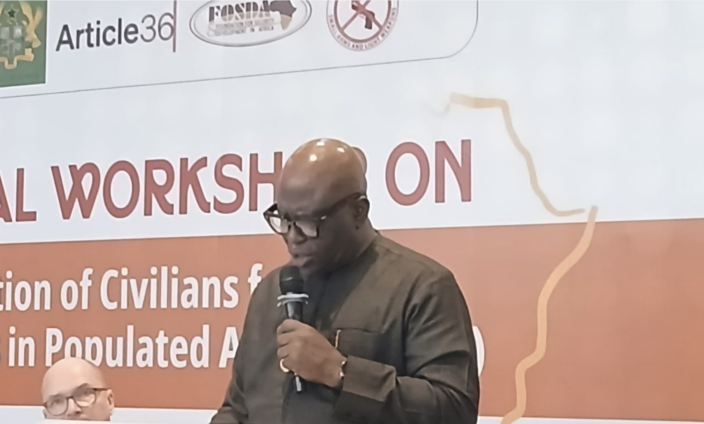
A two-day Africa regional workshop on Strengthening the Protection of Civilians from the Use of Explosive Weapons in Populated Areas (EWIPA) has opened in Accra.
The workshop, co-hosted by Ghana and Austria in collaboration with Article 36 and the Foundation for Security and Development in Africa, seeks to deepen regional cooperation and promote implementation of the EWIPA Political Declaration adopted in 2022.
Mr Jurgen Heissel, Austrian Ambassador to Ghana, speaking at the opening ceremony, said the use of explosive weapons in populated areas continue to have devastating humanitarian consequences, with civilians accounting for most victims.
“On average, 90 per cent of victims of explosive weapons in populated areas are civilians, often half of them children,” he said.
Mr Heissel explained that the declaration, though not legally binding, reinforced international humanitarian law and provided practical measures for protecting civilians, including improved data collection, strengthened military policies and enhanced humanitarian access.
He noted that partnerships between governments, the United Nations, the International Committee of the Red Cross and civil society had been critical in advancing disarmament efforts globally.
Mr Ebenezer Okletey Terlabi, Deputy Minister of the Interior, said Ghana was committed to advancing civilian protection both domestically and internationally, and had initiated steps towards endorsing the declaration.
“The declaration is not just a foreign policy consideration but speaks directly to our domestic governance priorities,” he said.
Mr. Terlabi said that Ghana’s ongoing review of its National Arms Bill and related frameworks demonstrated its commitment to strengthening civilian protection mechanisms.
“Explosive harm is a matter of real lives, real families and real communities who demand concrete actions, coordinated governance and unwavering resolve,” he said.
Dr Adam Bona, Executive Secretary of the National Commission on Small Arms and Light Weapons, underscored Africa’s role in shaping global humanitarian norms.
“We gather to generate political momentum and practical commitments that will translate the declaration from aspiration into a living instrument of civilian protection,” he said.
Madam Laura Boillot, Director of Article 36, highlighted the predictable and preventable nature of civilian harm caused by explosive weapons in urban settings.
“When explosive weapons are used in towns and cities, the harm to civilians is not accidental. It is predictable and it is preventable,” she said.
The workshop, attended by government officials, security experts, civil society actors and international organisations, is expected to deliberate on adapting military operations to minimise civilian harm, improving casualty data collection, strengthening humanitarian access and enhancing support for affected communities.
It also aims to promote African leadership and a unified regional approach to advancing civilian protection in armed conflict.
Latest Stories
-
Mr John Blankson Adu Otu
30 minutes -
Prof. D. K. Yeboah-Amankwah
34 minutes -
AFCON 2027Q: Queiroz ‘proud’ of Black Stars performance despite defeat to Cote d’Ivoire
49 minutes -
Your next home could be here: 3rd JoyNews Republic Bank Habitat Clinic opens at Junction Mall today
52 minutes -
GCAA assures safety won’t be sacrificed to attract more airlines
56 minutes -
AFCON 2027Q: Queiroz furious with ‘joke’ penalty awarded Cote d’Ivoire in Black Stars defeat
1 hour -
GCAA backs more domestic airlines to drive down airfares
1 hour -
SHC launches nationwide audit, gives occupants 21 days to regularise property interests
1 hour -
Manhyia South MP describes EOCO arrest attempt as ‘provocation’
1 hour -
Appiagyei appeals to Lordina Mahama, Jane Naana over detention of Ghana Jollof accused
2 hours -
New regional hospitals will bring specialist care closer to Oti, Savannah and Western North – Health Ministry
2 hours -
Gender Minister delivers Mahama’s address at launch of State of Africa’s Children Report
2 hours -
Lambussie NCCE engages stakeholders on rule of law, anti-corruption fight
2 hours -
Lands Minister cuts sod for Phase Three of Appiatse Redevelopment Project
2 hours -
GNFS swift response saves three bedrooms from fire at Amasaman
2 hours