

Audio By Carbonatix
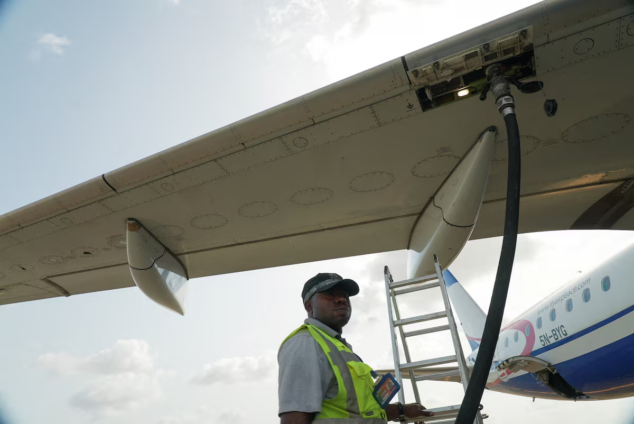
Airlines grappling with soaring jet fuel prices are facing a second blow as supply shortages disrupt flight schedules and crew rotations, industry groups and airlines said, heightening safety and operational concerns across Nigeria’s aviation sector.
The National Association of Aircraft Pilots and Engineers (NAAPE) said persistent scarcity of jet fuel has triggered widespread operational challenges, including flight delays, route adjustments, and extended crew duty periods, as airlines struggle to manage schedules amid rising costs.
NAAPE President Captain Bunmi Gindeh said ongoing fuel shortages were pushing crews beyond planned limits, increasing fatigue and potentially eroding safety margins in an industry governed by strict rest regulations.
Local carrier Rano Air said this week that jet fuel prices, which it said had more than quadrupled, had made some routes commercially unsustainable, forcing operational adjustments.
Other carriers have also begun rescheduling or cancelling flights and cutting unprofitable routes, industry sources said.
This comes at a difficult time for Nigeria’s aviation sector, already strained by foreign-exchange volatility, high aircraft maintenance costs, airport infrastructure strains and fuel price swings, after airlines last month threatened to suspend operations over what they described as crippling and artificially inflated jet fuel prices.
Nigeria’s airline industry carries millions of passengers annually across an extensive domestic network and plays a critical role in connecting cities where road travel is often slow or insecure, making reliable air services economically and socially important.
The Nigerian Midstream and Downstream Petroleum Regulatory Authority said fuel prices would not be capped (nL6N41B0N4), adding that any decisions on deregulated products would be formally communicated.
Fuel is one of the airlines' biggest cost components. While local refining capacity is expanding, with Dangote supplying most of the volumes, operators say prices remain prohibitive.
Analysts warn that prolonged disruption could strain crew scheduling, aircraft turnaround, and maintenance planning, with knock-on risks for safety oversight.
Latest Stories
-
WAEC cancels 2026 results of 8,295 candidates over examination irregularities
20 minutes -
WAEC releases provisional 2026 WASSCE results for 512,862 candidates
33 minutes -
CJ’s remarks on SOEs were made in good faith, not to undermine judicial independence – Judicial Service
4 hours -
Bright Future Alliance pays courtesy call on Akufo-Addo, invites him to African Leaders of Influence Lectureship Series
4 hours -
This is an attempt to break the Minority caucus – Patricia Appiagyei on alleged GH¢70k payment
4 hours -
‘OSP hasn’t contacted me’ – Patricia Appiagyei assures cooperation if invited
5 hours -
I find it strange that this memo was purportedly written by me – Patricia Appiagyei
5 hours -
Ayariga calls for stronger church partnership to tackle sanitation, environmental challenges
5 hours -
I don’t think we have an industry – Patchbay Band manager
5 hours -
Patchbay Band questions recognition of live bands in Ghana’s music industry
5 hours -
Newsfile to discuss SOEs’ GH¢19.8bn profit, dissolution of 9 boards, CJ’s visits to SOEs, GH¢70k gift rejection
6 hours -
BoG warns against spraying, defacing and using cedi notes for decorations
6 hours -
Adwumawura: Selected applicants to receive notifications from today – NEIP CEO
6 hours -
‘Fake memo’ fabricated to smear me – Patricia Appiagyei
6 hours -
ATLF2026: Culture, investment and tourism take centre stage as Africa’s tourism leaders gather in Polokwane
6 hours