

Audio By Carbonatix
Misinformation and disinformation are closely related because both involve false information, but they differ in intent. Misinformation refers to the circulation of false content without the knowledge that it is false, whereas disinformation is false content deliberately created to deceive people.
However, the purpose of this article is not merely to explain the difference between misinformation and disinformation. Rather, it is to highlight how misinformation is plaguing the Ghanaian media landscape, the dangerous consequences it poses, and how it can be addressed or at least significantly reduced.
On June 21, 2025, the Media and Information Literacy Club – UG Chapter was launched on the University of Ghana campus. I was privileged to be among the founding members of the club and also had the honour of serving as MC for the launch.
One particular insight from one of the invited experts completely changed my perspective on how I consume information today. Unfortunately, I cannot recall his name to give him the proper attribution he deserves. He said:
“As media and information literates, you should not take things lightly. You have to conduct thorough verification before accepting information. For example, the TV3 logo is red, yellow, and green, with black writing on the right. If you only see the red, yellow, and green without the black TV3 inscription, then it is not the TV3 logo. Similarity does not make it authentic, and we have to be careful about such things.”
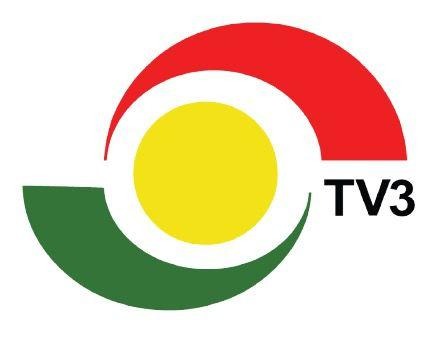
Original version of the TV3 logo
What a powerful insight that was. Since then, whenever I come across a logo or image online, I consciously compare it with the original before accepting it as genuine. It may sound funny, but it is extremely important. I realised that disinformation actors often exploit the smallest details people overlook, and the only way to outsmart them is through critical attention to detail.
The Christina Koch misinformation saga
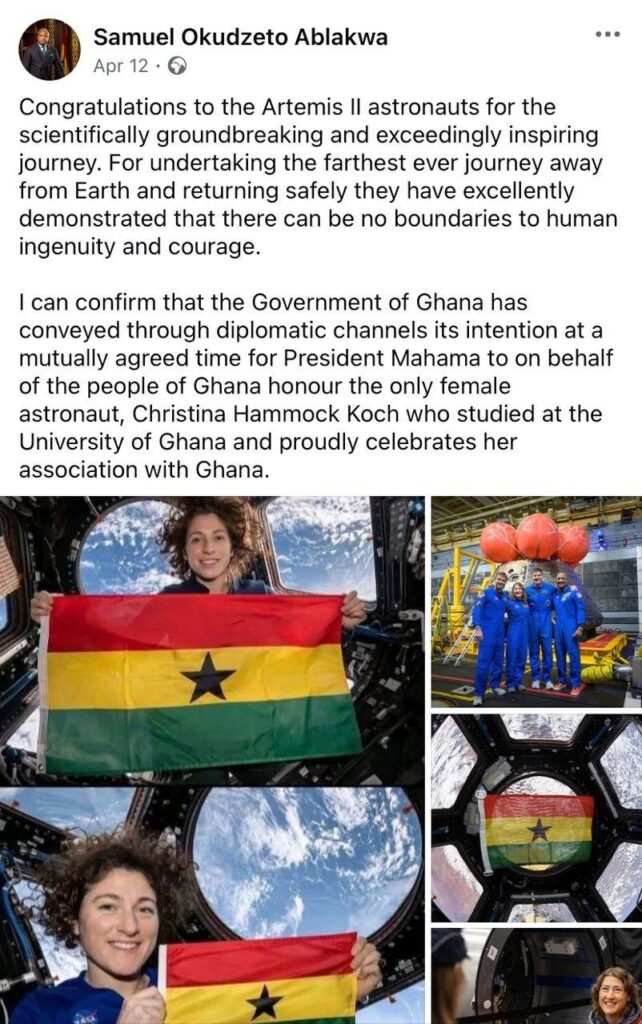
Around April 2026, several social media accounts, including some prominent Ghanaian media houses, circulated claims accompanied by an image that NASA astronaut Christina Koch had taken Ghana’s flag to the Moon on the Artemis II mission.
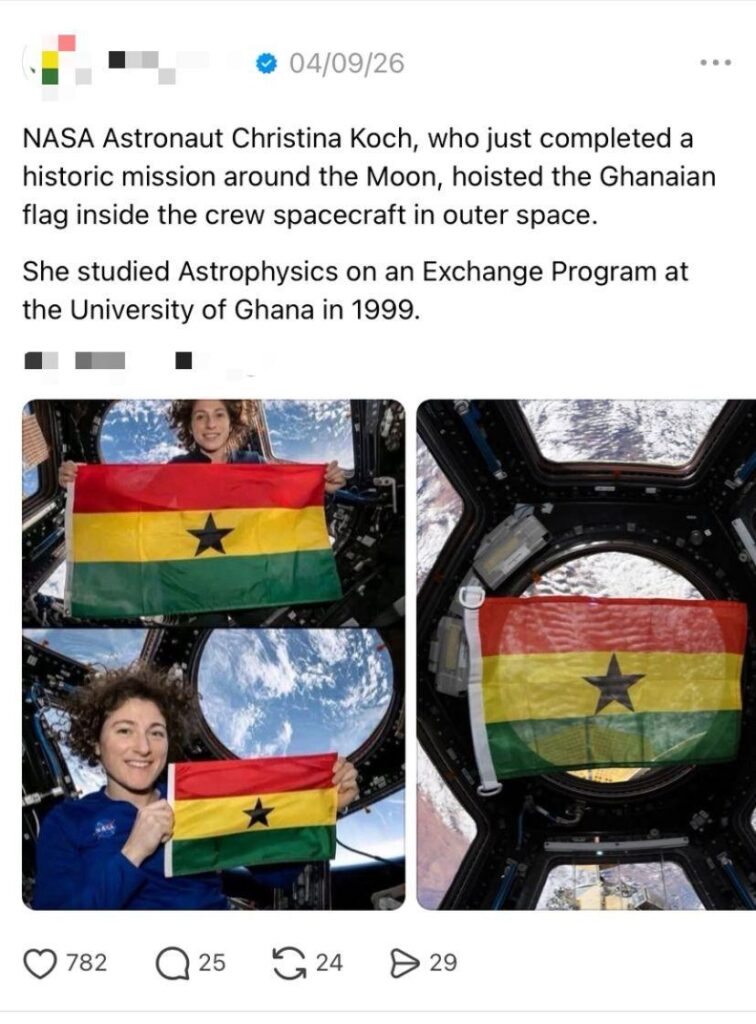
In reality, the image being linked to the Artemis II mission had originally been shared by Christina Koch on December 12, 2019, while she was aboard the International Space Station during her record-breaking “longest single spaceflight by a woman.” In that post, she reflected on her time in Ghana as an exchange student and how the experience shaped her worldview.
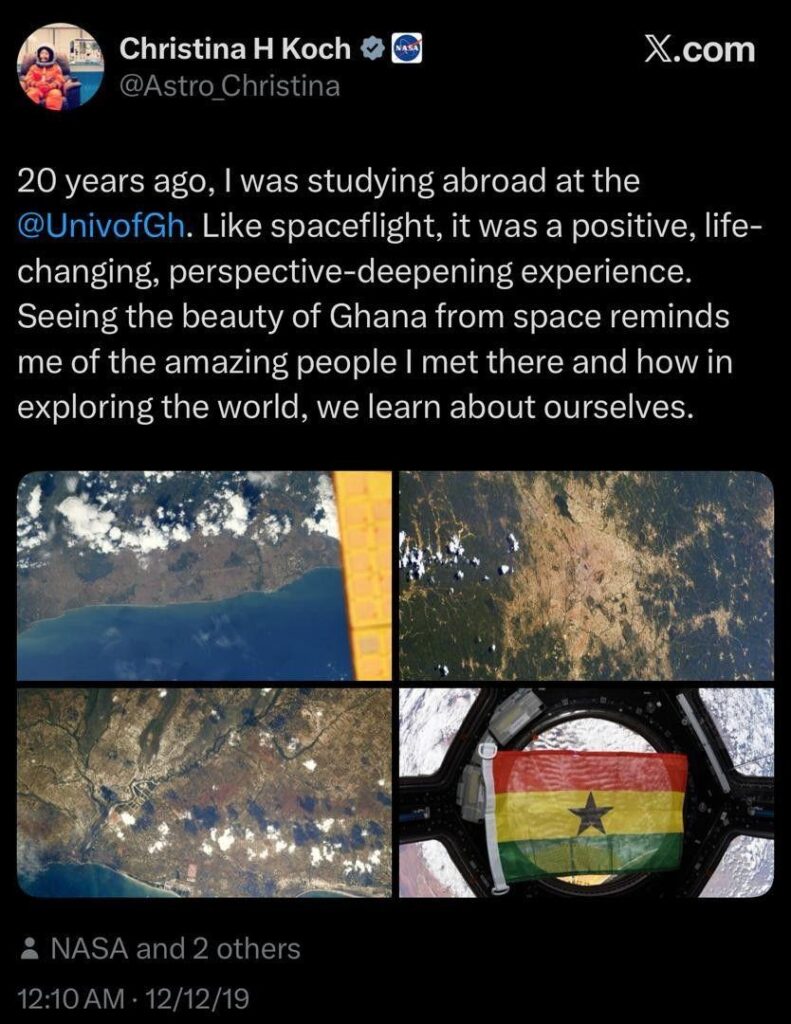
This raises an important question: while disinformation actors will always exist, what about the media personnel who amplify such claims without verification? Why did some journalists and media houses fail to verify the information through NASA’s official platforms or Christina Koch’s verified accounts before publishing it?
Media practitioners are not merely posting content for themselves. Millions of people rely on them for credible and authentic information. When journalists spread falsehoods, they misinform the public, erode trust, and shape perceptions based on inaccuracies. That, in itself, is an existential threat and should be treated with the seriousness it deserves.
The misinformation surrounding the Christina Koch story became even more concerning when Ghana’s Minister for Foreign Affairs, Samuel Okudzeto Ablakwa, shared the image on Facebook on April 12, 2026, while announcing plans to honour Koch for her achievements.
When misinformation reaches the presidency
Even more troubling was when President John Dramani Mahama, on April 9, 2026, publicly commended Koch for allegedly hoisting Ghana’s flag in space during the Artemis II mission.
“Her gesture of hoisting the Ghanaian flag in outer space was a deeply touching moment for every Ghanaian. It is a testament to the fact that no matter how far one travels, even into the vastness of space, the friendships made and the lessons learned stay with you,” Mahama wrote on Facebook.
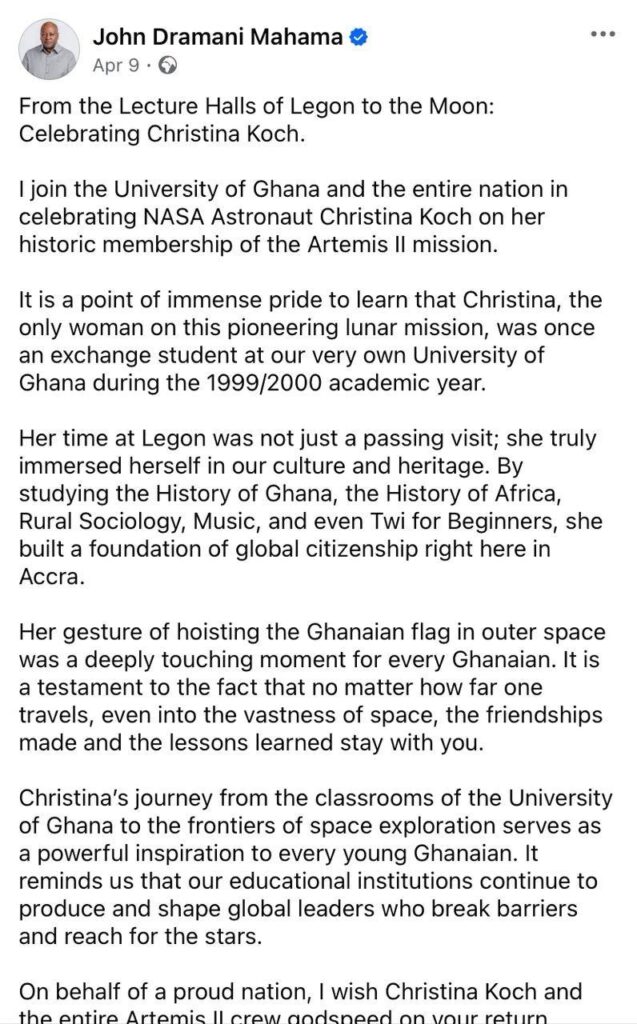
However, NASA records on items carried aboard the Artemis II mission did not support the claim. The image of Koch with the Ghanaian flag dated back to 2019 aboard the International Space Station, not the Artemis II mission.
This development raises serious concerns about those responsible for feeding the President — the Commander-in-Chief of the Ghana Armed Forces — with information and handling official communications. If misinformation can reach the highest office in the country unchecked, then the consequences for national decision-making could one day be severe. That is why I strongly believe misinformation should be regarded as an existential threat.
The Chef Smith controversy
Another major misinformation incident that shook the country involved Chef Smith, who on July 2, 2024, invited media houses to announce himself as the Guinness World Record holder for the longest cooking marathon after allegedly clocking 802 hours and 25 minutes.
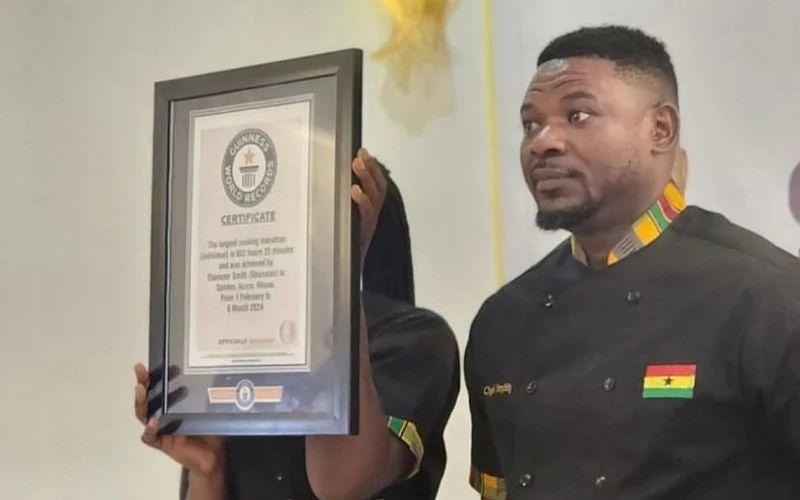
Chef Smith with his fake Guinness World Record certificate
Almost every major media house in Ghana reported the claim.
It was only later that some journalists contacted Guinness World Records to verify the announcement, and GWR clarified that the claim was false. By then, however, the damage had already been done. The public had already celebrated a false achievement.
This incident again exposed the failure of some media practitioners to prioritise verification before publication. Why could media houses not contact Guinness World Records beforehand to authenticate the claim? Instead, many became tools in spreading misinformation nationwide.
The Dr. UN embarrassment
Another infamous case occurred on August 28, 2020, when a man identified as Kwame Fordjour, popularly known as Dr. UN, organised the so-called “7th Global Leadership Service to Humanity Awards.”
The event featured plaques branded as the “UN Kofi Annan Excellence Awards” and honoured individuals from entertainment, politics, media, and business.
The ceremony attracted massive publicity because of the high-profile personalities involved. Among those honoured were rapper Sarkodie, broadcaster Berla Mundi, musician D-Black, Chairman Wontumi, Captain Smart, DJ Black, Natalie Fort, the Daughters of Glorious Jesus, former Vice-Chancellor of the University of Ghana Prof. Ebenezer Oduro Owusu, and Speaker of Parliament Alban Bagbin, among others.
Barely a day later, investigations revealed that Dr. UN had no affiliation whatsoever with the United Nations or the late Kofi Annan. He also lacked any verifiable academic or international credentials.
This embarrassment could have been avoided had proper checks been conducted through official UN platforms or the Kofi Annan Foundation before the event gained national attention.
False sports reports and the speed of misinformation
More recently, on the morning of Monday, May 18, 2026, a journalist shared a flyer in a sports WhatsApp group claiming that Black Stars head coach Carlos Queiroz had released his provisional 55-man squad.
Another journalist in the group quickly debunked the claim as false.
A few moments later, while scrolling through Facebook, I saw a prominent Ghanaian media house with over 1.3 million followers publishing the same false information. Honestly, I felt disappointed because more than a million unsuspecting followers had just been misinformed.
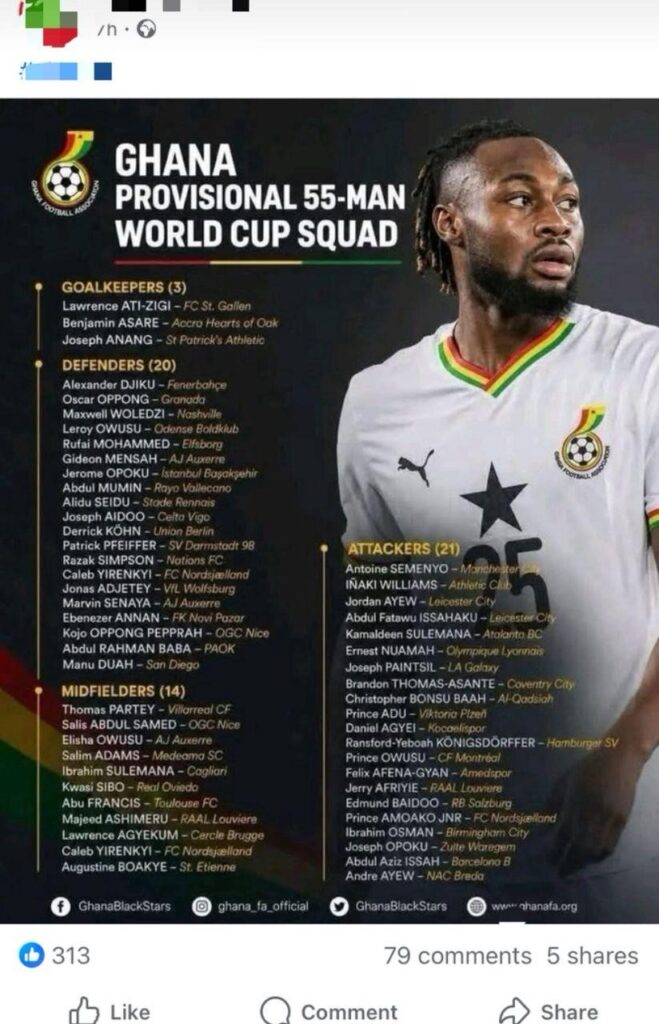
If the provisional squad had genuinely been released, the first point of verification should have been the official handles of the Ghana Football Association and the Black Stars.
In conclusion, just as illegal mining (galamsey) has been described as an existential threat to Ghana, I strongly believe misinformation deserves the same level of attention because of its destructive consequences on public trust, governance, journalism, and national discourse.
Misinformation does not merely distort facts; it shapes decisions, damages reputations, influences public opinion, and weakens institutional credibility. Until verification becomes a culture rather than an afterthought, misinformation will continue to endanger the very society we seek to inform.
Latest Stories
-
Africa World Airlines unveils first Embraer E190 as part of 10-aircraft fleet expansion
41 minutes -
Civilian hospitalised after alleged machete attack by prison officers, inmates
57 minutes -
Toobu rejects calls to recall Parliament over 3.9-tonne cocaine shipment
2 hours -
Residents in 5 Northern Regions warned of approaching rainstorm
2 hours -
Constituency Games still a work in progress – Sports Minister
2 hours -
Team Ghana set for historic Karting Africa Showrun in Angola
2 hours -
52-year-old South African arrested with suspected heroin after arriving from Accra
2 hours -
Shatta Wale challenges UPSA students to build entrepreneurial mindsets
3 hours -
Finance Minister advises African governments to strengthen regional tax cooperation
4 hours -
NPP accuses NDC of master-minding demolition of Ho regional office fence
4 hours -
Ghana plans stronger regional power trade with Nigeria
4 hours -
GRA Commissioner-General calls for stronger tax cooperation to boost regional revenue mobilisation
4 hours -
NACOC needs more personnel to tackle drug trafficking – Toobu
4 hours -
Railway workers resist KMA eviction order, demand consultation
4 hours -
Legacy Leadership Africa Institute to host boardroom women’s leadership programme
5 hours