

Audio By Carbonatix
Between 1993 and 2000, thirty-four women were strangled, raped and abandoned across Accra. Most were night traders and food sellers. Women on the margins.
Ghana had a serial killer, and for years, the state did very little. Not because the murders were secret, but because the women being killed were not the kind of women anyone in power felt urgently responsible for.
A man named Charles “Papa” Kwabena Ebo Quansah was eventually convicted of nine of the killings in 2002 and sentenced to death. Whether he killed all thirty-four remains unresolved. What is not in dispute is what those murders exposed: institutions that treated women’s safety as someone else’s emergency.
That was twenty-six years ago. The institutions have not changed as much as we would like to believe.
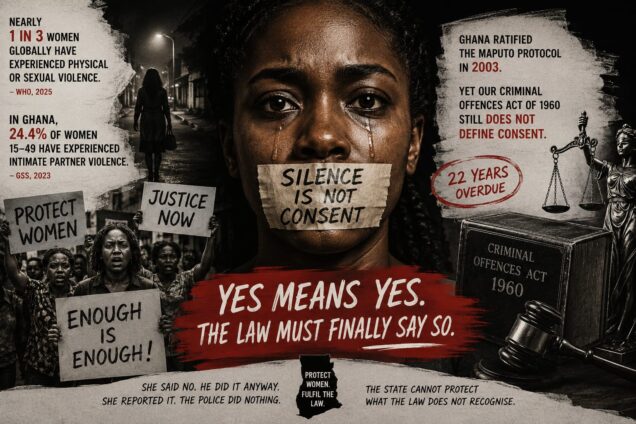
According to a landmark 2025 joint report by the World Health Organisation and six UN partner agencies, an estimated 840 million women, almost one in three globally, have experienced physical or sexual violence at least once in their lives. One woman or girl is killed by a partner or family member every ten minutes, 137 every single day.
In Ghana, according to the Ghana Statistical Service, 24.4% of women between 15 and 49 have experienced intimate partner violence. A further 35.2% have experienced emotional violence. According to UNICEF, one in five girls between 15 and 19 has already experienced sexual violence.
The women in those numbers are not so different from the night traders of Dansoman. They are market women, chop bar operators, seamstresses, teachers, corporate and other professional women. Women in whose lives violence has been allowed to become ordinary.
In November 2025, a woman named Harriet Amuzu was lured back to her estranged husband’s home in Ofankor after he called to say their youngest child was sick. When she arrived, she found the children playing. He had lied.
That night, he demanded sex. She refused. She told him they had been separated for five months and she had moved out. He responded by assaulting her in broad daylight. The incident was captured on video and went viral. Only after the video circulated was he arrested.
According to various media reports, Harriet had previously filed complaints at both Tesano and Ofankor Police Stations. Nothing was done, even with evidence.
She later chose to reveal her identity publicly, telling TV3 she wanted to empower other survivors. Her story is not an exception. It is a system. She said no. He did it anyway. She reported it. The police did nothing. The public had to do the state’s job.
And yet, most women never even reach the point of filing a report.
According to ActionAid Ghana, two in three women do not report abuse, especially sexual violence. A 2022 Afrobarometer survey found that more than four in ten Ghanaians believe a woman is likely to be criticised, harassed or shamed if she reports.
So she stays quiet. She absorbs it. She manages it. The cycle continues, undisturbed, unaccounted for.
This is not a failure of courage. It is a rational response to a system that has repeatedly shown women that coming forward costs more than staying silent.
Now, here is what sits at the root of it all
In 2003, Ghana ratified the Maputo Protocol, the African Union’s binding treaty on women’s rights, which explicitly obliges member states to protect women’s bodily integrity, including from sexual violence. Ghana has been legally bound by that obligation for over twenty years.
And yet Ghana’s Criminal Offences Act of 1960 still does not define consent.
Which means that in courtrooms across Ghana today, the question of whether a woman agreed to what was done to her remains legally ambiguous. The absence of resistance is treated as the presence of agreement. Silence is treated as permission. Fear is rendered invisible.
Compare this to what happened on 29 April 2026, at the European Parliament in Strasbourg. According to its official press release, Members of Parliament voted 447 in favour and 160 against to demand an EU-wide consent-based definition of rape.
“Yes means yes”, not the absence of no. Not silence. Not the absence of struggle. The report also recognised that trauma responses such as freezing or appeasing an attacker do not constitute consent.
Swedish MEP Evin Incir said after the vote: “It is both morally and legally unacceptable that women are not protected by ‘only yes means yes’ legislation.”
Europe, with all its institutional machinery, is still working in 2026 to make this standard universal. Ghana, which signed binding obligations over twenty years ago, has not yet defined it in law.
This is not about blaming men. Boys raised in environments where violence is normalised are also failed by the silence around it. Gender-based violence diminishes everyone it touches.
But the obligation on the state is clear and not optional.
Ghana ratified the Maputo Protocol. Ghana passed the Domestic Violence Act. Ghana signed regional gender equality commitments. Yet Ghana has not amended its core criminal law to define consent.
That amendment is not a favour to women. It is a legal obligation, long overdue.
It is what Harriet Amuzu’s refusal should have been protected by. It is what the night traders of Dansoman deserved three decades ago. It is what every woman who stayed silent because she did not believe the law would stand with her was owed.
We do not know all thirty-four names. We do not know all their stories. What we know is that they were someone’s mother, someone’s daughter, someone’s friend.
They woke up that morning and went to work—but did not come home.
And the law that governed what was done to them did not have a word for what they had not agreed to.
They are not history. They are a mirror.
And when we look into it honestly, we see the faces of those still out there tonight—still unprotected, still unheard, still waiting for a system that finally says what they have always known:
That silence is not consent. That fear is not consent. And that the absence of evidence is not evidence of absence.
Sweety Aborchie writes on Women, Power and Politics for myjoyonline.com.
Latest Stories
-
Prof. Kwofie urges publishers to use indigenous knowledge systems to decolonise AI
46 minutes -
NDC’s two years of economic gains not enough to establish stability – Alan Kyerematen
55 minutes -
AFCON 2027Q: Nine new call-up for Cote, The Gambia matches
1 hour -
Ghana’s MSMEs: Burdened by regulation and overtaxed; why the system isn’t working
1 hour -
Patience Akyianu, former Barclays Bank Ghana MD and Hollard Group CEO, reported dead
2 hours -
Mahama pushes ‘health sovereignty’ agenda, says Global South needs control over resources
2 hours -
Mahama: We are reforming systems, fighting corruption and improving use of public funds
2 hours -
Catholic Bishops welcome task force to tackle drug menace, acknowledge inter-agency efforts
2 hours -
Ghana Catholic Bishops demand urgent action against drug trafficking
2 hours -
Tamale: 5 arrested over suspected drug activities; police seize pistols, narcotics
2 hours -
We have lost a great developer – Mankranso residents pay tribute to late DCE
2 hours -
Ghana Law Society sets September 30 for maiden Bar Conference on legal reforms
3 hours -
GPL Week 3: Port City’s Gyetuah bags a brace as 9 outstanding players named NASCO Players of the Match
3 hours -
Visibility without substance is just noise; I don’t seek popularity—Dr Oppong-Fosu
3 hours -
The late Abubakar Sedik was an exceptional DCE – Ashanti Regional Minister
3 hours