

Audio By Carbonatix
President John Dramani Mahama on Thursday, June 25, announced that the Cabinet has approved the new National Ethics and Anti-Corruption Action Plan – 2026-2036 for onward transmission to Parliament.
This is part of the Government’s efforts to ensure transparency and accountability.
The President also announced that the Cabinet had decided to direct the Attorney-General to draft a Bill for the Protection of State Assets – the State Assets Protection Bill.
He added that it showed the guidelines under which any State Assets could be disposed of, including lands, buildings, factories, and industries, so that no government just appreciates these state assets.
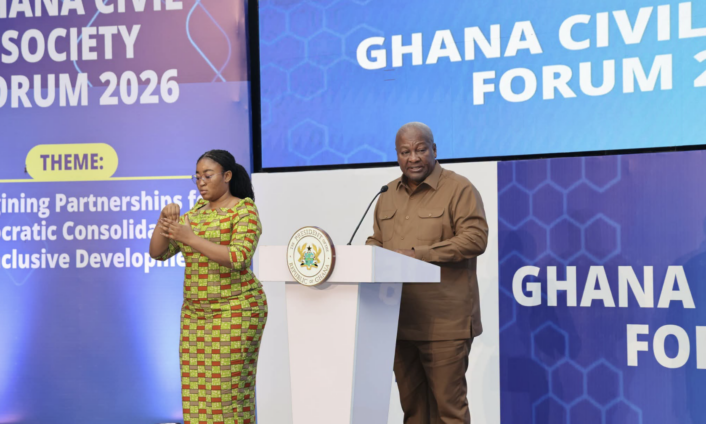
The President said this in his remarks at the opening of the Ghana Civil Society Forum (GCSF) 2026 at the University of Ghana, Legon, Accra.
The two-day conference on the theme “Reimagining Partnership for Democratic Consolidation and Intensive Development” is being organised by the STAR-Ghana Foundation in partnership with other stakeholders.
It brought together stakeholders from across civil society, government, development partners, academia, the private sector, media, faith-based organisations, traditional institutions and youth groups to explore new pathways for democratic consolidation and inclusive development.
The President said accountability and the fight against corruption were essential to democratic consolidation.
He restated his commitment to transparency and accountable governance.
President Mahama said during his previous Presidency, he had the privilege of launching the 10-year National Anti-Corruption Action Plan in 2015.
He noted that civil society remains one of the most important pillars of Ghana’s democracy and that throughout the nation’s history, civil society organisations have served as advocates for vulnerable populations, defenders of human rights, champions of transparency and accountability, providers of social services, and development partners.
President Mahama said many of Ghana’s democratic gains had been achieved through constructive engagement of civic actors.
“Civil society has helped shape public discourse, informed policy choices, strengthened accountability mechanisms, and amplified the voices of communities that might otherwise have gone unheard. The role of civil society has become even more important during periods of economic transition and institutional reform.
He noted that as the Government pursued ambitious programmes for economic transformation, governance reform, healthcare delivery, youth employment, education, social protection, climate resilience, and constitutional renewal, these programmes required the active participation of an informed, vibrant, and constructive civic sector.
“We welcome scrutiny. We welcome dialogue. And above all, we welcome partnership. This government does not regard civil society as an adversary. We regard civil society as a strategic partner in nation building.” He said.
The President said the future of democratic governance depends on the quality of the relationship between citizens and the public institutions that serve them.
“Strong democracies are built on trust. Trust grows when citizens can meaningfully participate in decision-making processes. Trust grows when governments are transparent and accountable. Trust grows when institutions deliver results,” he stated.
He said civil society organizations help strengthen the trust by creating channels for citizens to engage constructively with their public institutions.
He said civil society bridges the gap between policy and lived experience, connects governments to communities , and ensures that governance remains responsive to the needs of the people.
“And this is why democratic consultation requires more than strong constitutional arrangements. It requires active citizenship. It requires vibrant civic engagement and requires enduring partnerships between the states and society.” The President said.
Adding that this administration remains firmly committed to participatory governance.
Dr Esther Ofei-Aboagye, Development Consultant and Local Government Expert, said democracy was not sustained by ballots, stating that “it is sustained by inclusion, participation and collective responsibility”.
Alhaji Ibrahim-Tanko Amidu, the Executive Director of STAR-Ghana Foundation, said when governments, through society, the private sector and citizens work together in pursuit of a shared vision, they accelerate their democratic dividends and build a future in which every Ghanaian has the opportunity to participate, contribute and thrive.
Latest Stories
-
Savio scores on debut as Spurs bounce back to beat Charlton
2 hours -
Uefa to push to remove Infantino after dropping boycott
2 hours -
GH¢1.7bn GoldBod loss misconstrued – IEA
2 hours -
Mahama unveils Bawku Revitalisation Fund Committee
3 hours -
Christians urged not to hide their gifts for church development
3 hours -
Deputy AG punches holes in Hannan’s counsels’ letters, medical reports
3 hours -
Field cashier of Cooperative Credit Union remanded for stealing
3 hours -
Ghana Armwrestling Federation engages Egyptian Ambassador over sports collaboration
3 hours -
NSMQ 2026: Augusco declared winners, book quarter-final spot after Anlo, Kumasi High walk off
3 hours -
Mourinho says hat-trick hero Mbappe hungry for Real Madrid history
4 hours -
Democracy Cup 2026: Winner to play in the United States in May 2027
4 hours -
NSMQ 2026: St. John’s Grammar knocks Mpraeso SHS off seeded spot, advances to quarter-finals
4 hours -
Rashid Pelpuo welcomes new role, thanks Mahama for keeping him in government
4 hours -
Mahama inaugurates committee to oversee GH¢1bn Bawku Revitalisation Fund
4 hours -
Berko’s US conviction does not automatically establish Ghana bribery claims – OSP
4 hours