

Audio By Carbonatix
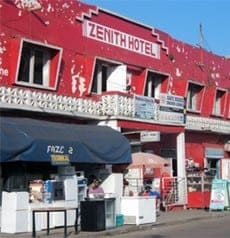
When I heard somewhere last week that the famous Zenith Hotel was being demolished, I wept for my country. I am not ashamed to admit it. I sat in my living room, phone in hand, staring at the news alert, and the tears just came. It felt like losing a relative—someone who had been part of my story even if I never met them in person.
I have always maintained that we could have maintained the building well to act as a museum or something of that sort. But we didn't. We let it rot. We let it become a shadow of its former self. And now, the wrecking ball is coming. The music is finally dying.
Last week, the Sekondi-Takoradi Metropolitan Directorate of NADMO confirmed what many of us had dreaded: the Zenith Hotel building in Takoradi has been selected as the first structure to be pulled down under a demolition exercise targeting 88 dilapidated buildings across the metropolis
I understand the safety concerns. I really do. But this is not just a building. This is sacred ground. This is where our music was born.
The Home of Legends
Let me tell you what the Zenith Hotel meant. In the late 1950s, when Ghana was still finding its feet as an independent nation, a man named J.K. Agyepong—who also ran the Prempeh Cinema—had a vision. In 1958, he did something extraordinary: he fully financed and housed a resident big band, the Broadway Dance Band, founded by Nigerian trumpeter Sam Obote. It became the first big band of its kind in Africa.
Think about that for a moment. In a small coastal city like Takoradi, a hotel owner decided to invest in music. Not because it was profitable—but because he believed in the power of sound.
The Broadway Dance Band played ballroom jazz, blues, and highlife. By the early 1960s, they were considered a national orchestra, touring with President Kwame Nkrumah himself. When Ghana Airways was inaugurated, the band performed in Khartoum and Beirut. They put Ghana on the map, not with politics or gold, but with music.
The name "Broadway" was later changed to Uhuru in 1964 after the hotel management sued the band over the use of the name. The musicians became the legendary Uhuru Dance Band—a 24-piece orchestra that would go on to become one of Ghana's most famous musical exports.
The musicians who played there were national treasures. And the hotel was their home.
Where Talent Was Born
But the Zenith Hotel wasn't just a performance venue. It was a nursery for talent. Highlife icon Pat Thomas learned his craft there, and it was there that he got his big break.
The story goes like this: a young Pat Thomas walked into a rehearsal at the hotel, approached the band, and began to sing. He wasn't invited. He wasn't announced. He just walked in and opened his mouth. His delivery was so powerful that it stunned the entire room. The musicians stopped playing. They just stared. And in that moment, a legend was born.
That is what the Zenith Hotel did. It created moments like that. It was a place where talent met opportunity, where a young boy with a dream could walk into a room and change his life forever.
The rooms of the Zenith Hotel had seen so much. They had seen the backs of travelling musicians and seafarers and dignitaries. They had seen the backs of many women who plied their trade around the area. They had held laughter and tears, joy and sorrow. They were alive.
A Demolition of History
Now, NADMO has earmarked the Zenith Hotel and the nearby Prempeh Cinema building for demolition. Final technical assessments are currently underway, and officials say the exercise could begin within a matter of days.
I understand the practicalities. I understand that buildings deteriorate. I understand that safety matters.
But what I don't understand is how we got here. How did we let a national treasure become a squatter's shelter? How did we let the walls that once echoed with jazz trumpets and highlife guitars become a danger to the public?
A Museum That Never Was
For years, I have argued that the Zenith Hotel should have been preserved—not as a hotel, but as a museum. A monument to the golden age of Ghanaian highlife.
Imagine it. Tourists from all over the world coming to Takoradi to see where Pat Thomas sang his first notes, where the Broadway Dance Band rehearsed, where President Nkrumah's orchestra was born. Imagine schoolchildren visiting to learn about their musical heritage. Imagine the pride we would feel.
Instead, we let it rot. We let it become a dilapidated shell. And now, safety concerns have given us no choice but to pull it down.
We could have saved it. We should have saved it. But we didn't.
The Silence of the Bricks
When the demolition begins, the walls of the Zenith Hotel will fall—walls that once echoed with jazz trumpets and highlife guitars. Walls that heard the laughter of musicians and the whispers of lovers. Walls that held the dreams of a young nation finding its voice.
When I heard the news, I wept for my country. Not because we are demolishing a building, but because we are demolishing our memory. We are choosing practicality over history, convenience over legacy.
And when the dust settles, all that will remain of the Zenith Hotel is what we carry in our hearts: the music, the legends, and the tears for what we let slip away.
I will remember the Zenith Hotel. I will remember the joy it brought, the talent it nurtured, the history it held.
And I will ask myself: what else are we letting slip away? What other treasures are we ignoring until it's too late?
The Zenith Hotel is gone. But the music—the music will never die. It lives in every highlife song we sing, every dance we dance, every memory we hold.
But oh, what a loss. What a terrible, avoidable loss.
Latest Stories
-
Ghana needs a law to sustain constitutional reforms – CDD-Ghana
1 hour -
COVID fumigation audit: Auditor-General has a lot of questions to answer – Akwatia MP
1 hour -
Stranded Ghanaian medical graduates in Cuba appeal to Mahama for immediate return
1 hour -
GNFS contains fire outbreak at Teshie Lekma Road near Lekma Hospital
7 hours -
Samia Nkrumah rejects the narrative that Ghanaians were happy after Nkrumah’s overthrow
9 hours -
A Mother’s pain: Tribute by Ivan Baidoo’s mother
9 hours -
‘Forgive us for staying away’ — Samia Nkrumah leads family back to Nkroful, pledges to preserve Nkrumah’s legacy
9 hours -
Ernest Nuamah scores twice as Lyon beat Rennes
9 hours -
‘My dear Ivan’ – A father’s tribute to a son tragically killed
9 hours -
GNPC Explorco advances Voltaian Basin drilling preparations with 13.5km access road
9 hours -
Cabinet approves facility manager for Borteyman Sports Complex – Kofi Adams
10 hours -
Sanitation is improving; critics may be ‘living in another world’ – Salaga South MP replies Bekwai MP
10 hours -
Government must do more to tackle sanitation crisis – Bekwai MP
10 hours -
World Cleanup Day: GFF begins sanitation education in local communities
10 hours -
EU Ambassador, IGP discuss stronger cooperation on policing and security
11 hours