

Audio By Carbonatix
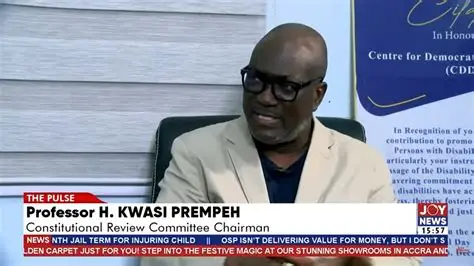
Chairman of the Constitutional Review Committee, Prof Henry Kwasi Prempeh, has renewed calls for Ghana's political parties to gradually abandon the delegate system in favour of more open and participatory primary elections, arguing that such a move would strengthen internal democracy and better reflect the principles of democratic governance.
Speaking in an interview with Accra-based Woezor TV, Professor Prempeh said although the delegate system has long been the preferred method for selecting parliamentary and presidential candidates within the major political parties, developments over the years suggest that the parties themselves recognise the need for broader participation by their membership.
According to him, the evolution of delegate numbers in recent election cycles demonstrates a growing acceptance within the political parties that the current system should become more inclusive.
"I think a lot has been said about the delegate system, often very critically," Professor Prempeh observed.
"You can tell even the way the numbers have evolved. The parties themselves have been growing the numbers incrementally."
Professor Prempeh noted that both major political parties have gradually increased the size of their electoral colleges over time, allowing more delegates to participate in the selection of party leaders and parliamentary candidates.
He argued that this gradual expansion reflects an acknowledgement by the parties that broader participation enhances the legitimacy of internal elections.
The Constitutional Review Committee Chairman explained that the trend suggests an underlying desire to move away from a system in which relatively small groups of delegates determine the political fortunes of aspiring candidates.
Instead, he believes the logical progression is towards a system in which ordinary party members are empowered to vote directly in primary elections.
"There's a certain impulse within the parties themselves that they need somehow to move towards open primaries where members will participate," he said.
Professor Prempeh pointed to an earlier attempt by one of Ghana's major political parties, the National Democratic Congress (NDC), to significantly expand participation in its internal elections.
According to him, the party at one stage sought to extend voting rights to almost its entire membership before later reversing that decision.
He explained that discussions with party officials at the time suggested the retreat was influenced less by opposition to wider participation than by concerns over political competitiveness.
"The sense was that if we do it alone and the other party doesn't reciprocate, then it's almost like we are placing ourselves at a disadvantage," he recounted.
Professor Prempeh maintained that open primaries, in which all registered party members participate in selecting candidates, represent a more democratic approach to internal party governance.
He argued that political parties, as institutions central to Ghana's democratic system, should themselves operate according to democratic principles.
"That is more democratic. That is really what a fully fledged democratic party should do," he stated.
He indicated that allowing the wider party membership to determine candidates would strengthen transparency, improve accountability and enhance the legitimacy of those elected to represent the parties.
The committee has been consulting political parties, civil society organisations, traditional authorities, professional bodies and members of the public on a range of constitutional and governance issues.
Professor Prempeh acknowledged that any transition from delegate-based elections to open primaries would require careful planning and broad consensus among the political parties.
Latest Stories
-
SSNIT says La Beach clearance was to protect hotel investments, beaches to remain public
35 minutes -
APSU congratulates St Augustine’s College after back-to-back National Investment Quiz wins
40 minutes -
Renewed flood intervention at Mallam Junction raises hopes among residents, businesses
1 hour -
St Augustine’s College retain National Investment Quiz title after nail-biting grand finale
1 hour -
Education infrastructure investment will drive Banda’s development – Ahmed Ibrahim
2 hours -
Teacher unions strike: Gov’t presents fresh proposals as talks end inconclusively
2 hours -
51,000 teachers’ promotion arrears to be validated for October payment – Education Minister
3 hours -
Kwabena Boamah appointed Board Chair for Impact Investing Ghana
3 hours -
Striking teacher unions to meet Fair Wages and Salaries Commission on October 6
3 hours -
EOCO working with AG to arraign Nana Baffour Awuah before weekend court
3 hours -
Duraplast reassures customers after fire, announces October 5 reopening
3 hours -
Call off strike, gov’t will not renege on promotion arrears pledge – Haruna Iddrisu to teacher unions
3 hours -
Committee set up to validate teachers eligible for 20% deprived-area allowance – Education Minister
3 hours -
Five-member committee to search for new Black Stars coach after Sports Ministry-GFA meeting
4 hours -
Pinktober: Breast cancer survival exceeds 90% when detected early – Breast Society of Ghana
4 hours