

Audio By Carbonatix
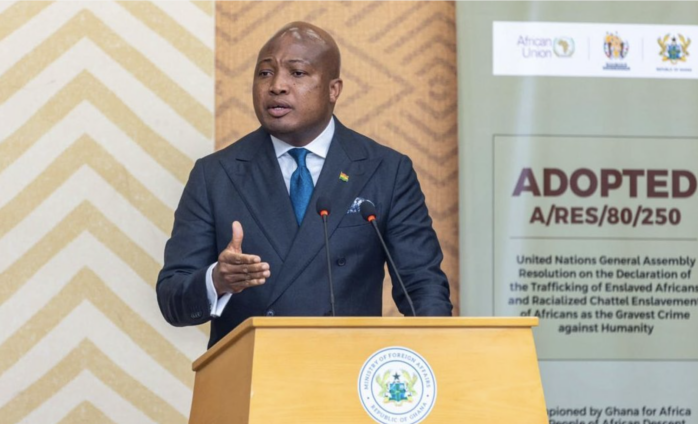
Samuel Okudzeto Ablakwa, Minister of Foreign Affairs, has rejected claims that Africa was an equal or active participant in the transatlantic slave trade.
He described such assertions as historically inaccurate and misleading.
Mr Ablakwa, addressing a press briefing in Accra on Tuesday following Ghana’s diplomatic success at the United Nations, said attempts to portray Africa as a co-architect of the transatlantic slave system distorted the historical record and undermined the pursuit of justice and reparations.
“It is important to address, with clarity and historical accuracy, a narrative that has often been used to dilute the gravity of this history, the suggestion that Africa was an equal participant in what has been described as a ‘trade’,” he stated.
The Minister explained that while there were isolated instances of local intermediaries within the continent, these did not amount to control, ownership, or design of the transatlantic slave system, which he said was driven by external forces.
According to him, the system was financed through transcontinental networks, sustained by foreign demand, and codified through legal regimes developed outside Africa.
He emphasised that the structures that enabled slavery, including laws, insurance systems, and global economic arrangements, were not created by Africans, but by external actors who benefited from the exploitation of enslaved people.
Mr Ablakwa’s remarks come in the wake of the adoption of a landmark United Nations General Assembly resolution declaring the enslavement of Africans and racialised chattel enslavement as the gravest crime against humanity.
The resolution, adopted on March 25, 2026, was spearheaded by Ghana under the leadership of President John Dramani Mahama, who serves as the African Union Champion on Reparations.
Co-sponsored by about 70 countries and supported by 123 Member States, the resolution marks a significant shift in the global response to slavery, moving beyond symbolic remembrance to formal recognition of its enduring structural impact.
Mr Ablakwa noted that for more than 300 years, over 12.5 million Africans were forcibly taken from the continent, with millions more dying during capture and transportation, making it one of the largest and most brutal forced migrations in human history.
Despite this, he said, the international community had largely limited its response to commemorative activities, without establishing a comprehensive framework for reparatory justice.
He described the newly adopted resolution as a turning point, providing an authoritative basis for dialogue on reparations, including calls for formal apologies, restitution, compensation, and institutional reforms to address systemic discrimination.
The Minister stressed that the resolution also reflected a broader continental agenda, aligning with the African Union’s Decade of Action on Reparations (2026–2036), the Accra Declaration on Reparations and Racial Healing, and Agenda 2063.
He reiterated that Ghana’s position was not one of confrontation, but constructive engagement, noting that the country would continue to maintain diplomatic relations with nations that abstained or voted against the resolution.
“We are not out for retribution…we are doing this in very good faith,” he said, adding that Ghana remained committed to dialogue, partnership, and global cooperation.
On the contentious issue of Africa’s role in the slave trade, Mr Ablakwa maintained that any involvement on the continent occurred within a context of coercion, unequal power relations, and external economic pressures that reshaped African societies.
“To suggest that this was a shared or equal enterprise is to misrepresent the scale, structure, and responsibility of what was, in reality, a system of organised exploitation imposed on African peoples,” he said.
He argued that narratives portraying Africans as beneficiaries of slavery were part of a longstanding “divide and rule” strategy that had historically weakened collective efforts toward justice.
The Minister said the adoption of the UN resolution had, however, strengthened unity among Africans and people of African descent globally, marking the first time a broad coalition had come together around a shared reparatory justice agenda.
Looking ahead, Mr Ablakwa indicated that Ghana would work with international partners, including the African Union, CARICOM, and other global stakeholders, to translate the resolution into concrete actions.
These include advancing education reforms to ensure accurate teaching of slavery, promoting the restitution of looted cultural artefacts, and supporting research and dialogue on reparatory mechanisms.
He expressed appreciation to countries and organisations that supported the resolution, describing the outcome as a “historic and consequential” moment in the global recognition of the injustices of slavery.
“This victory marks only a significant beginning,” he said, adding that sustained effort would be required to dismantle enduring structures of inequality and ensure justice for Africans and their descendants worldwide.
Latest Stories
-
Vibes The Movie: Big Ghun’s Ghanaian film earns five nominations at 2026 REFFA
29 minutes -
MamaCare CEO warns unresolved conflicts among health workers could undermine maternal and neonatal care
53 minutes -
Health professionals urged to translate medical knowledge into practice to save mothers
60 minutes -
Conflicts among care providers linked to maternal, neonatal deaths – Expert
3 hours -
GIS marks 10th TIME conference, champions improved teaching practices
3 hours -
BRICS Or Balance? What Ghana’s bid really means
3 hours -
GPRTU wants full TRAFFITECH-GH implementation to start in 2027
3 hours -
Mahama announces plans to import electric wheelchairs for PWDs
4 hours -
KGL U17 Colts 2026: Western beat Prempeh Elite Academy to set up final final with Greater Accra Region
4 hours -
Late Solanke strike salvages 10-man Spurs draw at Man United
4 hours -
Gender Ministry to monitor welfare of Nana Akua Addo’s children amid domestic violence case
4 hours -
Benedict Okyere Yeboah: Ghana’s football problem goes beyond sacking a coach
4 hours -
GPL 2026/27: Darkwah Wiafe’s winner sees All Blacks beat Kotoko
4 hours -
ITF World Tour : Patel Wins Boys’ Singles Final at J100 Accra
5 hours -
Ghana must pursue BRICS partnership if it brings economic benefits – Kpebu
5 hours