

Audio By Carbonatix
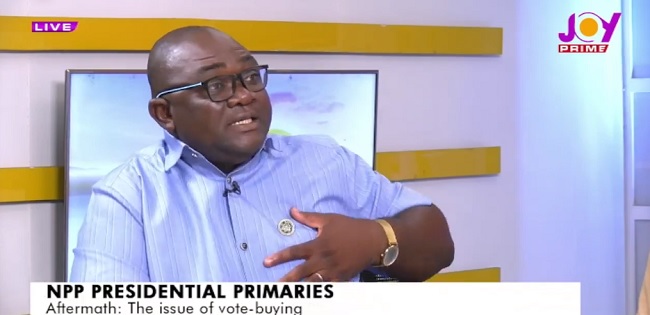
Former Member of Parliament for Ablekuma Central constituency, Ebenezer Nartey, has said that approximately 90% of all members of political parties in Ghana, including the New Patriotic Party (NPP), do not pay dues.
According to him, members were paying during the membership card era until the party decided to change the style by transferring it into a database.
Speaking to Roselyn Felli on Joy Prime’s Prime Morning, the former MP stated that following the changes, some members were still contributing but later stopped due to the hacking of some accounts.
“All political parties always entreat their members to pay dues, but to be honest and sincere with you, I can tell you that about 90% of our members don’t pay dues. I can’t remember the last time I paid dues because we were then using the membership card."
Reacting to the question of why it is the responsibility of party aspirants to cater for the welfare of delegates rather than the entire body of the party, he said it is because they have run short of finances since members fail to pay.
As a result, members vying for positions take on the task by catering for the voters’ welfare through transportation, among other things, with the help of their sponsors. While some prefer to finance everything single-handedly, others devise a strategy for raising funds through their supporters.
Even though it is the role of the party to provide for the welfare of its members, Mr. Nartey feels one cannot rely solely on the party.
It has been alleged that some presidential aspirants of the NPP induced party delegates with money at some polling stations in various regions to earn votes at the just-ended presidential primaries of the party.
Also speaking on the show, political scientist and author, Dr. John Osae Kwapong said it will be a good initiative for parties to fund the campaigns of aspirants. He did, however, mention the possibility of candidates receiving an unfair distribution of resources from their parties.
He said, “If resources are uneven, it places the candidates with more resources in a more advantageous position than other candidates.”
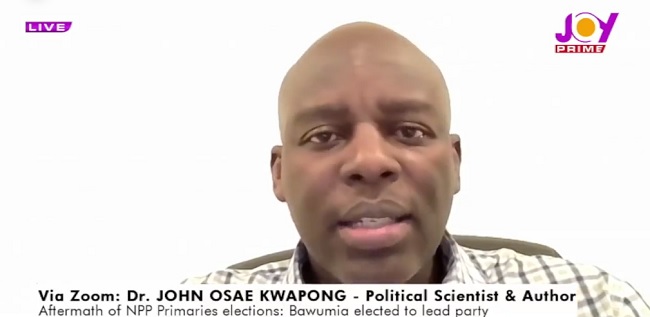
Nevertheless, Dr. Osae Kwapong is of the view that if the burden of candidates facilitating the transportation of delegates is resolved, it can reduce the issue of vote-buying during primaries.
Latest Stories
-
President Mahama ends Resetting Ghana tour of Ahafo Region
50 minutes -
African negotiators seek delivery of climate commitments at COP31
51 minutes -
BoG develops AI rules for financial sector
53 minutes -
‘Big Push’: Government assures contractors of prompt payments
57 minutes -
Court fines miner for breaking into gold buying shop
1 hour -
Tarkwa court jails labourer for three years over GH¢123,000 theft
2 hours -
GAEC must retain nuclear scientists for Ghana’s nuclear ambitions – Minister
3 hours -
Man reportedly mistaken for game and shot by hunter dead in forest
3 hours -
19-year-old mason jailed 15 years for defiling seven-year-old pupil
3 hours -
Ghana’s banking sector assets rise 20.47% to GH¢500.2bn – BoG Governor
3 hours -
22 injured as Sprinter bus overturns at Sege after tyre burst
3 hours -
UN housing expert urges Ghana to strengthen Rent Control Department amid housing affordability concerns
3 hours -
Delta-BCI partnership reaches 166,000 people with breast cancer education
3 hours -
Power restoration fault suspected in Kumasi Central Market fire
8 hours -
The 7-foot giant of Ngleshie Amanfro: Seven-foot Ghanaian Ephraim Saawa dreams of joining the national basketball team
9 hours