


Audio By Carbonatix
The African Continental Free Trade Area (AfCFTA) will create new opportunities for women in economic areas, where they are concentrated, such as agriculture, industry, services and trade.
To ensure that women have access to these opportunities, African Union Members must take intentional steps in creating and implementing gender-sensitive policies and implementing targeted complementary measures.
Mr Gerald Woode, the Lead Researcher at the Ghana International Trade and Finance Conference (GITFiC), said this during the Conference’s monthly briefing on the topic: “Distributional impact of AfCFTA on poverty reduction and employment in Sub-Saharan Africa.”
In the area of AfCFTA on unemployment, he said employment in North Africa was predicted to grow from 64.2million to 75.9million by 2035 at an annual rate of 1.12 per cent, which was quite close to the non-AfCFTA average.

The Lead Researcher said in contrast, employment in Sub-Saharan Africa was predicted to grow at a 2.7 per cent yearly rate from $437million to more than $650million.
He said concrete steps must be implemented to promote women and youth entrepreneurship, which could be accomplished through national efforts such as gender-sensitive education, women-training programmes, and financial support for female entrepreneurs.
Mr Woode said the full implementation of the potential of AfCFTA would lift 67.9million people or 3.6 per cent of the continent’s population out of poverty by 2035.
According to the World Bank Report (2018), 415 million people live in extreme poverty on the African continent, with 60 per cent of the people living in unstable countries.
“At the moderate poverty line of Purchasing Power Parity (PPP) $5.50 US dollars a day, the full implementation of the potential will lift 3.6 per cent of the continent’s population out of poverty by 2035,” he said
Mr Woode said the full implementation of the agreement could also lift an additional 30 million people out of extreme poverty by 2035.
He said the report indicated that Africa’s extreme poverty headcount ratio was projected to decline from 34.7 per cent in 2015 to 15.5 per dent by 2030 and 10.9 per cent in 2035.
The Research said throughout the period, Sub-Saharan Africa would observe a decline in extreme poverty to 13.1 per cent from the most recent estimate of 41.1 per cent, but most countries in North Africa would be expected to eradicate extreme poverty by 2035.
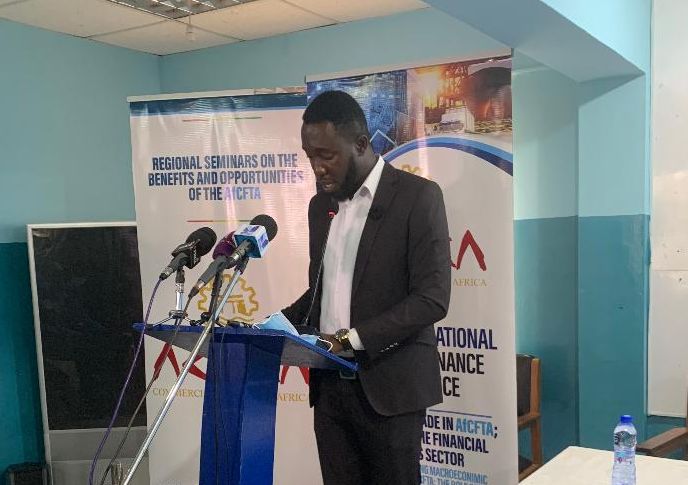
Mr Selasi Koffi Ackom, Chief Executive Officer, GITFiC, said small and Medium-sized Enterprises (SMEs) must consolidate to have larger productions to make them eligible to compete in the international market.
He said businesses must consider the quality, pricing, standard, and packaging of their products to compete globally.
Mr Ackom called on policymakers to devise mechanisms to help bridge language barriers to facilitate communication on the international market.
Mr William Boateng, Executive Head, Corporate and Enterprise Banking at Bank of Africa Ghana, said businesses required the understanding of economic situations in order to actualize their goals and activities.
“We are not only supporting Ghanaian businesses but also businesses around the world to maximize opportunities to help them actualize their business goals and objectives,” he added.
Mr Boateng advised that bureaucracies relating to customs and administrative entry processes, trade barriers, sanitary and phytosanitary measures should be reduced to the barest minimum to facilitate trade.
Latest Stories
-
Mr President, Ghana was mentioned at the UN; why aren’t we talking about it?
17 minutes -
Accra to convene Africa’s regulators and markets on tokenization at AVAS 2026
20 minutes -
The Paradox of Plenty — When every smartphone becomes a newsroom
53 minutes -
GTA sensitises taxi drivers in ‘Know Ghana’ tourism campaign
2 hours -
Archbishop Agyinasare calls for responsible speech amid growing social media abuse
2 hours -
‘It will be inexcusable for gov’t not to honour payment of teachers’ arrears by 30th October’ – Haruna Iddrisu
2 hours -
Forbes’ World’s Best Employers 2026: No Ghanaian firm ranked among 900 companies
2 hours -
Electronic processing of teachers’ data: ‘The decision is the Controller’s’ – GES boss
2 hours -
Teachers’ Strike: Haruna Iddrisu questions paper-based processing of promoted teachers’ data
3 hours -
Savannah Region: Kunfusi bridge collapses again, leaving nearly 4,000 residents cut off
3 hours -
Teachers’ strike: GES targets Monday deadline to submit promotion data to Controller
3 hours -
Inflation to average 11.3% in 2027 – Fitch Solutions
3 hours -
‘I didn’t campaign for NDC to come and do this nonsense’ – Kpebu on EOCO’s conduct
3 hours -
Fitch Solutions maintains policy rate forecast of 14% by December 2026
3 hours -
Diaspora Nasara Caucus congratulates Mohammed Ali Suraj, new NPP executives
5 hours