

Audio By Carbonatix
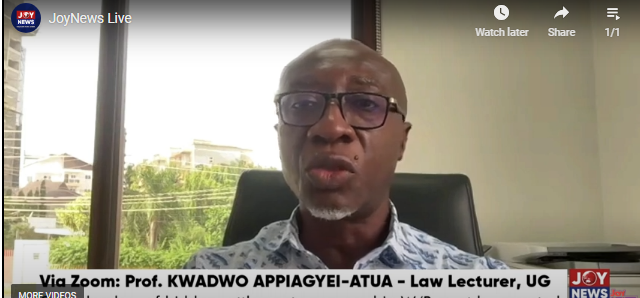
University of Ghana law lecturer, Professor Kwadwo Appiagyei-Atua, has called for the immediate arrest of gang leaders operating in a hidden galamsey settlement recently destroyed by the military in the Western Region.
He argues that unless these gang leaders are apprehended, the illegal mining problem will continue to thrive and the settlement may simply re-establish itself.
Speaking on JoyNews’ AM Show, Prof Appiagyei-Atua said that while the military's destruction of the settlement, which housed over 10,000 residents, was a necessary action, it only addresses the surface of the issue.
According to him, the core problem lies in the gang leaders who manage these operations, and without their arrest, the settlement could easily regenerate.
“These settlements are springing up, and from the look of things, this one has been there for quite some time,” he said. “People have been going in and out, and there were clear indications of the numbers involved. This is not a new development.”
The law professor stressed the need for proper intelligence gathering before such operations.
“Before the operation, we should have gathered enough intelligence to fully understand the scope of the situation. We needed to know how many people were there so we could prepare adequately,” he explained.
“More armed personnel should have been deployed, and better coordination was needed to arrest as many people as possible—especially the gang leaders.”He added.
He further emphasised the importance of targeting the gang leaders, who play a central role in running these illegal operations.
“From the information we have, there has been no mention of any arrests or the capture of specific gang leaders,” he said.
“These leaders control everything they collect taxes, manage the operations, and ensure the settlement continues to function. Unless we address them directly, we cannot solve the problem.”He stated.
Prof Appiahgyei also expressed concern over the authorities' preparedness for the operation, particularly the claim that they lacked the necessary resources to arrest the estimated 2,000 individuals involved in the settlement.
“This highlights a serious intelligence failure and a lack of preparation for the operation,” he said. “If they were unable to arrest those involved, it raises serious questions about the planning behind the operation.”
Prof Appiagyei called for a more strategic and thorough approach in future operations.
“There will likely be more resistance in the future,” he warned. “If we do not focus on arresting the gang leaders and dismantling their networks, the problem will only persist and may even worsen.”
Latest Stories
-
51,000 teachers’ promotion arrears to be validated for October payment – Education Minister
28 minutes -
Kwabena Boamah appointed Board Chair for Impact Investing Ghana
35 minutes -
Striking teacher unions to meet Fair Wages and Salaries Commission on October 6
49 minutes -
EOCO working with AG to arraign Nana Baffour Awuah before weekend court
52 minutes -
Duraplast reassures customers after fire, announces October 5 reopening
1 hour -
Call off strike, gov’t will not renege on promotion arrears pledge – Haruna Iddrisu appeals to teacher unions
1 hour -
Committee set up to validate teachers eligible for 20% deprived-area allowance – Education Minister
1 hour -
Five-member committee to search for new Black Stars coach after Sports Ministry-GFA meeting
2 hours -
Pinktober: Breast cancer survival exceeds 90% when detected early – Breast Society of Ghana
2 hours -
TCDA to adopt Upper West’s MATCO mango farm as northern prototype, issues warning against felling shea trees
2 hours -
‘Fear delegates’ tag: Afoko touts genuineness among delegates ahead of NPP delegates conference
2 hours -
John Boadu: The leader our party needs at this time – Amb. Edward Akwasi Boateng
2 hours -
Baffour Awuah: EOCO arrested, detained MP after hours of waiting, questioning – Afenyo-Markin
2 hours -
EOCO court warrant authorised search of Baffour Awuah’s law firm, not residence – Afenyo-Markin
3 hours -
NPP delegates conference: 3,000 to 4,000 police personnel deployed for security in Kumasi – Anthony Karbo
3 hours