

Audio By Carbonatix
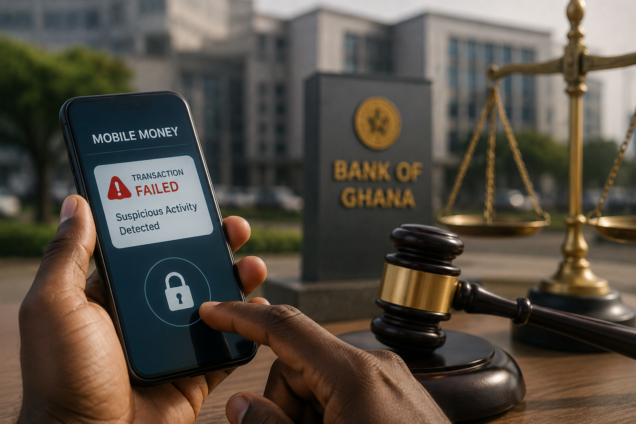
The Head of Fintech and Innovation at the Bank of Ghana, Elhanan Owureku Asare, says it is difficult to conclude that existing punishments for digital financial fraud are enough to deter offenders.
He says fraudsters often weigh the risk of being caught and punished before deciding whether to target victims through mobile money, banking apps and other digital payment channels.

Mr Asare was speaking in a yet-to-be-aired documentary ahead of the maiden Digital Economy Forum under the theme, “The Trust Crisis: Why Fraud Is Holding Back Ghana’s Digital Economy.”
The thought-leadership platform, an initiative of Hubtel, will air on JoyNews and Joy FM on Wednesday, July 22, 2026, at 8 p.m.
The forum will bring together regulators, banks, fintech companies, telecommunications firms, security agencies and consumers to examine whether Ghana’s regulatory system is keeping pace with the growth of digital finance.

He said digital fraud can involve relatively small amounts, but the effect on victims and confidence in the system can be significant.
“You know, from the fraudsters’ perspective, they, I’m sure, will probably weigh their risk. So, it will be very difficult for me to say that the deterrence is enough to threaten them. Somebody can social-engineer me, or you and then probably get away with a thousand cedis. Somebody can do the same process and get away with a hundred cedis. Some can do the same, get away with, let’s say, three thousand cedis,” Mr Asare said.

Mr Asare said Ghana must do more to publicise convictions and punishments so that fraudsters understand the consequences of digital financial crime.
“I believe that it is a matter of making sure that we unveil some of these things so that at least they serve as examples to society. I know I have actually seen some rulings that are relatively harsh. I do not know whether we socialise it enough for everybody to know that, look, irrespective of the amount that you are involved in, the fact that you are involved in a digital financial service crime, this is what you are going to do. This is the consequence,” the Head of Fintech and Innovation said.

He said criminal laws already provide routes for dealing with offenders, but the challenge is whether punishment is visible enough to influence behaviour.
Mr Asare said even severe sentences may not completely stop fraud, but repeated enforcement and public awareness could discourage others.
“Apart from our own laws, there are criminal laws that will be able to deal with them accordingly. It is very difficult for me to say that, from a criminal perspective, whether the deterrence is enough to prevent them from doing it or not.”
“Some of these guys, irrespective of even if you give them a life sentence, trust me, you will get somebody who will still want to try this. So it is up to us to continuously showcase and make examples of them so that the guy next in line will know that, look, this thing, when I try, the punishment is severe,” he indicated.
His comments come as Ghana continues to record rising fraud exposure across the financial sector.
The Bank of Ghana’s 2024 fraud report shows that banks, specialised deposit-taking institutions and payment service providers recorded 16,733 fraud cases in 2024, up from 15,865 in 2023. The total value at risk increased by 13 per cent, from GH¢88 million to approximately GH¢99 million.
Payment service providers recorded 15,673 fraud cases in 2024, while the value at risk in that sector rose by 18 per cent to GH¢19 million.
The recovery of fraud proceeds remains a major challenge.
According to the Bank of Ghana’s report, banks and specialised deposit-taking institutions reported GH¢83 million in fraud value at risk in 2024, but only GH¢3 million was recovered, leaving about GH¢80 million at risk after recoveries.
The report also noted that prolonged legal proceedings have made recovery efforts difficult, sometimes causing financial institutions to abandon attempts to recover fraud-related losses.

This raises a central question for Ghana’s digital finance ecosystem: if fraud cases take too long to prosecute and stolen funds are rarely recovered, will offenders believe the system can catch and punish them quickly enough?
Mr Asare said the challenge is not only about punishing fraudsters after the crime has occurred. It is also about building systems that reduce the chances of fraud succeeding.
He said service providers have clear regulatory requirements to protect customers and prevent cyberattacks.
However, he said social engineering remains harder to prevent because fraudsters often manipulate customers into giving away one-time passwords, PINs and other sensitive information.
“Somebody downloads an MTN app, or somebody downloads a bank app, or an AT app, or a Telecel app, and they go through their process. They call and say, ‘We are from such and such centre. Can you repeat the OTP?’ Don’t forget that these are processes that are supposed to protect the customer. That same authentication, they call you for you to freely provide it. They call you again to say, can you add your PIN to it? How do you prevent that?” he added.
The Bank of Ghana’s 2024 fraud report directed banks and specialised deposit-taking institutions to work with law-enforcement agencies and other stakeholders to ensure suspected fraudsters are apprehended and prosecuted.
Payment service providers were also directed to strengthen authentication, introduce customer-behaviour monitoring technologies, educate customers and improve the monitoring and training of mobile money agents.
The fight against digital fraud must combine prevention, prosecution and public awareness.
Punishment must not only exist in law. It must be visible enough to deter offenders and reassure consumers that digital financial crime carries real consequences.
The issue will form part of discussions at the maiden Digital Economy Forum as regulators, banks, fintech companies, telecommunications firms, security agencies and consumers examine how Ghana can protect trust in its fast-growing digital economy.
Latest Stories
-
Mahama’s proposed airline looks to South America, Caribbean as Ghana confronts mounting drug trafficking cases
4 minutes -
5% progress on Suame Interchange Phase One inadequate – Roads Minister tasks contractor to speed up work
6 minutes -
Photos: Vice President joins GAAS Awards to celebrate outstanding women leaders
7 minutes -
OSP vs Ken Ofori-Atta, SML and others: Court gives OSP four more weeks to serve Ofori-Atta with summons
9 minutes -
High Commission sends caution to Ghanaians in South Africa ahead of planned protests
12 minutes -
Okai Mintah outlines vision for NDC Youth Wing as he engages MMDCEs
17 minutes -
Mahama Ayariga leads renewed push for stronger local governance through partnerships
21 minutes -
NDC youth organiser aspirant Okai Mintah consults MMDCEs ahead of elections
22 minutes -
PHOTOS: Ayikuma Methodist Basic School wins National Juniors Challenge
24 minutes -
Silence has entered our homes : Salomey Awiti Bafoh and the chilling effect of free expression in Ghana
25 minutes -
UG Pro-VC calls for stronger research funding to curb brain drain
27 minutes -
Woman in critical condition after shooting at funeral grounds in Yeji
29 minutes -
Breast Cancer awareness must lead to action – Deputy Health Minister
32 minutes -
UK identified as leading destination for Ghana’s illicit cannabis exports – Report
34 minutes -
Drug money allegedly finances Ghana’s political parties and real estate – Global Organised Crime Index
39 minutes