

Audio By Carbonatix
ACCRA, Ghana -- Flipping through a family album, Keachia Bowers paused on a photo of her as a baby on her father’s lap as he held the 1978 album “Africa Stand Alone” by the Jamaican reggae band Culture.
“He joined the ancestors when I was 10 years old. I was supposed to come to Ghana with him,” she said.
Bowers and her husband, Damon Smith, are among the 524 diaspora members, mostly Black Americans, who were granted Ghanaian citizenship in a ceremony in November.
A day earlier, Bowers had marked 10 years since her father's death. Though he was a Pan-Africanist who dreamed of visiting Ghana, he never made it here.
Bowers and Smith moved to Ghana from Florida in 2023 after visiting the region several times between them since the ’90s. They now run a tour business that caters to Black people who want to visit Ghana or elsewhere in West Africa, or like them have come to consider a permanent move.
The November group was the largest one granted citizenship since Ghana launched the “Year of the Return” program, aimed at attracting the Black diaspora, in 2019. It marked 400 years since the first African slaves arrived in Virginia in 1619.
Ghana’s Tourism Authority and the Office of Diaspora Affairs have extended the program into “Beyond the Return,” which fosters the relationship with diasporans. Hundreds have been granted citizenship, including people from Canada, the U.K. and Jamaica.
Bowers said moving to Ghana gave her family a certain feeling of ease they didn’t have in the U.S.
“When we see Trayvon Martin, Sandra Bland, all these stories of people being murdered just in their home, living in their home and being murdered at the hands of police brutality, hearing about it creates trauma,” she said.
She also worried about her son Tsadik, 14.
Tsadik towers over loved ones in the way that lanky teenage boys often do. He is shy but opens up around his younger sister Tselah, 11, and the family’s dog, Apollo.
“In America, being a Black male with locs who’s very tall for his age, he is treated like a threat,” Bowers said.
Americans face few obstacles to living in Ghana, with most people paying an annual residency fee. But Bowers said getting citizenship signified more than simply living in Ghana.
“I didn’t need (citizenship) to tell me that I’m African. Anywhere that I go in the world and someone looks at me, I’m melanated,” she said.
“But my ancestors who wanted to return and come back home, those ancestors who never made it back," she said, “that passport, for me, is for them.”
Between 10 to 15 million people were forcibly taken from Africa to the Americas during the trans-Atlantic slave trade, the majority from West and Central Africa.
Ghana, then a British colony known as the Gold Coast, was a main point of departure.
As memorials to the slave trade become tourist destinations across West Africa, painful reminders of its brutality are easily accessible. From Ghana to Senegal to Benin, one can visit variations of the “Door of No Return," haunting doorways that open to the Atlantic Ocean where slaves left Africa, and their families, for the last time.
The joy that people feel in finding connections that were broken long ago is palpable. Videos of the recent citizenship ceremony show men and women of all ages waving Ghanaian flags and cheering.
Deijha Gordon, 33, was one of them.
“I first visited Ghana in 2015. From then on, I knew this is a place that I wanted to be and a place where I wanted to show other diasporans, African-Americans, that we have a place where we belong,” she said.
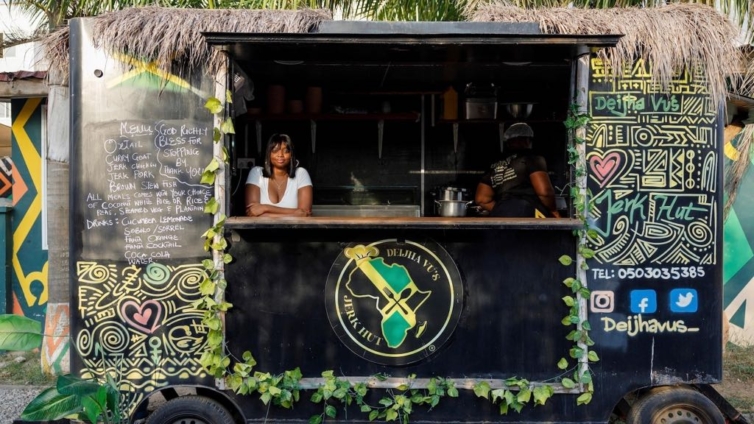
She moved from Brooklyn to Ghana in 2019 and opened a food truck, Deijha Vu’s Jerk Hut, selling Jamaican food.
Between bagging to-go orders and speaking to a Black American tourist couple, she explained how she built the business from scratch.
Gordon was giddy while recalling the moment she got citizenship.
“It just feels good to have a connection to an African country as an African-American, as a Black American. Because back in America we don’t have anything to trace our roots to but Africa. To have that connection here, I feel like I’ve done something right,” she said.
Like Bowers, Gordon has had a stream of people reaching out and asking about the citizenship process.
The path is not clearly defined. Citizenship must come from a concession from Ghana's presidency, a process made legal under the 2000 Citizenship Act. It's granted to those residing in Ghana who have told the Office of Diaspora Affairs that they are interested in citizenship.
Ghana's government in part describes the program as a benefit to the economy and focuses on investment opportunities for those wishing to relocate.
Festus Owooson with the local nonprofit Migration Advocacy Center said that though the government emphasizes the economic angle, the real benefits of citizenship are intangible.
“I don’t think (recipients) were crying because they have landed a gold mine, or they’ve found oil or some kind of business opportunity. But it’s something so relieving, which you cannot put value or a price on,” he said.
President Nana Akufo-Addo’s administration, which launched the “Year of the Return,” is on its way out. Ghana’s main opposition party won the presidential election on Dec. 7.
But Owooson said Black Americans and other diaspora citizens are likely to continue receiving citizenship by presidential concession.
Citizenship also can pass to the next generation. The children of Bowers and Smith received it automatically after their parents' ceremony.
Bowers’ father, like her husband and children, was a follower of the Rastafari faith. “Part of the Rastafarian tradition is to repatriate. We see repatriation as the ultimate experience that you can have on this earth,” she said.
She believes that her father is proud of her. “I really feel like he’s smiling, where he is. He wanted to experience this for himself, so he’s experiencing it through me.”
Culled from abcnews.go.com
Latest Stories
-
Ga Adangbe traditional priests petition Mahama over McDan aviation licence revocation
3 minutes -
Anti-LGBTQ Bill: NDC’s arrogance is worrying – Hassan Tampuli
13 minutes -
Let’s give OSP time to mature, not to scrap it – Hassan Tampuli
17 minutes -
Nigeria convicts 386 Islamist militants in mass trials
22 minutes -
Djibouti president wins election with 97.8% of vote, state media says
27 minutes -
We don’t have mandate to deduct tax from rent allowance of security services personnel – Interior Ministry clarifies
41 minutes -
Ablakwa receives Presidential Special Envoy on Reparations to advance global agenda
59 minutes -
Christina Koch becomes first woman to travel around the moon on Artemis II
1 hour -
Epstein survivors’ calls to meet King Charles and Queen harder to ignore as US visit approaches
1 hour -
UN Secretary-General names Ghana’s Anita Kiki Gbeho as South Sudan envoy
1 hour -
Mali withdraws recognition of Sahrawi Republic, backs Morocco’s autonomy plan
1 hour -
Gov’t distributes over 8,500 laptops to One Million Coders project
1 hour -
Julius Debrah, ‘man to beat’ as NDC’s James Agbey dismisses Musah Dankwah’s polls
1 hour -
GPRTU in Savannah Region to protest alleged eviction in Damongo
2 hours -
Re: Reinsurance does not replace process — A response to the SIGA–SIC defence
2 hours