

Audio By Carbonatix
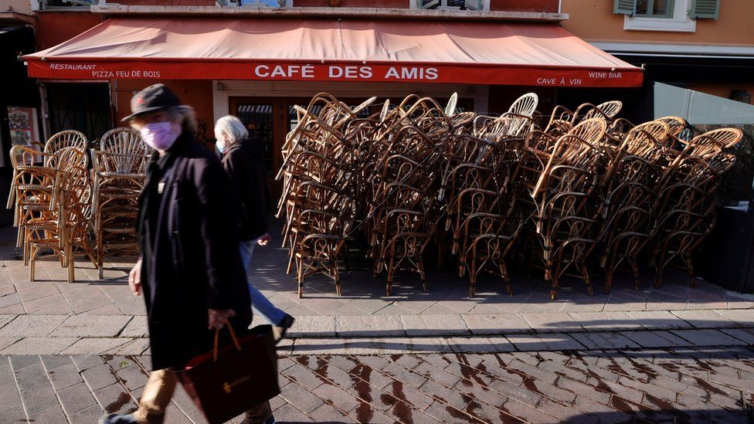
France has entered its third national lockdown as it battles a surge in cases of Covid-19 that threatens to overwhelm the country's hospitals.
All schools and non-essential shops will shut for four weeks, and a curfew will be in place from 19:00 to 06:00.
On Friday, the number of seriously ill Covid patients in intensive care units (ICU) increased by 145 - the biggest jump in five months.
President Emmanuel Macron has promised more hospital beds for Covid patients.
France is currently battling a peak of about 5,000 Covid patients in ICUs. On Friday, the country recorded 46,677 new cases and 304 deaths.
As well as the restrictions that came into force on Saturday, from Tuesday people will also need a valid reason to travel more than 10 km (six miles) from their homes.

President Macron had hoped to keep France's coronavirus cases under control without having to impose another lockdown.
However, the country has struggled with an EU-wide delay in the vaccine rollout, as well as several new strains of the virus.
What about the rest of Europe?
In Germany, President Frank-Walter Steinmeier called on people to play their part and get vaccinated.
Speaking in a television address to the nation on Saturday, he said the country was in the middle of a third wave and that it faced more restrictions.
He also admitted that mistakes had been made - specifically in testing and in the vaccine rollout - and talked about there being a "crisis of trust" in the state.
"Of course, there is no single silver bullet to get out of the pandemic," President Steinmeier said. "And that is why political dispute is needed - but the arguing must not become an end in itself.
"Whether it's about a federal or state level, party or coalition, or whether opinion polls are up or down - none of that can play the main role now.
"We need clarity and determination, we need understandable and pragmatic regulations so that people have direction, so that this country can again achieve what it has within."

Last month, German officials announced that the country would be placed in a strict Easter lockdown - only to reverse the decision just days later.
German Chancellor Angela Merkel called the plan for a lockdown from 1 to 5 April a "mistake", and said she took "ultimate responsibility" for the U-turn.
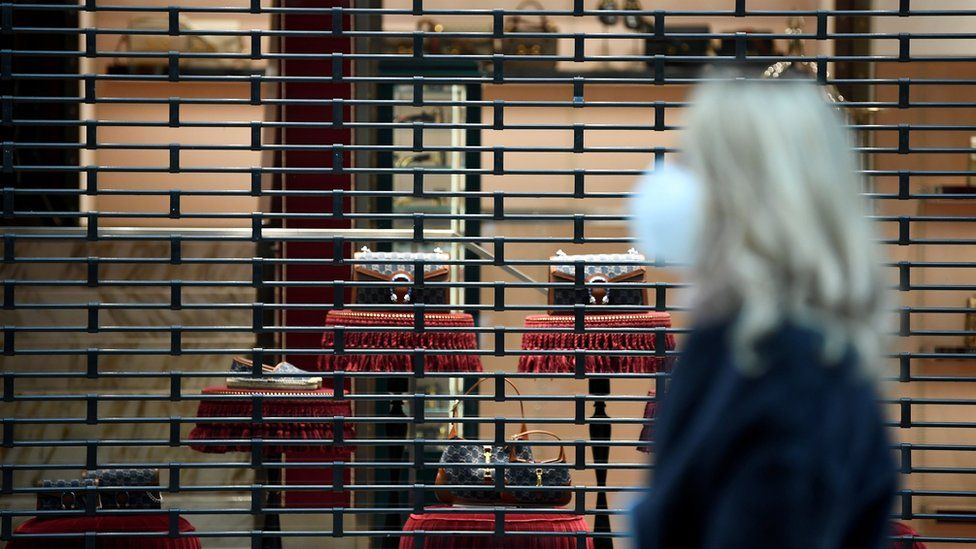
Italy also entered a strict three-day lockdown on Saturday in order to try to prevent a surge in Covid-19 cases over the Easter weekend.
All regions are now in the "red zone" - the highest tier of restrictions - as the country records about 20,000 new cases a day.
Non-essential movement is banned, but people are allowed to have an Easter meal in their homes with two others. Churches are also open, but worshippers are being told to attend services within their regions.
Pope Francis delivered his Easter message to a scaled back group of about 200 people, with St Peter's Square empty for the second year.
Different regions will remain in either "orange zone" or "red zone" restrictions until the end of the month.
The Italian government also announced it was placing 70,000 extra police officers on surveillance nationwide, in order to enforce the lockdown rules.
"This is not the time to lower our guard, and to let go of that sense of responsibility shown so far," Interior Minister Luciana Lamorgese told the newspaper Il Messaggero. "Because the progress recorded by the campaign for vaccines finally gives a glimpse of a different horizon that will allow us to gradually return to normal."
What's happening with vaccinations in Europe?
On Friday, the World Health Organization (WHO) criticised Europe's "unacceptably slow" vaccine rollout, and said the situation in the region is now worse than it has been for several months.
"Vaccines present our best way out of this pandemic... However, the rollout of these vaccines is unacceptably slow," WHO director for Europe Hans Kluge said in a statement.
"We must speed up the process by ramping up manufacturing, reducing barriers to administering vaccines, and using every single vial we have in stock, now."
In the meantime, as long as vaccine coverage remained low, he said EU countries would have to impose lockdowns and other measures to compensate for the delays.
According to the WHO, only 10% of the nearly 900 million people in the region have had a single dose of coronavirus vaccine.
Latest Stories
-
Gender Ministry supports Harriet Amuzu in ongoing abuse case
11 seconds -
AG joins plaintiff to scrap OSP ?: We should be mindful of the mischief in this – Bobby Banson
6 minutes -
Samson Lardy Anyenini questions willingness of Attorneys-General to prosecute political colleagues
9 minutes -
It is only fair the OSP is heard in Supreme Court case – Bobby Banson
15 minutes -
Asiedu Nketia resumes Ashanti tour, second leg kicks off on Sunday
23 minutes -
NLA denies salary cut claims, threatens legal action over reports
27 minutes -
BoG Governor honoured for stabilising cedi, improve inflation
29 minutes -
Trade Minister applauds GUTA as a pillar of economic growth; Prez Mahama honoured
1 hour -
President’s brother’s takeover of Damang Mines is ‘untidy’ – Alhassan Tampuli
2 hours -
It’s not true that gov’t decided not to renew the lease for Gold Fields – Bobby Banson
2 hours -
Ghana to boost tomato production with 60-hectare irrigated farms and processing initiatives
2 hours -
E&P’s takeover process of Damang Mines was very clean – Inusah Fuseini
2 hours -
Damang takeover: There is not going to be any job loss; it is a lease change – Bobby Banson
2 hours -
Gold Fields didn’t stop mining at Damang mines; such claims are untrue – Bobby Banson
3 hours -
Engineers and Planners currently operate only in Ghana – Bright Simons
3 hours