

Audio By Carbonatix
President John Dramani Mahama has called for urgent investment in Africa’s creative and digital economy.
He argues that startups in these sectors generate employment at a rate far exceeding traditional industries like agriculture and manufacturing.
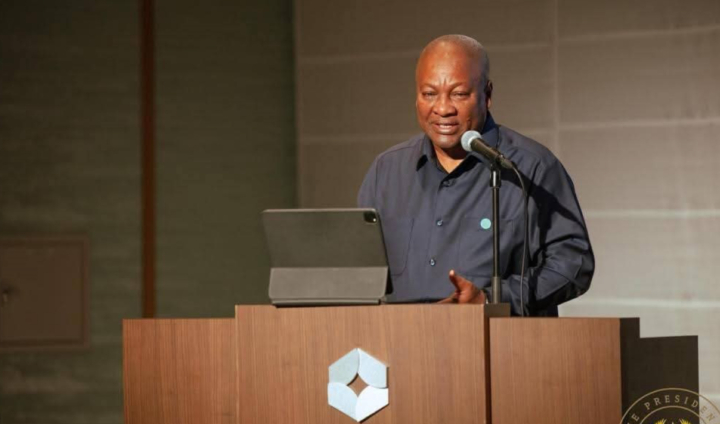
Speaking at the private–public business dialogue of the ongoing 9th Tokyo International Conference on African Development (TICAD IX) on Thursday, Mahama said the evidence is clear that the future of Africa’s jobs lies in knowledge-driven sectors.
“Apart from that, the creative sector and youth startups are adding jobs faster than the traditional sectors. And so if you take the creatives, renewable energy and those spaces, they add about four jobs before you can create one job in agriculture or manufacturing. And so investing in that sector means that we can absorb more of the myriad of young people who are coming out of school.”
He noted that Africa’s demographic reality demands urgent policy shifts.
“The youth form 60% if you take the age category of between 16 and 35 they form 60% of Africa’s population. And so that’s not a demographic you can ignore. But aside from that, the world is changing, and it’s now a knowledge economy.”
President Mahama stressed that young Africans are moving away from traditional career paths and showing strong interest in technology-driven fields.
“The youth are interested in certain sectors that are not the traditional sectors, and so in the creatives, in the renewable energy space, even if they go for traditional sectors like agriculture, they are looking at agri tech and other knowledge-driven aspects of those traditional sectors.
"And so it is important to find where their interests are and invest in those sectors so that you can attract the youth to go into those sectors.”
He cited Africa’s booming startup ecosystem as proof of the continent’s ongoing economic transformation.
“If you look at Africa in 2024 there was about an investment of 4.2 billion in startups, and a lot of that went into the biggest majority was about 45% which went into fintechs. The fintech space is growing at an astronomical rate in Africa, and it’s mainly driven by smart, tech savvy youth who have seen openings and are taking advantage of it. In all our countries a change in the economic structure is happening.”
Drawing on Ghana’s experience, President Mahama explained how the services sector has already overtaken agriculture and industry.
“For instance, in Ghana, about in 2015 the services sector overtook agriculture and industry and manufacturing to become the largest sector in our economy. And that’s how it should be.”
He highlighted the transformative potential of digital innovation in agriculture, recalling his encounter with a fintech solution that changed how inputs and credit were distributed to farmers.
“One of the interesting ones I found was an agri tech company, and it was solving a problem that we’d been struggling with as government for many years, how to extend credit and support to farmers in order that they can increase productivity.
"We had a shot in the dark approach distributing fertilizers, distributing inputs and so on and so forth, and you couldn’t tell who exactly those inputs were going to and whether you were getting value for money.
"These young people set up a platform, gave mobile phones to farmers, distributed agricultural inputs based on their acreage and their need, and because they had them on the platform, they could send credit by mobile money and at the end of the farming season, go directly to the farmer and off-take the production.
"That changed it completely. The farmers are able to get a credit score now, and so you can see who’s credit worthy and who’s not. And so it’s changed the face of agriculture in our country.”
President Mahama warned that Africa must create between 12 and 15 million jobs every year to keep up with the youth population, and traditional sectors alone cannot meet that demand.
“If we decide to concentrate on manufacturing and industry, Africa needs to turn up about 12 to 15 million jobs a year. You cannot create that in manufacturing and industry and agriculture alone.
"But the rate at which the creatives and digital space add jobs is much faster than the traditional economy, so it’s a place that we must invest as governments in order that we can absorb more of the youth.”
He cautioned that Africa’s youth bulge could easily turn into a threat if opportunities are not created.
“We know that we say the youth bulge, or the huge youth population in Africa, is an advantage, but if we do not create enough jobs fast enough to absorb those young people coming out, then it will become a gun powder keg and it could cost humans.”
Latest Stories
-
Fiscal policy implementation poses downside risk to inflation – BoG
4 minutes -
Organised Labour should seek fair adjustment, not excessive pay rise – Labour consultant
8 minutes -
BoG maintains medium-term inflation target of 8 ± 2%
15 minutes -
Sammi Awuku urges NPP Germany to unite ahead of 2028 elections
54 minutes -
The Inconvenient Truth: We cannot pray for the cure while protecting the disease
2 hours -
MTN Ghana trains civil society organisations on artificial intelligence
2 hours -
GoldBod FX framework aims to make dollar supply predictable – Acheampong
3 hours -
How does a Ghanaian team make it to the BAL?
3 hours -
Ghana’s investment climate presents opportunities for industrial growth and job creation.
3 hours -
‘I paid thousands to a company for jobs that never came’
3 hours -
SSNIT intensifies informal sector enrolment drive with Techiman float
4 hours -
Ghana seeks long-term mining investments that benefit local communities – Armah-Kofi Buah
4 hours -
GHATOF demands compensation for 85 businesses affected by La Pleasure Beach demolition
4 hours -
Bono Regional Minister calls for investor education to drive economic growth
4 hours -
Ghana’s Ambassador to China, Kojo Bonsu, presents credentials to Nepalese President
4 hours