

Audio By Carbonatix
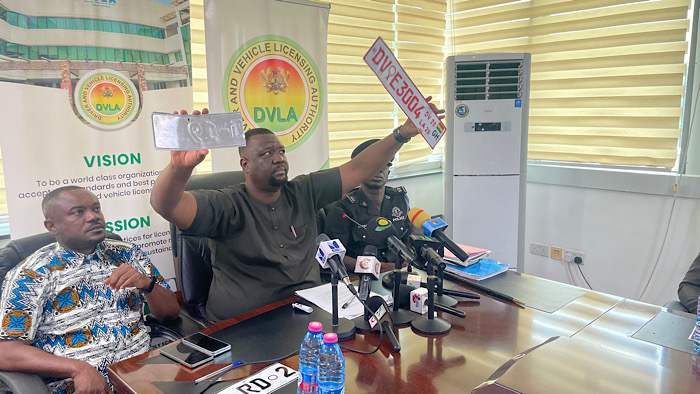
The Driver and Vehicle Licensing Authority (DVLA) has uncovered a criminal network responsible for the illegal manufacture and distribution of more than 30,000 counterfeit dealer vehicle (DV) plates nationwide, with an estimated value of GH¢12.51 million.
The Chief Executive Officer of the authority, Julius Neequaye Kotey, disclosed this at a press briefing in Accra on March 10, 2026.
He said the activities of the network were costing the state about GH¢20 million annually in lost revenue.
Mr Kotey described the operation as “not merely a regulatory breach” but “a criminal enterprise that threatens national security, undermines law enforcement, and deprives the state of legitimate revenue”.
According to him, five suspects have been arrested and arraigned in court. They have been remanded into custody and are expected to reappear on March 17, 2026.
Two other suspects identified in the operation remain at large and are being pursued by national security operatives.
Investigations conducted over the past two weeks by the DVLA, in collaboration with the Ghana Police Service and National Security, revealed what officials described as a well-structured operation with a clear chain of command.
The authority said the counterfeit plates were produced at an undisclosed location before being transported at night to a distribution point in La Paz, Accra, from where they were distributed through networks operating in Kumasi and Takoradi.
Mr Kotey explained that the fake plates were frequently accompanied by forged documentation to give the impression that vehicles were properly registered and insured.
These documents included counterfeit motor insurance certificates as well as fake Form D and Form E logbook documents.
“In the event of an accident, victims may find that the supposed insurance cover is fraudulent, leaving them without protection or compensation,” he said.
The DVLA also linked the suspects to the activities of illegal intermediaries, popularly known as goro boys, who operate within and around DVLA offices.
Mr Kotey said preliminary findings indicated that those arrested were part of a larger network allegedly controlled by individuals who had yet to be apprehended.
“It seems like all the people we arrested are goro boys, and they have a master somewhere they report to. The master is the one we are going to hunt for now,” he said.
He added that the DVLA would intensify enforcement operations with the police and national security agencies to clamp down on illegal operators within its offices across the country.
He advised the public to transact business directly with authorised DVLA officials and avoid middlemen.
Mr Kotey also reminded the public that the use of DV plates is regulated under the Road Traffic Regulations, 2012 (L.I. 2180). Regulation 23 restricts the issuance of such plates to motor traders, fleet owners and licensed plate dealers.
Under the regulation, DV plates may only be used for specific purposes, including moving an unregistered vehicle to a dealer’s premises, testing a vehicle after assembly or repair, or delivering a repaired vehicle to a fleet owner.
Subregulation 11 further makes it a criminal offence to use DV plates for unauthorised purposes or to manufacture, possess or distribute counterfeit plates. Offenders found guilty are liable to prosecution. Each officially issued DV plate costs GH¢417.25.
Earlier at the briefing, the Deputy Chief Executive in charge of Services at the DVLA, Foster Akwasi Asante, cautioned individuals who might consider engaging in the illegal trade.
“I would admonish anyone who is now nurturing that idea of engaging in the sale of illegal plates to take a pause, breathe deeply, and be reassured that the security operatives are after those. The sun will definitely shine on them,” he said.
Mr Kotey also announced that the authority would soon introduce radio-frequency identification (RFID) embedded number plates as part of measures to tackle the problem of counterfeit vehicle plates.
He said the technology would enable law enforcement agencies to verify vehicle registration details electronically and detect fake plates.
In addition, the DVLA plans to open five new offices within the next two weeks, bringing the total number of new offices opened within the past year to 18, as part of efforts to improve access to its services nationwide.
The five suspects currently on remand are expected to return to court on March 17, 2026.
Latest Stories
-
Kojo Antwi and Meiway set London ablaze with historic live concert at Dominion Centre
52 minutes -
Arrive three hours before flight home, airline boss tells UK holidaymakers
59 minutes -
US, UK and Australia to develop underwater drone technology
1 hour -
Prisons Service launches investigation after inmate linked to murder of Abamba Queen Mother
1 hour -
Akatsi Police launch full investigation into shooting, arson incident in Deti
1 hour -
Government commissions shelter for domestic violence survivors
1 hour -
Xenophobia: “I am very free now” – Ghanaian evacuee recounts 18-year stay, robbery ordeal
1 hour -
Excessive Bail Conditions in Ghana: A threat to the presumption of innocence and the right to liberty guaranteed under the 1992 constitution
2 hours -
Petrol, LPG prices set to go up, but diesel to decline from June 1
2 hours -
Hitz FM’s ‘Rep Ur Jersey’ underway at Aviation Social Centre
2 hours -
Xenophobia: Minority commends government on Ghanaian evacuation from South Africa
3 hours -
Gov’t reaffirms commitment to expanding shelter services for domestic violence survivors – Gender Minister
3 hours -
Fisheries Ministry intensify efforts to protect premix fuel subsidy
3 hours -
Liverpool sack head coach Slot
3 hours -
Xenophobia: Disregard Malema’s comments on Ghana’s evacuation – Minority urges gov’t
3 hours