

Audio By Carbonatix
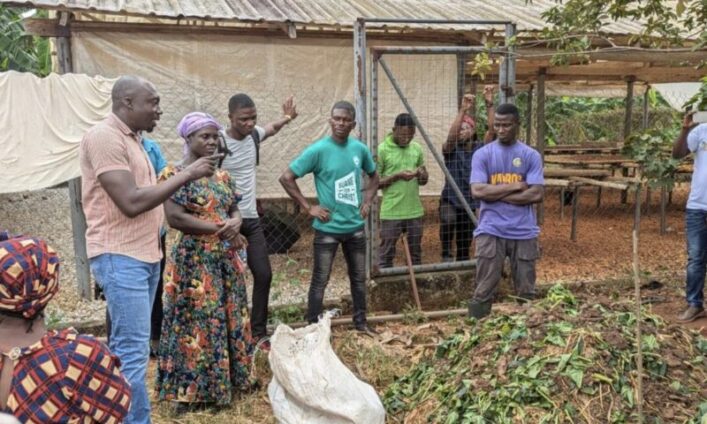
The Peasant Farmers Association of Ghana, in collaboration with the Council for Scientific and Industrial Research-Crops Research Institute (CSIR-CRI), has organised a two-day practical workshop on agroecology and circular economy innovations, aimed towards promoting sustainable agriculture.
Participants, made up of farmer association leaders, agriculture extension officers, NGOs, and civil society organisations drawn from the Ashanti Region gathered at Offinso to receive hands-on training in simple composting techniques, aimed at reducing chemical fertilizer use and minimising agriculture-related biomass burning, which are key contributors to black carbon emissions, a potent short-lived climate pollutant.
Participants also learned to create nutrient-rich compost from organic waste, which enhances soil health while lowering costs.
Again, they were introduced to the preparation of different types of liquid fertilizers using fresh fish and cow milk, combined with water, molasses, and decanted rice soaking water.
This eco-friendly approach empowers farmers to utilize local resources effectively, reducing over-dependence on chemical fertilizers.
The training was part of the Agroecology and Circular Economy for Ecosystem Services (ACE4ES) project, which aimed at promoting sustainable agriculture practices to mitigate short-lived climate pollutants and enhance ecosystem services.
Dr. Kwaku Onwona-Hwesofour Asante, ACE4ES Project Lead, elaborating on the principles of agroecology and the circular economy, said the technology-enhanced food security and reduced agricultural greenhouse gas emissions.
The focus of the discussions was the reduction of methane and nitrous oxide emissions in rice cultivation.
Dr. Asante highlighted innovative practices such as the System of Rice Intensification and Alternate Wetting and Drying techniques, which could significantly decrease emissions while improving rice yields.
He said the workshop presented an opportunity to equip farmers with the knowledge and tools necessary for adopting sustainable agricultural practices, adding that through collaboration and innovation, “we can enhance livelihoods and contribute to combating climate change.”
The ACE4ES project, he stated, remained committed to fostering innovation across Ghana’s agricultural sector to pave the way for a greener and more resilient future.
Mr. Douglas Annor, Ashanti Regional Focal Person for the Peasant Farmers Association of Ghana, acknowledged the assistance from the Climate and Clean Air Coalition in supporting the ACE4ES project.
He said the collaboration would empower farmers with the tools and knowledge to adopt sustainable practices that benefit both livelihoods and the environment.
Latest Stories
-
Labour Minister wants SOEs to help shape new public pay system
3 hours -
IPEC will ensure Equity and Sustainability in SOEs Compensation
3 hours -
White House bars CNN from travelling with Trump on Air Force One
4 hours -
Fennis wins second consecutive ITF J60 title in Accra
4 hours -
Spain beat England in thriller after Kane penalty miss
4 hours -
GPL 2026/27: Zaidan’s late goal ends Hearts of Oak unbeaten start
4 hours -
CEOs demand clarity on pay harmonisation, board autonomy as FWSC engages SOEs bosses over IPEC transition
4 hours -
2026 Women’s Super Cup: FC Savannah, Epiphany Warriors maintain top spots ahead of final group games
4 hours -
‘Is EOCO responsible for determining lawyers’ fees?’ – Baffour Awuah
4 hours -
David Beckles claims second J60 Accra title
5 hours -
No France cocaine suspect linked to Mahama, Vice President’s security details – NACOC
5 hours -
Anwelle Foundation launched in Jirapa to tackle poverty, youth unemployment
5 hours -
Joy Sports Editor Fentuo Tahiru Fentuo to moderate inaugural Music Meets Football Summit in Zambia
5 hours -
Court premises too volatile for Baffour Awuah’s attempted arrest by EOCO – Inusah Fuseini
6 hours -
Drug bust: Under no circumstances will NACOC leadership be compromised – Twum-Barimah
6 hours