

Audio By Carbonatix
Two newly surfaced details first revealed by African.football could significantly strengthen Morocco’s case when the Court of Arbitration for Sport (CAS) examines Senegal’s appeal over the 2025 Africa Cup of Nations final.
The revelations centre on a leaked report from the final’s general coordinator and remarks attributed to the chairman of CAF’s referees committee. Together, they appear to reinforce Morocco’s core argument that the match should have been considered abandoned when Senegal’s players left the field in protest during the closing stages of the final in Rabat.
If accepted by CAS as credible and relevant, the two points may help Morocco argue not only that Senegal breached CAF regulations, but also that the game should have been stopped once the walk-off occurred, rather than being allowed to continue to extra time.
A final still under dispute
The 2025 AFCON final remains one of the most controversial matches in African football history.
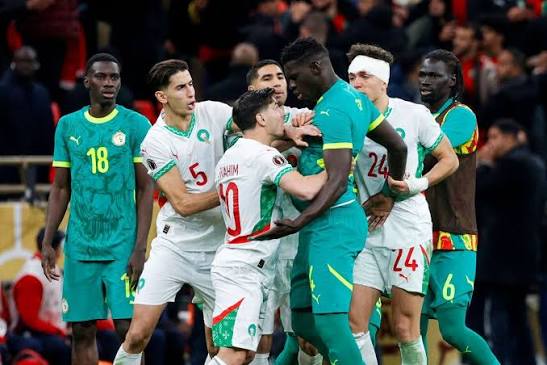
Senegal appeared to have won the title on 18 January after beating hosts Morocco 1-0 following extra time. But the match was overshadowed by chaotic scenes late in normal time when Senegal’s players left the pitch in anger after Morocco were awarded a penalty.
Although the players later returned, Brahim Diaz missed the spot-kick, the match went to extra time, and Senegal eventually scored what seemed to be the winning goal.
That result, however, was later overturned.
On appeal, CAF ruled that Senegal had forfeited the final under Articles 82 and 84 of the competition regulations, with Morocco awarded a 3-0 victory and the title. Senegal rejected the ruling and took the case to CAS, insisting the decision was “unfair, unprecedented and unacceptable”.
Coordinator’s report could prove crucial
According to African.football, one of the most significant new elements is contained in a leaked report written by match official Khaled Lemkecher, the general coordinator of the final.
In that report, Lemkecher is said to describe “very strong protests” from the Senegal team, which “intensified even more” after the penalty decision.
He then reportedly writes that the players went “to the locker room, abandoning the match,” while noting that only “one player [Sadio Mané] remained and later asked a member of the technical staff to go to the locker room and tell the players to return to the pitch to finish the match.”
That language could be highly damaging to Senegal’s case.
Morocco may use it to argue that an official directly involved in managing the final interpreted Senegal’s actions as abandonment, not merely protest.
In legal terms, that distinction is critical because CAF’s regulations are clear that a team that leaves the field before the end of a match without the referee’s authorisation can be declared to have forfeited.
For Morocco, the report could serve as fresh support for the idea that the legal threshold for forfeiture had already been crossed before the match resumed.
Safari remark raises issue of officiating interference
The second revelation may be equally important.
African.football reports that during a CAF Executive Committee meeting in Dar es Salaam on 13 February, Olivier Safari, chairman of the confederation’s referees committee, made remarks that appear to suggest outside intervention in how the situation was handled.
He reportedly said: “Every Senegalese player who left should have been immediately cautioned upon returning to the pitch, but we gave instructions not to do so, in order to preserve the match and avoid bringing it to a premature end.”
That statement, if accurate, is likely to become a central talking point.
Morocco could argue that it shows the laws of the game and competition regulations were not applied as they ordinarily should have been.
More significantly, it may support the claim that officials consciously acted to avoid ending the final, even though the circumstances may have justified doing so.
In effect, Morocco may tell CAS that the match was artificially kept alive after a breach serious enough to warrant immediate consequences.
Why the 15-minute delay matters
One of the key issues likely to be debated at CAS is whether the match should have been stopped once Senegal’s protest continued for around 15 minutes.
Morocco’s position is expected to be that once Senegal left the pitch and remained off it for that period, the final should have been called off under the regulations. The fact that the players later returned would not, in that view, erase the original breach.
The two new revelations appear to support that interpretation: one from the general coordinator describing abandonment, and one from a senior refereeing official indicating that normal sanctions were not applied in order to keep the match going.
Senegal still have arguments of their own
Senegal, however, are unlikely to accept that these points settle the issue.
Their lawyers are expected to argue that whatever happened during the protest, the referee did not abandon the game.
Instead, play resumed, the penalty was taken, full-time was reached, and extra time was completed under official supervision.
That gives Senegal a strong line of defence: the match was finished on the pitch and under the authority of the officials in charge.
They may also argue that if procedural or refereeing errors were made, responsibility lies with the match authorities rather than the players alone, and that it would be unjust to retrospectively strip a team of a title won after the game was officially completed.
Senegal have consistently maintained that they remain the rightful champions in sporting terms, even if CAF’s legal ruling says otherwise.
A case that may turn on interpretation
What the African.football news website has uncovered does not guarantee victory for Morocco at CAS, but it may significantly sharpen their case.
The leaked report appears to offer contemporaneous evidence that Senegal’s actions amounted to abandonment. Safari’s reported remarks may add a separate layer by suggesting that officiating procedures were adjusted to prevent the final from ending prematurely.
For CAS, the challenge will be to weigh the technical application of the rules against the reality that the match was ultimately resumed and completed.
For Morocco, these revelations could become powerful new ammunition.
For Senegal, they represent another hurdle in an appeal already loaded with legal, sporting, and political significance.
What once looked like a football result is now a battle over regulation, interpretation, and credibility — and the latest details suggest the final argument may yet favour Morocco.
Latest Stories
-
Let The Constitution direct Chieftaincy to deliver “All Development Is Local”
25 minutes -
Ghana explores centre of excellence for hearing, communication and cochlear implant care
2 hours -
Schizophrenia-related disorders lead mental health cases recorded in Ghana
2 hours -
Dutch authorities enlist Ghana in hunt for fugitive drug lord Bolle Jos
3 hours -
Ghana housing finance conference adopts communiqué to improve affordable housing access
7 hours -
Special Initiatives Minister urges Wa Technical Institute to enrol more girls as EU-backed solar training lab opens
7 hours -
In the matter of my first year at the Bar
8 hours -
ActionAid Ghana calls for an end to child marriage, greater investment in girls’ rights
8 hours -
Newsfile to tackle World Cup visa scandal, beach demolitions, education strikes, BRICS bid
8 hours -
UK-Ghana Trade & Investment Summit: Trade Resource Centre to help businesses maximise UK-Ghana trade opportunities
8 hours -
Embassy of Denmark celebrates World Maritime Day
8 hours -
Linking LEAP to productive inclusion could cut extreme poverty by 2030 – UNICEF
10 hours -
Trade Ministry backs use of creative arts to rehabilitate prison inmates
10 hours -
Negotiations with government to continue despite strike suspension – GNAT
10 hours -
‘Ghana cannot afford to waste public resources; every cedi has a job’ – Ato Forson
10 hours