

Audio By Carbonatix
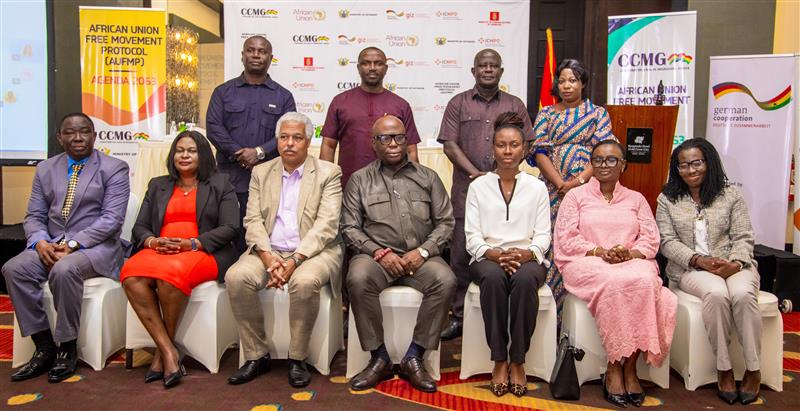
Ghana has taken a bold step toward accelerating the ratification of the African Union’s Free Movement of Persons (AU FMP) Protocol by hosting a two-day National Dialogue in Accra. The dialogue was convened by the Ministry of the Interior in partnership with the Coalition of CSOs in Migration, Ghana (CCMG), with support from the German Development Cooperation and the International Centre for Migration Policy Development (ICMPD).
The event united key stakeholders such as the African Union (AU), Ministry of the Interior, GIZ Ghana, ICMPD, IOM Ghana, members of the CSOs Coalition on Migration Ghana, and various government institutions to deepen collaboration and fast-track regional momentum on the ratification and implementation of the AU’s Free Movement of Persons Protocol.

In his keynote address, the Deputy Minister for the Interior, Hon. Ebenezer Okletey Terlabi, reaffirmed Ghana’s commitment to regional integration and effective migration governance under the AU’s Agenda 2063. He stated that “The dialogue presented an important opportunity to align national perspectives and stimulate informed debate towards accelerating the ratification process as part of Ghana’s broader role in fostering African unity and economic development.”
Speaking on behalf of the AU, Dr. Olamuyiwa Oluwafemi Solomon, Free Movement Protocol Officer, Department of Health, Humanitarian Affairs and Social Development of the African Union Commission, underscored the AU Free Movement Protocol’s pivotal role in facilitating trade across Africa. “The African Continental Free Trade Area (AfCFTA) and the Single African Air Transport Market (SAATM) remove barriers to goods and services and enable the movement of people, essential for business and investment.”
Mr. David Robert, Head of Project, Digital Transformation Centre, GIZ Ghana, spoke on behalf of the German Development Cooperation and highlighted the importance of free movement in driving economic development, regional integration, and migration management. “Free movement is not just a humanitarian or social issue, but a strategic economic opportunity—a business case for Africa and partner regions such as Europe, including Germany and Ghana.”

Speaking for the CSOs Coalition on Migration, Mr. Eric Peasah stressed Africa’s rich history of mobility and trade, contrasting it with today’s restrictive visa regimes and fragmented migration policies that hinder integration and development.
The dialogue also drew valuable lessons from Rwanda’s experience, where the removal of visa restrictions has significantly fueled economic growth—especially in the tourism and hospitality sectors-doubling revenues between 2020 and 2024.
At the close of the event, a communiqué was adopted, affirming commitments from members of the national coordination mechanism-including ministries, departments, agencies, and civil society organisations intensify efforts toward Ghana’s ratification of the AU FMP Protocol. Among other things, the communiqué recognised the critical role of parliament in championing the AU FMP and called for enhanced advocacy, policy coherence, and collective stakeholder engagement to achieve ratification by December 2027.
About Programme “Shaping Development-Oriented Migration” MEG
The Global Programme “Shaping Development-oriented Migration” (MEG), which is closely aligned with the Global Compact for Safe, Orderly and Regular Migration (GCM), supports partner countries to make gender-responsive contributions to the GCM, focusing on regular migration, diaspora cooperation, mitigating precarious situations, and fostering global partnerships with a whole-of-Government and whole-of-Society approach.
About GIZ
As a provider of international cooperation services for sustainable development and international education work, GIZ is dedicated to building a future worth living around the world. GIZ has over 50 years of experience in a wide variety of areas, including economic development and employment, energy and the environment, and peace and security. We work with businesses, civil society actors, and research institutions, fostering successful interaction between development policy and other policy fields and areas of activity. The German Federal Ministry for Economic Cooperation and Development (BMZ) is our main commissioning party.
Currently, GIZ promotes sustainable development in Ghana via about 50 programmes and projects. Our activities currently cover three priority areas: Energy and Climate, with a concentration on renewable energy and energy efficiency; Training and Sustainable Growth for Decent Jobs; and Peaceful and Inclusive Societies, which looks at good governance. For more information, please visit www.giz.de/ghana.
Latest Stories
-
Diaspora Nasara Caucus congratulates Mohammed Ali Suraj, new NPP executives
37 minutes -
Dr Antwi-Boasiako’s cybersecurity book showcased at UN crime prevention congress
39 minutes -
We will empower the grassroots and protect every vote – NPP’s 1st Vice Chair Kojo Bamba
49 minutes -
I do not see myself as better than anyone – NPP’s 1st Vice Chair Kojo Bamba
1 hour -
Police blur the line between invitations and arrests – Reindorf Twumasi Ankrah
2 hours -
Turning invitations into arrests is making citizens reluctant to assist police – Twumasi Ankrah
2 hours -
The Traffitech-GH SMS spot-fine system: The good, the sad, and the funny – Bright Simons writes
3 hours -
Hawa Koomson pledges experienced and mature leadership of NPP women’s wing
4 hours -
Young woman found dead at Kasoa Peace Town
4 hours -
Playback: The Law examined lawful arrest in Ghana
5 hours -
Mahama urges African governments to treat healthcare as an investment, not budget cost
5 hours -
Bawumia congratulates John Boadu and new NPP executives, pledges support ahead of 2028
5 hours -
Aksa Energy delegation pays courtesy call on GRA Commissioner-General
5 hours -
‘No talent should be left out’ – Bawumia pledges inclusive NPP campaign for 2028
5 hours -
Prof. Mike Oquaye recounts how he blocked the Special Prosecutor’s attempt to arrest Bawku Central MP
6 hours