

Audio By Carbonatix
Ghana’s licensed cocoa buyers owe banks as much as $750 million, the association that represents them said, leaving the financial sector starved of cash for bean purchases at a time when lenders are straining to recover from the country's deepest economic crisis in a generation.
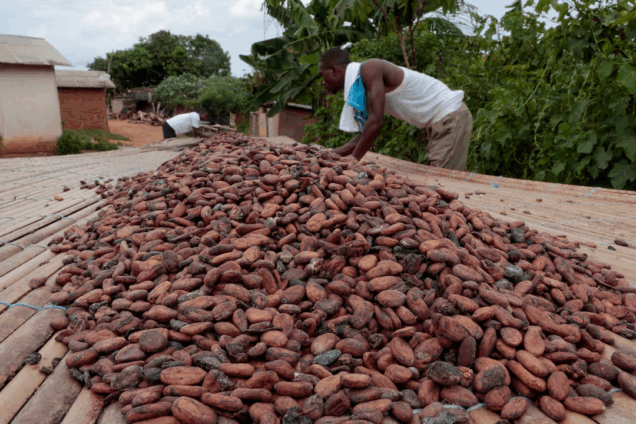
The cocoa sector in Ghana, the world’s second largest producer, has suffered two consecutive poor harvests due to crop disease and inclement weather.
Globally, cocoa prices have collapsed due to weak demand, leaving an abundance of unused supply in Ghana and neighbouring Ivory Coast, which together produce half of the world's cocoa.
London cocoa futures fell to near a three-year low on Tuesday.
Samuel Adimado, president of the Licensed Cocoa Buyers Association of Ghana, said debts were accumulating because Cocobod, the country's cocoa regulator, has been spending more on non-core activities like road construction. As a result, buyers have taken out bank loans to pre-finance bean purchases.
In all, buyers owe banks around 7 billion to 8 billion cedis ($650 million to $750 million), and 2.2 billion to 2.5 billion cedis to farmers, he told Reuters. "Interest keeps piling up," he said.
Ghana's government has taken steps this month to boost demand, including slashing the fixed price it pays for bean purchases and announcing plans for a cocoa financing scheme to raise funds, which buyers hope will provide badly needed cash.
Cocoa buyers delivered around 580,000 metric tons to Cocobod this season but are still awaiting payment, while 70,000 metric tons of beans are still in the field, Adimado said. The reduced cocoa producer price will apply to around 100,000 metric tons of cocoa.
Cocobod has said it is working with the government to address its strained finances.
BANKING SYSTEM UNDER STRAIN
The Ghana Association of Banks (GAB) confirmed that lenders across the cocoa sector are exposed to the accumulating debts.
Association CEO John Awuah declined to provide a total but said the growing figures had forced some loan restructurings and may result in losses.
Ghana’s banks are still recovering from the government's decision in 2023 to restructure nearly all domestic bonds under the Domestic Debt Exchange Programme (DDEP), an exercise that nearly wiped out capital cushions, forced recapitalisations and triggered record losses.
The exercise saw Cocobod’s short-term cocoa bills — used to finance annual bean purchases — forcibly converted into longer-dated bonds with lower coupon rates.
Awuah said the system appears resilient but requires careful management to remain in compliance with Ghana's International Monetary Fund programme.
Latest Stories
-
Church of Pentecost supports over 2,000 BECE candidates in Obuasi with career guidance seminar
22 minutes -
Brandon Asante and Coventry all but promoted to Premier League despite Sheffield Wednesday draw
44 minutes -
GPL 2025/26: Late Kwartemaa strike downs Hearts in Tema
50 minutes -
Ghana Faces Sierra Leone Moment as Prosecutorial Powers come under strain
60 minutes -
Don’t consume fish or seafood from Tema Shipyard until further notice – FDA warns
1 hour -
Why volunteering might be Africa’s most underrated career accelerator
1 hour -
ActionAid Ghana raises concern over gender gaps in Feed Ghana Programme
1 hour -
Windstorm wreaks havoc in Gushegu, displacing nearly 2,000 residents and damaging schools
1 hour -
Friends of Bridget Bonnie Marks her 35th birthday with donation to Kasseh Model Health Centre
2 hours -
From Ekumfi Kokodo to the Pulpit Stage: Essi Donkor’s gospel journey takes shape
2 hours -
Landfilling waste management creates no value, it’s an economic waste
3 hours -
Photos: Speaker Bagbin Commissions MPs constituency office under parliamentary decentralisation programme
3 hours -
Black Stars technical advisor Winfried Schäfer sacked as GFA shakes up backroom staff
3 hours -
Wenchi water project almost complete, critical to gov’t agenda – GWL MD
3 hours -
Anti-LGBTQ+ bill not part of government’s legislative agenda – Inusah Fuseini
3 hours